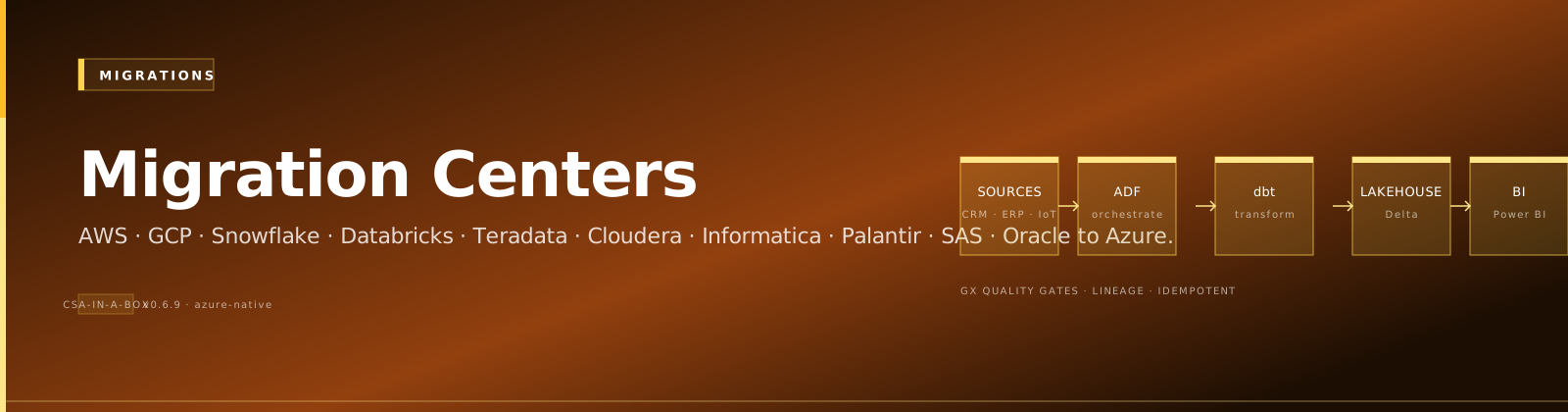
SQL Server to Azure SQL Migration Center
The definitive resource for migrating on-premises SQL Server to Azure SQL Database, Azure SQL Managed Instance, and SQL Server on Azure VMs -- integrated with the CSA-in-a-Box analytics and governance platform.
Who this is for
This migration center serves database administrators, data engineers, cloud architects, application developers, and IT leadership who are planning or executing a migration from on-premises SQL Server to Azure. Whether you are responding to end-of-support deadlines, pursuing cost optimization, modernizing your data platform, or meeting federal compliance requirements, these resources provide the assessment tools, migration patterns, and step-by-step guidance to execute confidently.
Quick-start decision matrix
| Your situation | Start here |
|---|---|
| Executive evaluating Azure SQL benefits | Why Azure SQL (Executive Brief) |
| Need cost justification for migration | Total Cost of Ownership Analysis |
| Need a feature-by-feature comparison | Complete Feature Mapping (60+ features) |
| Ready to plan a migration | Migration Playbook |
| Targeting Azure SQL Database (PaaS) | Azure SQL DB Migration Guide |
| Targeting Azure SQL Managed Instance | Azure SQL MI Migration Guide |
| Targeting SQL Server on Azure VM | SQL on VM Migration Guide |
| Need schema conversion guidance | Schema Migration |
| Need data movement strategies | Data Migration |
| Migrating security and compliance | Security Migration |
| Migrating HA/DR | HA/DR Migration |
| Federal/government-specific requirements | Federal Migration Guide |
| Want hands-on tutorials | Tutorials |
| Need performance data | Benchmarks |
Choosing the right Azure SQL target
The most critical decision in a SQL Server migration is selecting the right Azure target. Each option optimizes for different priorities.
flowchart TD
    A[On-Premises SQL Server] --> B{Need 100% feature compatibility?}
    B -->|Yes| C{Need OS-level access or<br/>third-party software?}
    C -->|Yes| D[SQL Server on Azure VM]
    C -->|No| E{Need CLR, Service Broker,<br/>cross-DB queries?}
    E -->|Yes| F[Azure SQL Managed Instance]
    E -->|No| G{Single database or<br/>elastic pool?}
    B -->|No| H{Willing to refactor<br/>application code?}
    H -->|Yes| G
    H -->|No| F
    G -->|Single DB| I[Azure SQL Database]
    G -->|Multiple DBs, shared resources| J[Azure SQL Elastic Pool]

    style D fill:#e8f5e9
    style F fill:#e3f2fd
    style I fill:#fff3e0
    style J fill:#fff3e0
Target comparison at a glance
| Dimension | Azure SQL Database | Azure SQL Managed Instance | SQL Server on Azure VM |
|---|---|---|---|
| Service model | PaaS (database-level) | PaaS (instance-level) | IaaS (full VM) |
| T-SQL compatibility | ~95% | ~99% | 100% |
| Migration complexity | Medium (app changes likely) | Low (near drop-in) | Lowest (lift-and-shift) |
| Operational overhead | Lowest | Low | Highest |
| Cost efficiency | Best for small-medium workloads | Best for multi-database consolidation | Best for complex legacy workloads |
| Max size | 100 TB (Hyperscale) | 16 TB | Limited by VM storage |
| Built-in HA | Automatic (99.99% SLA) | Automatic (99.99% SLA) | Requires Always On AG config |
| Scaling | Elastic (serverless available) | Manual (vCore) | Manual (VM resize) |
| Modernization path | Direct to cloud-native | Step toward full PaaS | Intermediate step |
How CSA-in-a-Box fits
CSA-in-a-Box is not a database migration tool. It is the analytics, governance, and AI platform that makes migrated SQL data productive in the cloud. Once your databases are running on Azure SQL, CSA-in-a-Box provides:
Data governance with Microsoft Purview
- Auto-scan Azure SQL databases to discover and classify sensitive data (PII, PHI, financial)
- Data lineage from source SQL tables through ADF/Fabric pipelines to analytics outputs
- Business glossary mapping SQL objects to business-friendly terminology
- Data catalog enabling self-service discovery across all migrated databases
Analytics with Microsoft Fabric
- ADF pipelines mirror Azure SQL data into OneLake in Delta Lake format
- dbt models transform raw SQL data through the medallion architecture (bronze/silver/gold)
- Direct Lake semantic models provide sub-second query performance without data duplication
- Power BI reports and dashboards deliver self-service analytics to business users
AI integration
- Azure OpenAI enables natural-language queries over migrated SQL data
- AI enrichment pipelines add intelligent classification, summarization, and anomaly detection
- Copilot in Azure SQL provides AI-assisted query tuning and optimization
Monitoring and operations
- Azure Monitor provides centralized observability across all Azure SQL instances
- Microsoft Defender for SQL delivers threat detection and vulnerability assessment
- Automated alerting integrates with CSA-in-a-Box operational dashboards
Strategic resources
These documents provide the business case, cost analysis, and strategic framing for decision-makers.
| Document | Audience | Description |
|---|---|---|
| Why Azure SQL | CIO / CTO / IT Director | Strategic brief on managed service benefits, AI integration, cost savings, and end-of-support timelines |
| Total Cost of Ownership | CFO / CIO / Procurement | 3-year and 5-year TCO projections comparing on-prem licensing to Azure SQL with Hybrid Benefit and reserved instances |
| Benchmarks & Performance | DBA / Platform Engineering | Query latency, IOPS, and throughput comparisons across all three Azure SQL targets |
Technical references
| Document | Description |
|---|---|
| Complete Feature Mapping | 60+ SQL Server features mapped to Azure SQL Database, SQL Managed Instance, and SQL Server on Azure VM with compatibility status and migration guidance |
| Migration Playbook | End-to-end migration playbook with phased plan, decision matrix, and CSA-in-a-Box integration |
Migration guides
Target-specific and domain-specific deep dives covering every aspect of a SQL Server-to-Azure migration.
By target
| Guide | Source | Azure target |
|---|---|---|
| Azure SQL Database Migration | SQL Server (any version) | Azure SQL Database (PaaS, database-level) |
| Azure SQL Managed Instance Migration | SQL Server (any version) | Azure SQL Managed Instance (PaaS, instance-level) |
| SQL Server on Azure VM | SQL Server (any version) | SQL Server on Azure Virtual Machines (IaaS) |
By domain
| Guide | Domain | Key topics |
|---|---|---|
| Schema Migration | Schema conversion | Compatibility levels, deprecated features, DMA assessment, Azure Data Studio extension |
| Data Migration | Data movement | DMS online/offline, bacpac, transactional replication, Azure Data Box, SSIS to ADF |
| Security Migration | Security & compliance | Entra authentication, TDE, Always Encrypted, Key Vault, Defender for SQL |
| HA/DR Migration | High availability & DR | Failover groups, geo-replication, MI link, backup to Azure Blob |
Tutorials
Hands-on, step-by-step walkthroughs for common migration scenarios.
| Tutorial | Duration | What you will accomplish |
|---|---|---|
| Online Migration with DMS | 2-3 hours | Set up Azure DMS, create a migration project, perform online migration to SQL MI with minimal downtime, execute cutover |
| Assess and Migrate with Azure Data Studio | 1-2 hours | Install the SQL Migration extension, run compatibility assessment, generate migration recommendations, execute migration |
Federal and government
| Document | Description |
|---|---|
| Federal Migration Guide | Azure SQL in Government regions, FedRAMP High, IL4/IL5, DoD considerations, Defender for SQL in Gov |
Timeline overview
A typical SQL Server migration follows this timeline, adjusted for estate size:
| Phase | Duration | Key activities |
|---|---|---|
| Assess | 2-4 weeks | Discover instances, run DMA/Azure Migrate, classify targets, estimate costs |
| Prepare | 3-4 weeks | Deploy landing zone, provision Azure SQL, configure networking, remediate schema issues |
| Migrate | 4-8 weeks | Execute migration waves (dev/test, low-risk, medium-risk, high-risk production) |
| Optimize | 2-4 weeks | Enable Hybrid Benefit, configure monitoring, integrate with CSA-in-a-Box analytics |
| Decommission | 2-4 weeks | Validate, document, decommission on-premises infrastructure |
!!! info "Estate size adjustments" - Small (1-10 databases): Compress to 8-12 weeks total - Medium (11-50 databases): 12-18 weeks with 2-3 migration waves - Large (50+ databases): 18-30 weeks with 4+ migration waves and dedicated migration factory
SQL Server version compatibility
All three Azure SQL targets support migration from SQL Server 2008 and later. Older versions require an intermediate upgrade step.
| Source version | Azure SQL DB | Azure SQL MI | SQL on VM | Notes |
|---|---|---|---|---|
| SQL Server 2008 / 2008 R2 | Supported | Supported | Supported | ESU expired; upgrade compatibility level post-migration |
| SQL Server 2012 | Supported | Supported | Supported | ESU expired July 2025; free ESU on Azure VMs |
| SQL Server 2014 | Supported | Supported | Supported | ESU available through 2027; free on Azure VMs |
| SQL Server 2016 | Supported | Supported | Supported | Extended support ends July 2026 -- urgent |
| SQL Server 2017 | Supported | Supported | Supported | Extended support ends October 2027 |
| SQL Server 2019 | Supported | Supported | Supported | Extended support ends January 2030 |
| SQL Server 2022 | Supported | Supported | Supported | Current version; full feature support |
Migration tooling overview
| Tool | Purpose | Cost | When to use |
|---|---|---|---|
| Azure Migrate | Estate discovery and assessment | Free | Large estates (50+ instances) |
| Data Migration Assistant (DMA) | Database compatibility assessment | Free | Per-database assessment |
| Azure Data Studio + SQL Migration ext | Assessment, SKU recommendation, migration | Free | Modern assessment and migration workflow |
| Azure Database Migration Service (DMS) | Online/offline data migration | Free (Standard) / Paid (Premium) | Production migrations requiring minimal downtime |
| SqlPackage | DACPAC/BACPAC operations | Free | Schema deployment, small database migration |
| Log Replay Service (LRS) | Log-based migration to SQL MI | Free | SQL MI migrations with fine-grained control |
| Managed Instance Link | Live replication to SQL MI | Included with MI | Zero-downtime migration to SQL MI |
| Azure Data Factory | Table-by-table data copy with transformation | Pay-per-use | Migrations requiring data transformation |
| Azure Data Box | Offline data transfer for large databases | Per-device rental | Databases > 10 TB with limited bandwidth |
Frequently asked questions
What is the maximum database size I can migrate?
- Azure SQL Database: Up to 100 TB (Hyperscale tier); 4 TB for General Purpose
- Azure SQL Managed Instance: Up to 16 TB
- SQL Server on Azure VM: Limited only by VM storage configuration
How much downtime should I plan for?
- Online migration (DMS/LRS/MI Link): Minutes of downtime during cutover
- Offline migration (BACPAC/backup-restore): Hours to days depending on database size
- Transactional replication: Minutes of downtime during subscriber promotion
Can I migrate from SQL Server Express or Developer Edition?
Yes. All SQL Server editions (Express, Standard, Enterprise, Developer, Web) can be migrated to any Azure SQL target. Azure SQL pricing is based on the target configuration, not the source edition.
What about SQL Server on Linux?
SQL Server on Linux (2017+) can be migrated to Azure SQL using the same tools and approaches. DMS, BACPAC, and backup/restore all support Linux-hosted SQL Server instances.
Can I keep my on-premises SQL Server running during migration?
Yes. Online migration modes (DMS, LRS, MI Link, transactional replication) keep the source database fully operational during migration. The source is only impacted at cutover when you stop writes and switch connection strings.
Related
- Azure SQL Guide
- SQL Server Integration Guide
- ADF Setup
- Microsoft Purview Guide
- Power BI Guide
- Medallion Architecture Best Practices
- Data Governance Best Practices