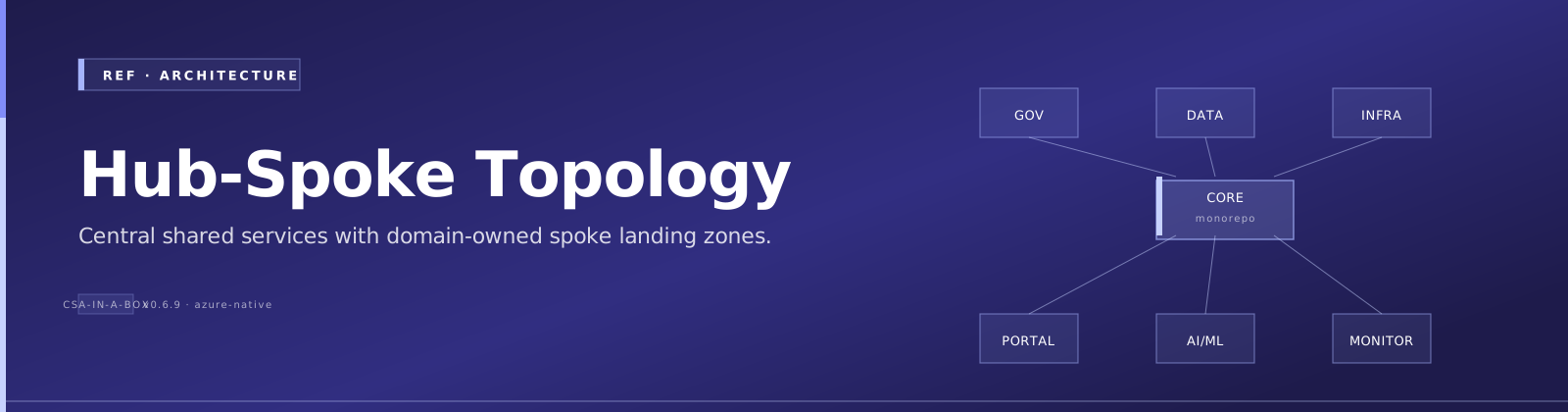
Reference Architecture — Hub-Spoke Topology for Analytics
TL;DR: Use hub-spoke for everything up to ~5 spokes/regions. Use Virtual WAN above that, or when you have global / cross-region transitive routing needs. Default to hub-spoke for analytics workloads — the routing is simpler and the management plane is one fewer thing to break.
The problem
An enterprise analytics platform connects to:
- Producers: source systems on-prem, in other clouds, or in other Azure subs
- Consumers: BI tools, downstream apps, partner APIs
- Operators: developers, SREs, data engineers, on-call
- Compliance: audit logging, security tooling, IDS/IPS
- Shared services: DNS, AD, monitoring, secrets
All of these need network reachability into the landing zone subscription that holds the data — but not into each other. The pattern that solves this for the typical Fortune 500 / federal-mid scale is hub-spoke.
Architecture
flowchart TB
    subgraph OnPrem[On-Premises]
        ER[ExpressRoute Circuit]
        VPN[Site-to-Site VPN<br/>backup]
    end

    subgraph Hub[Hub VNet — Connectivity Subscription]
        ERGW[ExpressRoute Gateway]
        VPNGW[VPN Gateway]
        FW[Azure Firewall<br/>Premium]
        DNS[Private DNS Zones<br/>privatelink.*.windows.net]
        BAS[Azure Bastion]
    end

    subgraph DLZ[Data Landing Zone — Spoke 1]
        DLZSubnets[Subnets:<br/>data, app, pe, mgmt]
        Storage[ADLS Gen2 + PE]
        Synapse[Synapse + PE]
        DBX[Databricks<br/>VNet-injected]
        AOAI[Azure OpenAI + PE]
    end

    subgraph DMLZ[Data Mgmt LZ — Spoke 2]
        Purview[Purview + PE]
        KV[Key Vault + PE]
        AzMon[Log Analytics<br/>+ App Insights]
        APIM[APIM internal mode]
    end

    subgraph IDLZ[Identity LZ — Spoke 3]
        Entra[Entra ID Connect Sync]
        AAD[Domain Controllers<br/>optional]
    end

    subgraph PortalLZ[Portal / Apps Spoke 4]
        Portal[Portal AKS or<br/>Container Apps]
        FrontDoor[Front Door<br/>WAF]
    end

    OnPrem --- ER
    OnPrem --- VPN
    ER --- ERGW
    VPN --- VPNGW
    ERGW --- FW
    VPNGW --- FW

    FW <--> DLZSubnets
    FW <--> DMLZ
    FW <--> IDLZ
    FW <--> PortalLZ

    DLZSubnets --> Storage
    DLZSubnets --> Synapse
    DLZSubnets --> DBX
    DLZSubnets --> AOAI
    DNS -.-> Storage
    DNS -.-> Synapse
    DNS -.-> AOAI
    DNS -.-> Purview
    DNS -.-> KV

    Internet[Public Internet] --> FrontDoor
    FrontDoor --> Portal
    Portal --> APIM
    APIM --> Synapse
    APIM --> AOAI

    AzMon -.collect.-> Storage
    AzMon -.collect.-> Synapse
    AzMon -.collect.-> DBX
    AzMon -.collect.-> AOAI
    AzMon -.collect.-> Portal
    AzMon -.collect.-> FW
Component responsibilities
| Component | Subscription / RG | Purpose |
|---|---|---|
| ExpressRoute / VPN | Connectivity sub | Private connectivity from on-prem |
| Hub VNet + Azure Firewall Premium | Connectivity sub | Single point of egress + east-west inspection |
| Private DNS zones | Connectivity sub | privatelink.* zones linked to all spokes — single source of truth |
| Bastion | Connectivity sub | RDP/SSH to spokes without public IPs |
| DLZ (Data Landing Zone) | Per-domain | The actual data + compute (Storage, Synapse, Databricks, AOAI) — see deploy/bicep/DLZ/ |
| DMLZ (Data Mgmt LZ) | Shared | Cross-cutting governance: Purview, Key Vault, Log Analytics, APIM — see deploy/bicep/DMLZ/ |
| Identity LZ | Shared | Entra ID Connect, optional domain controllers if you need traditional AD on Azure |
| Portal / Apps LZ | Per-app | User-facing apps (React portal, Power Apps, custom) — internet-facing via Front Door + WAF |
Subnets per spoke (DLZ example)
| Subnet | Purpose | Min size |
|---|---|---|
snet-data | Storage account private endpoints, Cosmos PE | /27 |
snet-app | Synapse SQL on-demand workers, Function App VNet integration | /26 |
snet-pe | All other private endpoints (Key Vault, AOAI, AI Search, etc.) | /26 |
snet-mgmt | Bastion-reachable mgmt VMs, self-hosted IR | /27 |
snet-databricks-public | Databricks public subnet | /26 (Databricks min) |
snet-databricks-private | Databricks private subnet | /26 (Databricks min) |
snet-aks (optional) | Portal AKS nodes if not using Container Apps | /22 |
Total: a single DLZ spoke needs roughly a /22 worth of address space (1024 IPs) to be comfortable. Plan address allocation accordingly — RFC 1918 exhaustion is a real problem at the 10-spoke mark.
Key design decisions
Why hub-spoke and not Virtual WAN?
- Hub-spoke routing is explicit and simple — every packet hits the firewall, no transitive surprises
- vWAN is better when you have >5 regions or need transit through Microsoft backbone between branches
- For analytics workloads (typically 1–3 regions, with on-prem ingest) hub-spoke wins on operational simplicity
If you're at >5 regions, see the Microsoft Virtual WAN reference and re-evaluate.
Why one DLZ per domain (not one giant DLZ)?
- Blast radius: a bad deploy in one DLZ doesn't break others
- RBAC scope: each domain team owns its subscription, no cross-team accidents
- Cost allocation: one subscription = one bill, no chargeback math
- Compliance scope: a HIPAA workload can be in its own DLZ without dragging the whole org into HIPAA scope
The DMLZ stays shared because Purview / Log Analytics / Key Vault are most useful when consolidated.
Why Azure Firewall Premium and not NVA?
- Built-in IDPS, TLS inspection, URL filtering — no licensing math
- First-class Bicep / CLI support
- We've never had a customer regret choosing AzFW Premium for analytics workloads
- If you need vendor-specific NVA features (Palo, Fortinet), put it as a second hop in front of AzFW, not instead of it
Why Private DNS zones in the hub?
- One zone per Azure service privatelink (
privatelink.dfs.core.windows.net,privatelink.openai.azure.com, etc.) - Linked to every spoke VNet — name resolution works the same everywhere
- Avoids the "every spoke has its own zone" anti-pattern that breaks cross-spoke private endpoints
- See the Networking & DNS Strategy pattern for the full DNS strategy
Trade-offs
✅ What this gives you
- Single egress chokepoint for compliance and inspection
- Consistent identity / DNS / monitoring across all data domains
- Independent blast radius per domain
- Simple mental model: "spokes never talk directly, always through hub"
⚠️ What you give up
- Hub firewall is a single point of failure — must deploy redundantly (zone-redundant in single region, paired-region for DR)
- Hub firewall is a bandwidth bottleneck — AzFW Premium tops out at ~30 Gbps per region, plan accordingly
- Hub VNet must be sized correctly the first time — resizing requires recreating peerings
- Cross-spoke traffic incurs two firewall hops (each direction) — latency-sensitive workloads should colocate
Variants
| Scenario | Variant |
|---|---|
| Azure Government | Identical pattern, but check service availability per region — see Government Service Matrix |
| Single-subscription dev/POC | Skip the hub — put everything in one VNet with subnet-level NSGs. Don't ship to production this way. |
| Multi-region active-active | Each region gets its own hub + DLZs; hubs peer to each other (or via vWAN). See Multi-Region |
| Air-gapped / sovereign | Hub-spoke still applies; Internet egress replaced with explicit allow-listed proxy. See Compliance — FedRAMP |
Related
deploy/bicep/landing-zone-alz/— Microsoft ALZ fork that builds the hubdeploy/bicep/DLZ/modules/network/— DLZ network module- Patterns — Networking & DNS Strategy
- Best Practices — Security & Compliance
- Multi-Region
- Multi-Tenant