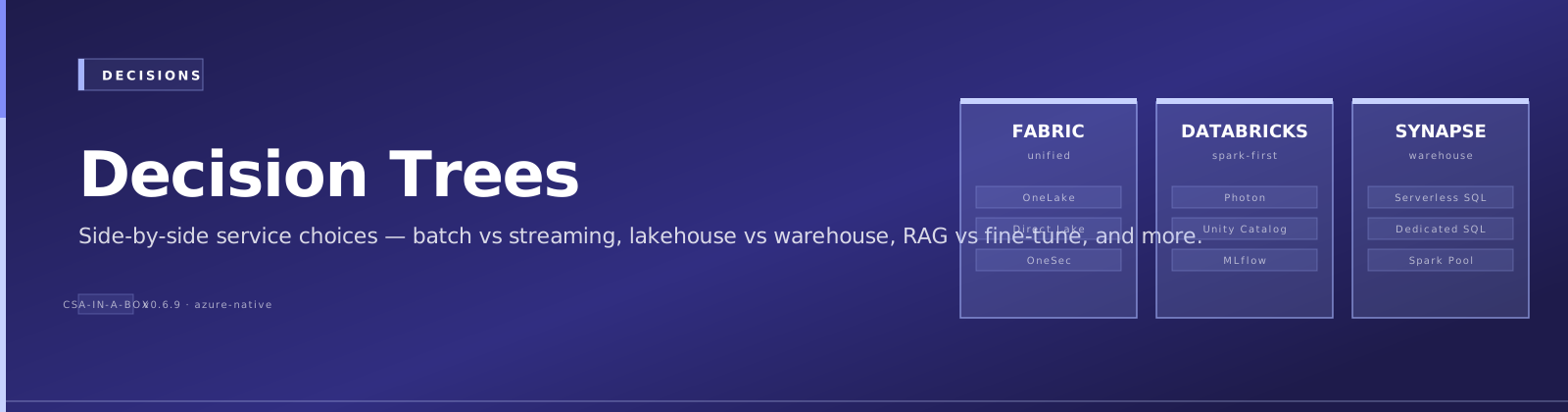
Fabric vs. Databricks vs. Synapse
Comparative positioning note
This document is written from the perspective of Microsoft Azure, Cloud Scale Analytics, and CSA Loom. Any description of third-party or competing products, services, pricing, or capabilities is derived from publicly available documentation and sources believed accurate at the time of writing, and is provided for general comparison only. We do not claim expertise in, or authority over, any non-Microsoft product or service; the respective vendor's official documentation is the authoritative source for their offerings, which may change over time. Nothing here is intended to disparage any vendor — where a competing product has genuine advantages, we aim to note them honestly. Verify all third-party details against the vendor's current official documentation before making decisions.
TL;DR
For a greenfield Azure Commercial analytics workload that is Power BI-centric, pick Microsoft Fabric. For Spark/ML-heavy or multi-cloud workloads, pick Azure Databricks. For Azure Government or existing dedicated SQL pool estates, pick Azure Synapse Analytics.
When this question comes up
- A new agency or business unit is scoping its first cloud analytics platform and wants one primary engine.
- An existing SQL DW or on-prem Hadoop workload is being modernized and must land on Azure.
- Leadership wants to consolidate multiple tools into a single "Fabric-equivalent" control plane.
Decision tree
flowchart TD
    start["Azure Commercial or Government?"] -->|Commercial| q_fit
    start -->|Government| q_gov

    q_fit{"Need Fabric-unique feature?<br/>(OneLake, Direct Lake,<br/>Data Activator, RTI)"}
    q_fit -->|Yes — PBI / OneLake central| q_shape
    q_fit -->|No — Spark / ML heavy| q_spark
    q_fit -->|No — SQL-first warehouse| q_sql

    q_shape{"Need custom Docker / non-notebook<br/>Python or >10 TB tuned Spark?"}
    q_shape -->|Yes| rec_db["**Recommend:** Azure Databricks"]
    q_shape -->|No| rec_fab["**Recommend:** Microsoft Fabric"]

    q_spark{"Need MLflow / Unity Catalog /<br/>Photon mastery?"}
    q_spark -->|Critical| rec_db
    q_spark -->|Nice to have| q_eco

    q_eco{"Heavy M365 / Power BI /<br/>Purview investment?"}
    q_eco -->|Yes| rec_fab
    q_eco -->|Mixed / multi-cloud| rec_db

    q_sql{"Dedicated-pool MPP needed?<br/>(>50 concurrent users)"}
    q_sql -->|Yes| rec_syn["**Recommend:** Azure Synapse"]
    q_sql -->|No| rec_fab

    q_gov{"Compliance ceiling?"}
    q_gov -->|FedRAMP High / IL4| q_gov_platform
    q_gov -->|IL5 / IL6| rec_syn

    q_gov_platform{"Databricks authorized in Gov?"}
    q_gov_platform -->|Yes| rec_db
    q_gov_platform -->|No — Synapse standard| rec_syn
Per-recommendation detail
Recommend: Microsoft Fabric
When: Commercial tenant, Power BI / OneLake / Data Activator is central, notebooks and T-SQL cover the transformation needs.
Why: Unified control plane (OneLake, Data Factory, Warehouse, Power BI, Data Activator, Real-Time Intelligence) with Direct Lake eliminating Power BI semantic-model refresh cycles.
Tradeoffs:
- Cost: F-SKU capacity base cost ($$$) plus pay-as-you-use CU overage.
- Latency: Direct Lake sub-second over gold-layer Delta.
- Compliance: Commercial GA only; FedRAMP High not yet GA in Azure Gov.
- Skill match: Low — SQL + notebooks + Power BI.
Anti-patterns:
- Custom Docker images or non-notebook Python entry points.
- Any Azure Government workload today (2026-Q2).
- Teams with deep MLflow + Unity Catalog practice they do not want to give up.
Linked example: examples/commerce/
Recommend: Azure Databricks
When: Spark, ML, streaming, or multi-cloud portability are critical; team has or wants MLflow + Unity Catalog expertise.
Why: Best-in-class Spark/Delta/Photon with the most mature lakehouse tooling; Unity Catalog gives fine-grained access control across workspaces.
Tradeoffs:
- Cost: DBU-based; right-sizing is an operational concern; Photon improves $/TB.
- Latency: Interactive seconds, streaming sub-minute, SQL Warehouses sub-second for BI.
- Compliance: Azure Commercial and Azure Gov (FedRAMP High, IL4, IL5 with qualifying SKUs).
- Skill match: Higher — Spark, Python/Scala, Unity Catalog required.
Anti-patterns:
- Pure SQL warehousing with no Spark needs.
- Workloads where Power BI Direct Lake and Data Activator are the primary requirement.
Linked example: examples/iot-streaming/
Recommend: Azure Synapse Analytics
When: Azure Government, existing dedicated-pool SQL DW, or IL5/IL6 compliance ceiling.
Why: Longest Gov compliance track record; mature dedicated MPP pools; serverless SQL for ad-hoc over ADLS.
Tradeoffs:
- Cost: Dedicated pools capacity-reserved ($$$); serverless SQL pay-per-TB-scanned.
- Latency: Dedicated pools sub-second for high concurrency.
- Compliance: Full FedRAMP High, IL4, IL5 in Azure Gov.
- Skill match: Medium — T-SQL first, Spark pools secondary.
Anti-patterns:
- Greenfield Commercial lakehouse — Fabric or Databricks wins on velocity.
- Intermittent / bursty workloads on dedicated pools — use serverless SQL or Databricks SQL Warehouse.
Linked example: examples/usda/
Related
- Architecture: Architecture Layers
- Architecture: Primary Tech Choices
- Guide: Microsoft Fabric Platform Guide
- Companion: Supercharge Microsoft Fabric — tutorials, feature guides, best practices, and POC agendas
- Finding: CSA-0010 (ARCHITECTURE decision matrix lacks branching and scenario axes)