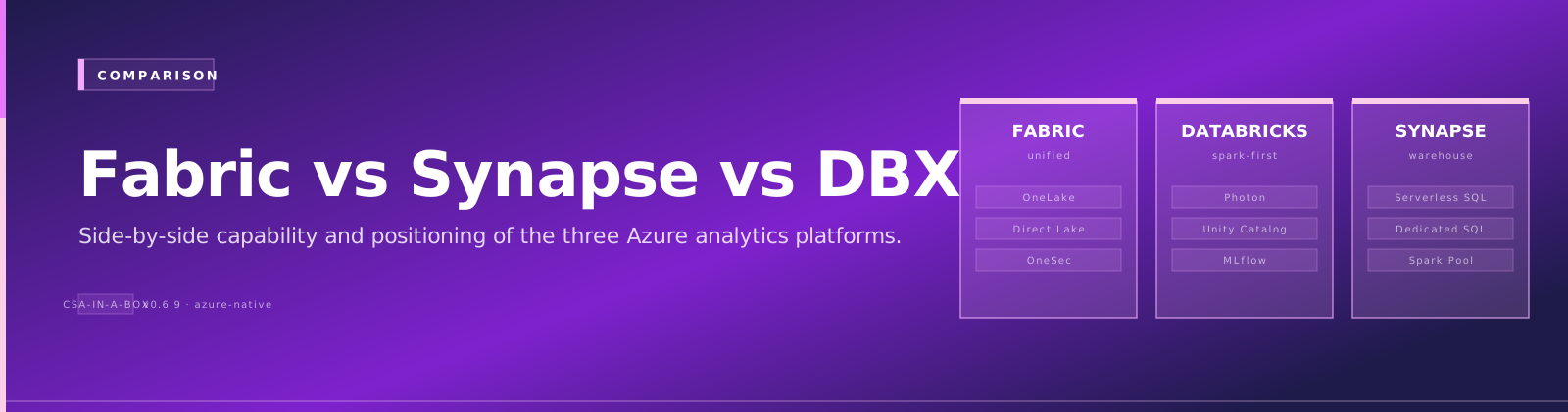
Reference Architecture — Fabric vs Synapse vs Databricks
Comparative positioning note
This document is written from the perspective of Microsoft Azure, Cloud Scale Analytics, and CSA Loom. Any description of third-party or competing products, services, pricing, or capabilities is derived from publicly available documentation and sources believed accurate at the time of writing, and is provided for general comparison only. We do not claim expertise in, or authority over, any non-Microsoft product or service; the respective vendor's official documentation is the authoritative source for their offerings, which may change over time. Nothing here is intended to disparage any vendor — where a competing product has genuine advantages, we aim to note them honestly. Verify all third-party details against the vendor's current official documentation before making decisions.
TL;DR (2026): Synapse + Databricks is the production backbone today; Fabric is the strategic forward path for new workloads, especially Real-Time Intelligence and Direct Lake semantic models. The right answer is usually "both, sequenced over 18–36 months." Don't pick one universally; pick per-workload using the decision tree below.
The decision
flowchart TD
    Start[New analytics workload] --> Q1{Is this workload<br/>net-new?}

    Q1 -->|No, migrating| Q2{From what?}
    Q2 -->|Synapse SQL pool / Spark| KeepSyn[Keep on Synapse;<br/>plan Fabric eval at next<br/>major schema change]
    Q2 -->|Databricks AWS/GCP/onprem| KeepDBX[Migrate to Azure Databricks;<br/>see migration playbook]
    Q2 -->|Snowflake / Redshift / BigQuery| Q5{Modern lakehouse OK?}
    Q5 -->|Yes| Fabric[Fabric Lakehouse<br/>+ dbt + Direct Lake]
    Q5 -->|Need Spark feature parity| DBX[Azure Databricks<br/>+ Unity Catalog]

    Q1 -->|Yes, greenfield| Q3{What's the<br/>primary workload?}
    Q3 -->|Real-time / streaming / IoT| Q3a{Sub-second latency?}
    Q3a -->|Yes| RTI[Fabric RTI / Eventhouse<br/>KQL DB]
    Q3a -->|Seconds-to-minutes| ASA[Stream Analytics or<br/>Databricks Structured Streaming]

    Q3 -->|Heavy ML / DL / GenAI training| DBX
    Q3 -->|Classic SQL warehouse / BI| Q4{Power BI primary<br/>consumer?}
    Q4 -->|Yes| FabricLH[Fabric Lakehouse<br/>+ Direct Lake]
    Q4 -->|No, mixed BI/SQL| Synapse[Synapse Serverless SQL<br/>over Delta]

    Q3 -->|Data engineering / dbt / pipelines| Q6{Existing<br/>investment?}
    Q6 -->|Heavy ADF| ADF[ADF + dbt + Synapse Spark<br/>or Databricks compute]
    Q6 -->|Greenfield| FabricDF[Fabric Data Pipelines<br/>+ dbt-fabric]

    Q3 -->|Lakehouse for AI grounding<br/>RAG/agents| Q7{Need vector search?}
    Q7 -->|Yes| AISearch[ADLS Delta + AI Search<br/>+ AOAI]
    Q7 -->|Use Fabric semantic search| FabAI[Fabric Lakehouse<br/>+ AI skills]

    style Fabric fill:#0078d4,color:#fff
    style FabricLH fill:#0078d4,color:#fff
    style FabricDF fill:#0078d4,color:#fff
    style FabAI fill:#0078d4,color:#fff
    style RTI fill:#0078d4,color:#fff
    style DBX fill:#ff6b35,color:#fff
    style Synapse fill:#13a3b5,color:#fff
    style KeepSyn fill:#13a3b5,color:#fff
    style ASA fill:#13a3b5,color:#fff
    style ADF fill:#13a3b5,color:#fff
style AISearch fill:#13a3b5,color:#fffSide-by-side
| Dimension | Fabric | Synapse | Databricks |
|---|---|---|---|
| Deployment model | SaaS (capacity SKU F2-F2048) | PaaS (workspaces + pools) | PaaS (workspaces + clusters) |
| Primary storage | OneLake (single namespace) | ADLS Gen2 (you bring) | ADLS Gen2 (you bring) + Unity Catalog |
| Primary table format | Delta Lake (auto-optimized) | Delta Lake or Parquet | Delta Lake (with Liquid Clustering) |
| SQL engine | Lakehouse SQL endpoint, Warehouse | Serverless SQL, Dedicated SQL Pool | Databricks SQL warehouses |
| Spark engine | Fabric Spark (forked from OSS) | Synapse Spark | Databricks Runtime (forked, optimized) |
| Streaming | Real-Time Intelligence (Eventhouse / KQL) | Structured Streaming, ASA bridge | Structured Streaming, Delta Live Tables |
| BI integration | Power BI Direct Lake (best in class) | Power BI Import/DirectQuery | Power BI Import/DirectQuery, Genie |
| Notebooks | Yes (Fabric notebooks) | Yes (Synapse notebooks) | Yes (Databricks notebooks — original UX) |
| ML platform | Fabric Data Science (preview) | Azure ML integration | MLflow native (best in class for ML) |
| Governance | Built-in (OneLake catalog) + Purview | Purview integration | Unity Catalog + Purview |
| Cost model | Capacity-based (F SKU $/hr, smoothed) | Per-pool (DWU) + per-query (serverless) | Per-cluster (DBU/hr) + storage |
| Auto-pause | Capacity is always on (smoothed) | Yes — pause SQL pool, autoscale Spark | Yes — auto-terminate clusters |
| Multi-cloud | Azure-only (AWS S3 read via shortcut) | Azure-only | AWS, Azure, GCP |
| Azure Government | Pre-GA, no MAG production yet | GA | GA |
| Maturity (2026) | GA but rapidly evolving | Mature, stable | Mature, stable |
| Best for | New BI workloads, RTI/IoT, Direct Lake semantic models, Power BI-first orgs | Existing Synapse investments, mixed SQL/Spark, federal/Gov | Heavy ML/DL/GenAI, multi-cloud, Spark experts |
Cost comparison (rough, 2026)
For a typical medium analytics workload (~5 TB Delta, 20 dbt models, daily refresh, BI to 200 users):
| Platform | Monthly cost (USD, dev) | Monthly cost (USD, prod) | Notes |
|---|---|---|---|
| Fabric | $260 (F2 8h/day) | $5,200 (F64 24/7) | Capacity is shared across BI + Lakehouse + RTI; smoothing helps |
| Synapse | $400 (Serverless + small Spark) | $4,800 (DW100c + Spark XS) | Serverless wins for spiky workloads; Dedicated wins for predictable |
| Databricks | $500 (Standard, auto-terminate) | $6,500 (Premium SKU + Photon) | DBU pricing varies a LOT by SKU and Photon usage |
These are order-of-magnitude estimates. Actual costs depend on query patterns, idle time, region, and reserved-capacity discounts. Always model with the real Azure Pricing Calculator before committing.
When to combine (not pick one)
This is the most common production answer:
flowchart LR
    Sources[Sources] --> ADF
    Sources --> EH[Event Hubs]
    ADF --> ADLS[(ADLS Delta<br/>shared bronze)]
    EH --> RTI[Fabric RTI<br/>streaming gold]
    ADLS --> DBX[Databricks<br/>silver+gold dbt<br/>+ ML]
    DBX --> ADLS
    ADLS -.OneLake shortcut.-> Fabric[Fabric Lakehouse<br/>BI surface]
    RTI --> Fabric
    Fabric --> PBI[Power BI<br/>Direct Lake]
    DBX --> ML[Azure ML<br/>training/inference]
DBX --> AOAI[AOAI + AI Search<br/>RAG/agents]- Databricks does the heavy lifting for transformations and ML
- Fabric is the BI presentation layer (Direct Lake reads the same Delta files via OneLake shortcut, no duplication)
- Fabric RTI handles the streaming gold for real-time dashboards
- Synapse is conspicuously absent from this picture for new workloads; it remains a strong choice for existing workloads and Azure Gov where Fabric isn't GA
Workload-fit matrix
| Workload | Best | Acceptable | Avoid |
|---|---|---|---|
| Power BI dashboards (large semantic models) | Fabric Direct Lake | Synapse + Import | Databricks SQL alone |
| Heavy Spark ML / GenAI training | Databricks | Synapse Spark | Fabric Spark (immature) |
| Real-time IoT (sub-second) | Fabric RTI / Eventhouse | Stream Analytics | Synapse Spark Streaming |
| Real-time analytics (seconds) | Fabric RTI, Databricks DLT | Synapse Spark Streaming | Synapse SQL |
| Ad-hoc analyst SQL over Delta | Synapse Serverless, Databricks SQL | Fabric Lakehouse SQL | Fabric Warehouse (preview-feel) |
| Federal / Gov workloads (today) | Synapse + Databricks | Synapse only | Fabric (pre-GA in MAG) |
| Multi-cloud (AWS/GCP source) | Databricks | Fabric (S3 shortcuts) | Synapse |
| Cost-sensitive POC | Synapse Serverless | Databricks Standard | Fabric F-SKU (capacity always on) |
| Net-new BI-first org | Fabric | Synapse | Databricks-only |
Migration sequencing (real-world)
If you have an existing Synapse + Databricks investment, the typical 18–36 month path is:
gantt
    title Synapse+Databricks → Fabric (typical enterprise)
    dateFormat YYYY-MM
    section Discovery
    Audit current workloads        :2026-01, 3M
    Pick pilot workloads           :2026-02, 1M
    section Pilot
    Fabric capacity provisioned    :2026-04, 1M
    Pilot 1 BI workload to Fabric  :2026-04, 4M
    Pilot 1 RTI workload           :2026-06, 4M
    section Wave 1
    Migrate Tier-2 BI to Fabric    :2026-08, 6M
    Keep ML on Databricks          :2026-08, 18M
    Keep Synapse SQL pools         :2026-08, 12M
    section Wave 2
    Migrate Tier-1 BI              :2027-02, 6M
    Decommission first SQL pool    :2027-08, 3M
    section Steady state
    Fabric for BI + RTI            :2028-01, 6M
    Databricks for ML              :2028-01, 6M
    Synapse archived               :2028-04, 1M
The point is don't try to forklift. Move workloads when they're already in flight (schema change, cost optimization, new feature) — never just because of platform fashion.
Trade-offs summary
✅ Why Fabric — Best Power BI integration, OneLake unifies storage, RTI is genuinely good, simpler ops model (one capacity) ⚠️ Why not Fabric (yet) — Pre-GA in Gov, immature ML, capacity model can be expensive for spiky workloads, Spark is forked-OSS not Photon
✅ Why Synapse — Mature, Gov GA, Serverless SQL is brilliant for ad-hoc, Dedicated SQL Pool is a real DW ⚠️ Why not Synapse — Microsoft's investment focus is on Fabric; Synapse is in maintenance mode; new features land in Fabric first
✅ Why Databricks — Best Spark/ML/GenAI runtime, Unity Catalog is excellent, multi-cloud, Photon is fast, MLflow native ⚠️ Why not Databricks — Pricier than Fabric for BI-only workloads, separate identity model adds complexity, Power BI integration is good but not Direct Lake-class
Related
- ADR 0010 — Fabric Strategic Target
- ADR 0002 — Databricks over OSS Spark
- ADR 0018 — Fabric RTI Adapter
- Decision — Fabric vs Databricks vs Synapse (the quick-pick version)
- Migration — Databricks to Fabric
- Use Case — Unified Analytics on Fabric
- Patterns — Power BI & Fabric Roadmap
- Supercharge Microsoft Fabric — companion site with tutorials, feature guides, and production best practices for Fabric