Forward migration to Microsoft Fabric
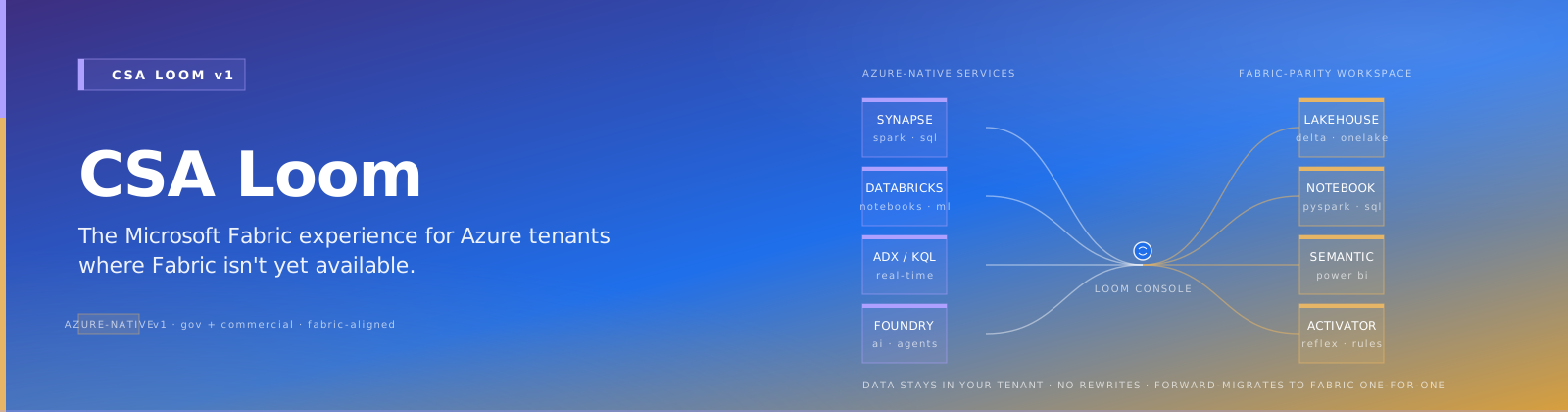
The strategic anchor of CSA Loom. When Microsoft Fabric reaches your audit boundary, forward-migrate your workloads with minimal rewrite.
When to migrate
Trigger conditions: - Microsoft Fabric reaches your audit boundary GA (FedRAMP High / IL4 / IL5) - Your customer has F-SKU Fabric capacity available - You've completed Loom v1 stabilization (not mid-deployment)
Verify via Azure Government product GA roadmap + subscribe to the Fabric Blog Gov announcements channel.
Migration matrix
Per ADR fiab-0012:
| Loom artifact | Fabric equivalent | Migration mechanism | Effort |
|---|---|---|---|
| ADLS Gen2 Delta tables | OneLake Delta tables | OneLake shortcut → zero data movement | Low |
| Loom workspaces | Fabric workspaces | Re-create with same name/domain; bind to same Git folder | Low |
| Loom Domains | Fabric Domains | Domain metadata exports to JSON; Fabric Domains API import | Low |
| Loom Mirroring configs (Debezium-based) | Fabric Mirroring | Per-source case-by-case; switch when Fabric Mirroring covers source | Variable |
| Loom Activator rules | Fabric Reflex / Data Activator | JSON export → Reflex import; rule primitives mostly map 1:1 | Low-Medium |
| Loom Data Agents | Fabric Data Agents | Agent config JSON → Fabric Data Agents REST API | Low |
| Direct-Lake-Shim semantic models | Direct Lake on OneLake | Re-author TMDL for Direct Lake on OneLake storage mode | Medium |
| Databricks notebooks | Fabric Spark notebooks | Git folder port; rebuild deps for Fabric Spark runtime | Medium |
| dbt models | dbt in Fabric Data Factory | dbt-fabric adapter; change connection string | Low |
| Synapse Serverless tables | Fabric Warehouse | Re-create as Warehouse tables; T-SQL DDL ports | Medium |
| Databricks SQL Warehouse tables | Fabric Warehouse | Re-create; UC tables → Fabric items | Medium |
| ADX databases / KQL queries | Fabric Eventhouse | Same engine; databases attach as Eventhouse | Low |
| Power BI semantic models | Power BI in Fabric | Already in Power BI Premium; rebind to OneLake shortcut | Low |
| Purview catalog | Fabric Purview | Same engine; Fabric items auto-register | Zero |
Migration tooling — fiab-migrate CLI (v1.1)
# 1. Snapshot the Loom estate
fiab-migrate snapshot \
  --admin-plane-sub-id <SUB-A> \
  --output ./loom-state.json

# 2. Plan migration to target Fabric capacity
fiab-migrate plan \
  --snapshot ./loom-state.json \
  --target-fabric-tenant <TENANT> \
  --target-capacity F128 \
  --output ./migration-plan.json

# 3. Execute the plan
fiab-migrate execute \
  --plan ./migration-plan.json \
  --dry-run    # or --commit

# 4. Verify
fiab-migrate verify \
  --plan ./migration-plan.json
The plan output flags per-item migration verdict (Direct / Manual / Skip) so customer can prioritize.
OneLake shortcut as the data-movement bridge
For Delta tables, forward migration is zero data movement:
- Create OneLake shortcut from Fabric workspace pointing at the existing Loom ADLS Gen2 lakehouse path
- Data is queryable from Fabric workloads immediately
- Customer optionally promotes data into native OneLake paths later via copy (incremental, customer-paced)
Side-by-side run pattern
Most customers run Loom and Fabric side-by-side for N weeks during transition:
- Migrate semantic models + Power BI reports first (lowest risk; highest user-visibility)
- Keep Loom Activator + Mirroring + Direct-Lake-Shim running for workloads not yet migrated
- Migrate workloads piecemeal — pipeline-by-pipeline, dashboard-by- dashboard
- Validate parallel-run results (KQL query against both systems; diff results)
- After ~30-90 days of clean side-by-side, decommission Loom components per workload
Decommissioning Loom (after migration complete)
- Loom Console: stop the Container App / AKS workload; tear down RG
- Loom Mirroring Engine: stop CDC connectors; verify Fabric Mirroring covers all sources
- Loom Activator Engine: confirm all rules migrated to Reflex; stop service
- Loom Direct-Lake-Shim: stop service (Direct Lake handles freshness natively in Fabric)
- Loom Data Agents: confirm migrated to Fabric Data Agents; stop extension service
- ADLS Gen2 lakehouses: keep (now accessed via OneLake shortcut from Fabric)
- Catalog (Purview / UC): keep — Fabric uses the same Purview
Reverse migration (Fabric → Loom)
Less common but legitimate (customer pilots in Fabric Commercial, moves to Gov). See Upgrade & migration.
Commitments
Loom commits: - OneLake shortcut path remains stable across Loom versions - dbt models port unchanged (no Loom-specific extensions) - TMDL semantic-model format is canonical - Activator rule JSON schema is published - fiab-migrate CLI ships in v1.1 — included in standard support
Related
- ADR: fiab-0012 Forward migration
- Runbook: Forward migrate to Fabric
- Use case: Hybrid Fabric Commercial + Loom Gov
- Parent: Microsoft Fabric in Azure Government