fiab-0012: Forward migration — OneLake shortcut + hybrid topology first-class¶
Status: Accepted Date: 2026-05-22 Locked decision ref: LD-13
Context¶
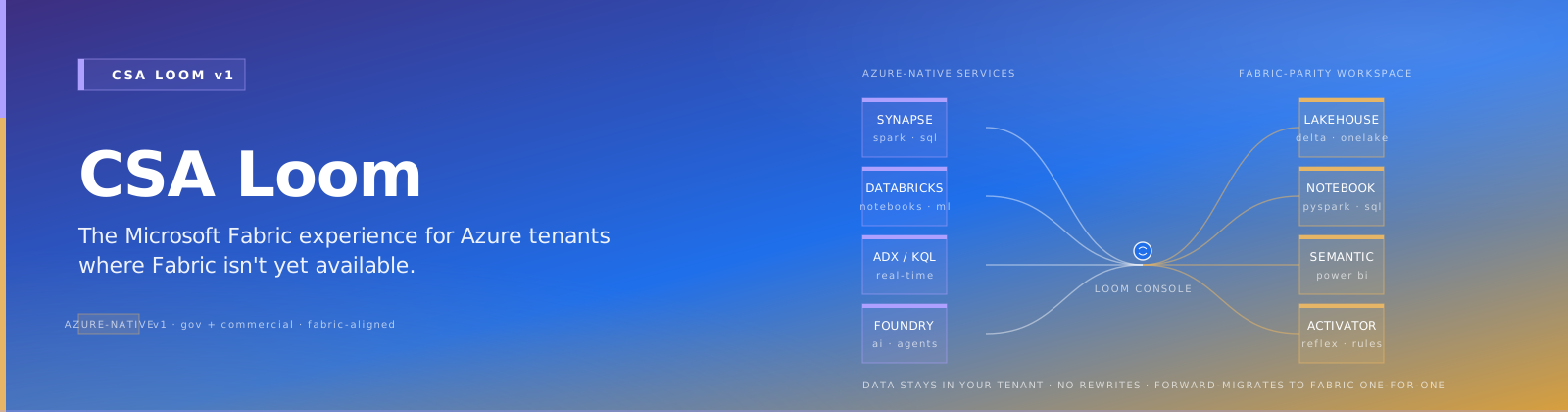
The strategic justification for CSA Loom is "head-start, not detour." Federal customers adopt Loom because Fabric isn't available in their boundary today; when Fabric reaches their boundary (whether that's 2027, 2028, or later), they expect a clean forward-migration path.
Without a forward-migration story, Loom looks like a permanent investment in a non-Fabric platform — which contradicts the csa-inabox parent project's ADR-0010 ("Fabric is the strategic target"). Customers will be hesitant to commit Bronze/Silver/Gold production workloads to a platform they can't migrate forward.
Per temp/fiab-research/03-fabric-only-internals.md: - OneLake is ADLS Gen2 underneath with a unified namespace via a Microsoft-managed gateway; OneLake shortcuts are first-class filesystem mounts that resolve to any ADLS Gen2 path - Most Loom artifacts (Delta tables, dbt models, KQL queries, notebooks) are already in formats Fabric understands directly - Some Loom artifacts (Activator rules JSON, Data Agent configs, TMDL semantic models) port via REST API export/import
Decision¶
Three commitments:
1. Bidirectional migration documented + tooled¶
Both Loom → Fabric and Fabric → Loom are first-class documented patterns:
- Loom → Fabric (forward) — when Fabric reaches your boundary; the strategic move
- Fabric → Loom (reverse) — for customers who piloted in Fabric Commercial then needed to move workload into Gov; documented but rarer
fiab-migrate CLI ships in v1.1 (PRP-104) to automate the forward- migration: - fiab-migrate snapshot — capture current Loom estate to portable JSON bundle - fiab-migrate plan — reads snapshot + target Fabric capacity; produces migration plan flagging Direct / Manual / Skip per item - fiab-migrate execute — runs the plan against Fabric REST APIs - fiab-migrate verify — diff results across Loom + Fabric
2. OneLake shortcut as the data-movement bridge¶
For Delta tables (the largest data volume customers carry), forward migration is zero data movement:
- Create OneLake shortcut from a Fabric workspace pointing at the existing Loom ADLS Gen2 lakehouse path
- Data is queryable from Fabric immediately
- Customer optionally promotes data into OneLake native paths later via copy (incremental, customer-paced)
Per-component effort:
| Loom artifact | Migration mechanism | Effort |
|---|---|---|
| Delta tables | OneLake shortcut | Zero data movement |
| dbt models | dbt-fabric adapter; change connection string | Low |
| Databricks notebooks | Git folder port; runtime swap | Medium |
| TMDL semantic models | Re-author for Direct Lake on OneLake storage mode | Medium |
| ADX databases / KQL queries | ADX databases attach as Fabric Eventhouse via documented procedure; queries unchanged | Low — same engine |
| Power BI semantic models | Already in Power BI Premium; rebind to OneLake shortcut | Low |
| Activator rule JSON | Export from Loom Activator → import via Reflex definition REST API | Low-Medium |
| Mirroring configs | Per-source case-by-case (Fabric Mirroring GA for some sources; keep Loom Mirroring for others) | Variable |
| Data Agents | Export agent config JSON → Fabric Data Agents REST API | Low |
| Purview catalog | Same engine — Fabric items auto-register into existing Purview | Zero |
3. Hybrid topology as first-class architecture pattern¶
The most realistic federal customer pattern is Fabric (Commercial) + Loom (Gov) running side-by-side indefinitely:
- Commercial tenant runs Fabric for public datasets, cross-agency analytics, exec Power BI dashboards
- Gov tenant runs Loom for CUI / classified mission data, agency- internal analytics, ITAR-eligible GCC-High workloads
- Cross-cloud B2B invitations bridge identity
- APIM Premium in each cloud brokers controlled cross-cloud API calls
This pattern lets customers move at their own audit-review cadence rather than a forced cutover. Documented in docs/fiab/use-cases/hybrid-topology.md.
Consequences¶
Positive¶
- Customers can commit production workloads to Loom knowing they're not trapped — every workload has a documented forward path
- OneLake shortcut means no data-movement cost at migration time for the largest data volume (Delta tables)
- Most artifact types port 1:1 (dbt, KQL, Purview) — only TMDL + notebooks + rules require re-author/runtime-swap effort
- Hybrid topology is a stable end-state, not just a transition pattern — many federal customers will run hybrid for years
Negative¶
- Some Fabric-only artifacts (Direct Lake sub-second freshness, Fabric IQ Ontology / Plan / Graph) don't reverse-map back — Fabric → Loom migration has more friction than forward
fiab-migrateCLI ships in v1.1, not v1 — v1 forward-migration is manual per the runbook- Customer must commit to the discipline of authoring TMDL in Git, rules in Git, agent configs in Git — so migration tooling can read them from a single source of truth
- Some Loom-specific extensions (rules using Loom-only NRules primitives that Reflex doesn't support) won't port; customers must re-author
Neutral¶
- Forward-migration is a quarterly check-in topic with Microsoft Fabric product team (when does Fabric Gov reach our customer's boundary?)
- Customers should treat Loom + Fabric as a continuum, not as a decision-point
Alternatives considered¶
| Alternative | Why not chosen |
|---|---|
| Forward-only (Loom → Fabric; no reverse) | Misses Fabric Commercial pilot → Loom Gov scenarios (real but rarer) |
| Hybrid only (no forward migration tooling) | Customer is blocked when Fabric Gov GA arrives and they need to migrate |
| Custom Loom-specific format for everything | Maximum lock-in; defeats the strategic positioning |
| Bidirectional sync (live mirroring Fabric ↔ Loom) | Engineering cost extreme; semantic conflict resolution unsolved; not a real customer ask |
References¶
- PRD:
temp/fiab-prd/09-forward-migration.md - Amendments:
temp/fiab-prd/AMENDMENTS.md§A14 - Parent ADR:
docs/adr/0010-fabric-strategic-target.md— Loom refines for the Gov-interim case - Build: PRP-104 —
platform/fiab-migrate/(v1.1)