Loom Console
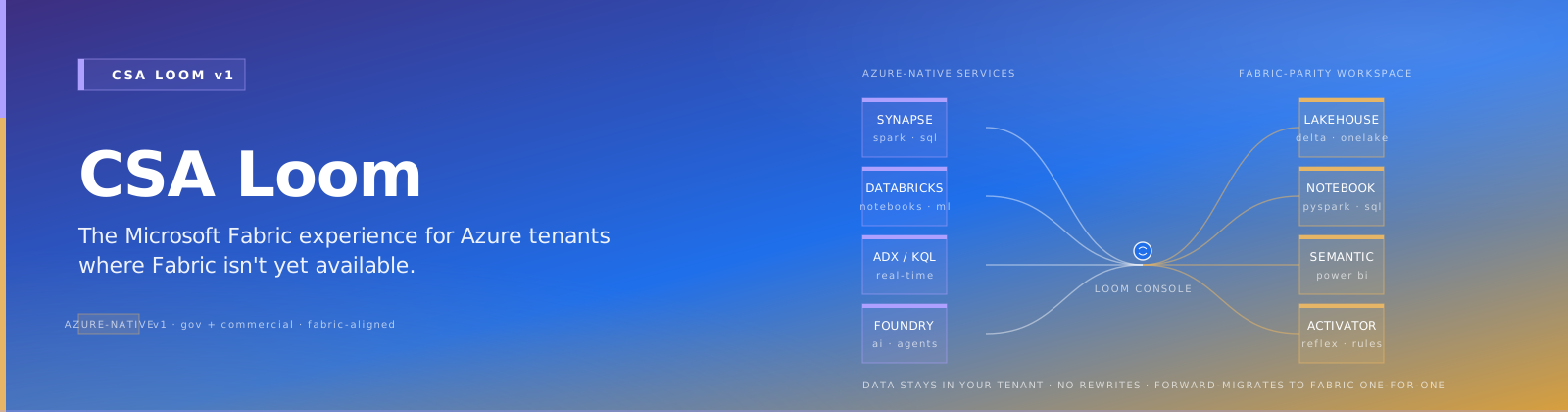
The Loom Console is the SaaS-feel front-end that gives federal customers the Microsoft Fabric workspace experience inside their Azure tenant. It's a Next.js 14 + Fluent UI v9 application running in Container Apps (Commercial / GCC) or AKS (GCC-High / IL5).
Panes (v1)
| # | Pane | Path | Purpose |
|---|---|---|---|
| 1 | Workspaces browser | /workspaces | List, filter, create workspaces |
| 2 | Workspace home | /workspaces/[id] | Item list across all workspace items |
| 3 | Lakehouse | /workspaces/[id]/lakehouse/[name] | Delta tables + files + SQL endpoint + lineage + RLS/CLS |
| 4 | Warehouse | /workspaces/[id]/warehouse | SQL editor + schema explorer + query history |
| 5 | Notebook | /workspaces/[id]/notebook/[id] | Embedded Databricks notebook iframe with SSO |
| 6 | KQL | /workspaces/[id]/kql/[db] | ADX query editor + dashboards iframe |
| 7 | Catalog | /catalog | UC + Purview unified browser (or Atlas at IL5) |
| 8 | Activator | /workspaces/[id]/activator/[id] | Visual rule designer + execution history |
| 9 | Data Agents | /workspaces/[id]/agent/[id] | Per-agent config + test chat |
| 10 | Monitoring Hub | /monitoring | Capacity / queries / deploys / audit / cost |
| 11 | Admin | /admin | Capacity scale + OAP + tenant settings + Entra groups |
| 12 | Setup Wizard | /setup | Conversational deploy (see Setup Wizard) |
Plus the Loom Copilot sidebar drawer + full-screen chat at /copilot (see Copilot runtime).
v1.1 additional panes
- Semantic Model designer (TMDL + DAX editor + Direct-Lake-Shim policy editor)
- Marketplace (data products)
- Real-Time Hub (visual stream designer)
- Mirroring (UI for Debezium connector configs; CLI in v1)
- Domains (visual domain hierarchy editor)
Tech stack
- Framework: Next.js 14 (App Router) — server components for data fetch + client components for interactivity
- UI library: Fluent UI v9 (matches Microsoft Fabric visual language; WCAG 2.1 AA baseline)
- Auth: MSAL BFF (cookies + refresh server-side; OBO for downstream calls)
- State: React Query for server state; Zustand for ephemeral UI
- API: Next.js Route Handlers under
/api/*proxy to Azure ARM, Databricks REST, Synapse REST, Power BI REST, ADX REST, Purview REST, AI Search REST, Loom backend services - Embeds: iframe for Databricks notebook, ADX dashboard, Power BI report — SSO via Entra; same-origin via BFF reverse-proxy
- Test: Playwright E2E + Vitest unit + axe-core accessibility
- Container: multi-stage Dockerfile; ~120 MB image; ACR-hosted
- Deploy: Container Apps (Commercial / GCC) or AKS Helm chart (GCC-High / IL5)
Performance targets
| Metric | Target |
|---|---|
| First Contentful Paint | < 1.5 s |
| Largest Contentful Paint | < 2.5 s |
| Time to Interactive | < 3.5 s |
| API response p50 | < 200 ms |
| API response p95 | < 500 ms |
| API response p99 | < 1.5 s |
| Initial bundle (gzipped) | < 400 KB; per-pane lazy-load |
Accessibility
- WCAG 2.1 AA compliance (Fluent UI v9 baseline)
- Keyboard navigation throughout
- Screen-reader labels
- High-contrast mode (Fluent theming)
- en-US baseline; locale structure ready
Related
- ADR: fiab-0007 Console framework
- Build PRP: PRP-03 —
apps/fiab-console/ - Setup Wizard route: Setup Wizard
- Copilot runtime: Loom Copilot runtime