Architecture Decision Trees
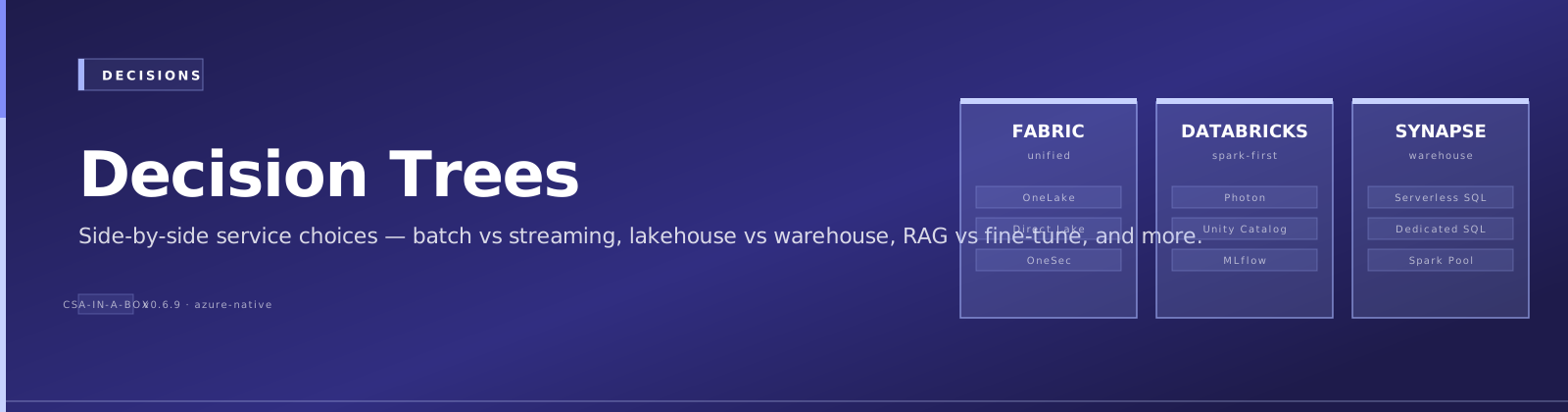
Scenario-driven decision trees for the recurring architecture questions on CSA-in-a-Box. Each tree is a branching flowchart that leads to a specific recommendation with rationale, tradeoffs (cost / latency / compliance / skill match), anti-patterns, and a linked working example.
For the machine-readable YAML source of truth (consumed by the future Copilot walk_tree skill), see decision-trees/ at the repo root. Both shapes are kept in sync.
How to use these
- Scan the TL;DR for your scenario.
- Walk the Mermaid diagram to your recommendation node.
- Read the Per-recommendation detail — especially the Anti-patterns.
- Open the Linked example to see the pattern in working code.
Catalog
| Tree | TL;DR |
|---|---|
| Fabric vs. Databricks vs. Synapse | Primary analytics platform. Fabric for Commercial + Power BI, Databricks for Spark/ML/multi-cloud, Synapse for Gov / dedicated-pool SQL. |
| Lakehouse vs. Warehouse vs. Lake | Storage + compute pattern. Lakehouse for mixed workloads >10 TB, Warehouse for pure BI at concurrency, Lake for raw exploration. |
| ETL vs. ELT | Default ELT; ETL when sensitive data must be redacted pre-landing; hybrid when redaction is narrow. |
| Batch vs. Streaming | SLA-driven. Streaming <1s, micro-batch <5min, batch hourly/daily. |
| Materialize vs. Virtualize | Materialize hot BI paths; virtualize for ad-hoc or <1 min freshness; hybrid for most real workloads. |
| Delta vs. Iceberg vs. Parquet | Delta default in Microsoft ecosystem; Iceberg when multi-engine is a hard requirement; Parquet only for append-only bronze. |
| Kafka vs. Event Hubs vs. Service Bus | Event Hubs default (Kafka API); Service Bus for ordered messaging; self-host Kafka only when full ecosystem needed. |
| RAG vs. Fine-Tuning vs. Agents | RAG default; fine-tune for style on stable corpus; agents for bounded tool workflows with human gates. |
Conventions
- Last Updated is always explicit.
- Linked examples always point to a real directory under
examples/. If a recommendation has no matching vertical, the tree notes that gap. - Anti-patterns are prescriptive — they block common misuses, not rare edge cases.
- Tradeoffs always cover the same four axes: cost, latency, compliance, skill match. Missing axes are an authoring bug.
Related
- Machine-readable source of truth:
decision-trees/ - Primary tech cheat sheet: ARCHITECTURE.md#Primary Tech Choices
- Finding: CSA-0010