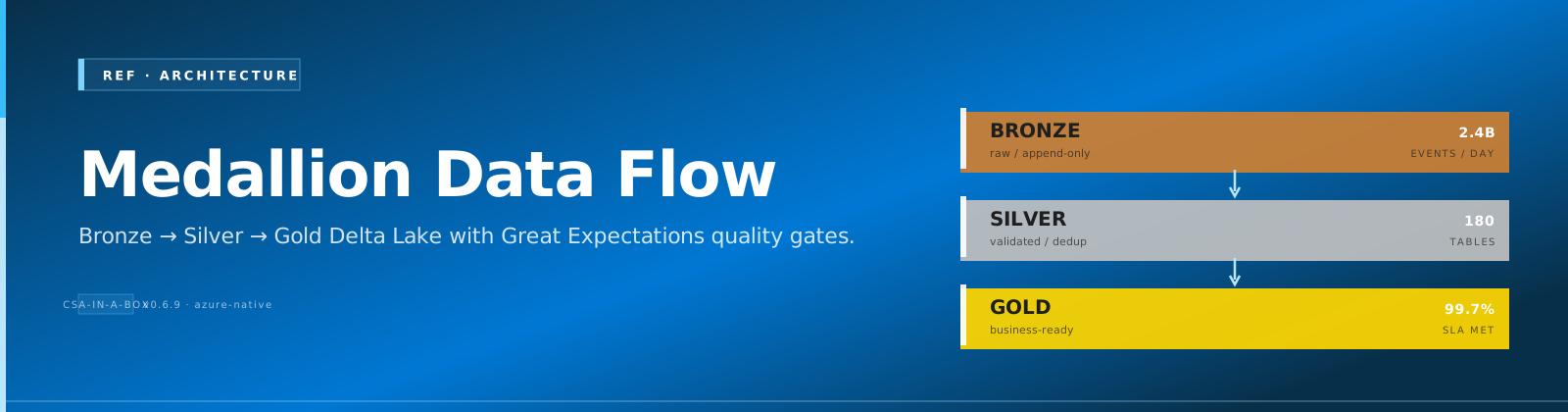
Reference Architecture — Data Flow (Medallion)
Comparative positioning note
This document is written from the perspective of Microsoft Azure, Cloud Scale Analytics, and CSA Loom. Any description of third-party or competing products, services, pricing, or capabilities is derived from publicly available documentation and sources believed accurate at the time of writing, and is provided for general comparison only. We do not claim expertise in, or authority over, any non-Microsoft product or service; the respective vendor's official documentation is the authoritative source for their offerings, which may change over time. Nothing here is intended to disparage any vendor — where a competing product has genuine advantages, we aim to note them honestly. Verify all third-party details against the vendor's current official documentation before making decisions.
TL;DR: Bronze stores raw, silver stores cleaned-and-conformed, gold stores business-ready. Every transition is a dbt (or Spark) job with tests, version control, and lineage to Purview. Don't skip layers; don't denormalize bronze.
The problem
A real analytics platform ingests from dozens of source systems with different schemas, qualities, freshnesses, and retention requirements — and serves dozens of consumer surfaces (BI, APIs, ML, AI agents, regulators) with conflicting needs. Without a strict layered approach, you end up with a god-mode pipeline that nobody can reason about and a single bad deploy breaks every dashboard.
Architecture
flowchart LR
    subgraph Sources[Source Systems]
        S1[OLTP DBs<br/>SQL Server, Cosmos, RDS]
        S2[SaaS APIs<br/>Salesforce, ServiceNow]
        S3[Files<br/>CSV/Parquet/JSON drops]
        S4[Streams<br/>IoT, Kafka, Event Hubs]
        S5[On-prem<br/>Teradata, Hadoop, mainframe]
    end

    subgraph Ingest[Ingestion]
        ADF[Azure Data Factory<br/>+ Self-Hosted IR]
        EH[Event Hubs<br/>+ Capture]
        ASA[Stream Analytics<br/>or Fabric RTI]
    end

    subgraph Bronze[🥉 BRONZE — Raw / Immutable]
        B1[(ADLS Gen2<br/>Delta tables<br/>partitioned by ingest_date)]
        B2[Schema = source schema<br/>+ ingestion metadata]
        B3[Retention: 7-90 days hot,<br/>archive cold]
    end

    subgraph Silver[🥈 SILVER — Cleaned / Conformed]
        Sv1[(Delta tables<br/>SCD2 where needed)]
        Sv2[Type-cast, deduped,<br/>nulls explicit, PII tagged]
        Sv3[Conformed dimensions<br/>+ surrogate keys]
        Sv4[Quality tests:<br/>Great Expectations<br/>+ dbt tests]
    end

    subgraph Gold[🥇 GOLD — Business / Aggregated]
        G1[(Star/snowflake schemas<br/>or wide flat tables)]
        G2[Business metrics<br/>+ KPIs]
        G3[ML feature tables]
        G4[Aggregates for BI]
    end

    subgraph Serve[Serving]
        BI[Power BI<br/>Direct Lake / Import]
        DAB[Data API Builder<br/>REST + GraphQL]
        AOAI[AI Agents<br/>RAG/GraphRAG]
        ML[Azure ML<br/>training + inference]
        Export[Reverse-ETL<br/>Salesforce, Sheets]
    end

    subgraph Governance[Cross-Cutting]
        Purv[Microsoft Purview<br/>catalog + lineage]
        KV[Key Vault<br/>secrets]
        LA[Log Analytics<br/>+ App Insights]
        Contracts[YAML data product<br/>contracts in git]
    end

    S1 --> ADF
    S2 --> ADF
    S3 --> ADF
    S4 --> EH
    S4 --> ASA
    S5 --> ADF

    ADF --> B1
    EH --> B1
    ASA --> B1

    B1 -- dbt run --> Sv1
    Sv1 -- dbt run --> G1

    G1 --> BI
    G1 --> DAB
    G1 --> AOAI
    G1 --> ML
    G1 --> Export

    Purv -. scans .-> B1
    Purv -. scans .-> Sv1
    Purv -. scans .-> G1
    Contracts -. validates .-> Sv1
    Contracts -. validates .-> G1
    KV -. secrets .-> ADF
    KV -. secrets .-> ASA
    KV -. secrets .-> AOAI
    LA -. logs .-> ADF
    LA -. logs .-> ASA
    LA -. logs .-> Sv1
Layer rules
Bronze (raw / immutable)
| Rule | Why |
|---|---|
Schema = source schema, plus 4 metadata cols (_ingest_ts, _source, _batch_id, _file_uri) | If source changes, you have what you need to replay |
| Append-only, never updated in place | Bronze is your backup-of-record; deletes/updates compromise replay |
| Partitioned by ingest_date (not source date) | Operational pruning matches operational queries |
| Stored as Delta (not raw Parquet/CSV) | ACID + time travel + cheap scans |
| No PII redaction at this layer | Source-system fidelity; redaction happens entering silver |
| Lifecycle: 7-90 days hot tier, then cool/archive | Hot Bronze is expensive; most queries hit silver/gold |
Silver (cleaned / conformed)
| Rule | Why |
|---|---|
Types are correct (no string-encoded ints, no null strings) | Downstream code can trust the schema |
Nulls are explicit and modeled (is_known, unknown_reason) | Telling "missing" from "actively unknown" matters for ML and reporting |
| PII is tagged (Purview classification or column-level tag) | Compliance can audit access |
| SCD2 where business semantics demand it (customers, products, orgs) | Historical reporting works |
Conformed dimensions (one canonical dim_customer, not 5) | Joining across domains is possible |
| Surrogate keys generated, natural keys preserved | Schema changes upstream don't break downstream joins |
| Quality tests are mandatory (not "we'll add them later") | Silver is what gold trusts |
Gold (business / aggregated)
| Rule | Why |
|---|---|
| Business-friendly column names, not source-system jargon | Analysts reading SQL shouldn't need a dictionary |
| Wide flat or star schema, optimized for the consumer | Direct Lake / Power BI prefers star; ML often prefers wide flat |
| Definitions match official metric definitions (and link to them in dbt docs) | "Revenue" means the same thing in every dashboard |
Aggregations are explicit (daily_sales_by_region, not sales) | Naming reveals the grain |
| Slowly-changing where business semantics demand, snapshotted otherwise | Predictable rebuild semantics |
| Each gold table maps to ≥ 1 published data product contract | Consumers can rely on schema + SLA |
Where each Azure service fits
| Service | Layer | Purpose |
|---|---|---|
| Azure Data Factory | Sources → Bronze | Batch ingestion, orchestration, self-hosted IR for on-prem |
| Event Hubs + Capture | Sources → Bronze | Streaming ingestion with auto-archive to ADLS |
| Stream Analytics / Fabric RTI | Sources → Bronze (or directly to Silver for streaming gold) | Stream processing, windowing, anomaly detection |
| ADLS Gen2 | Bronze, Silver, Gold | Object store for all Delta tables |
| Delta Lake | Bronze, Silver, Gold | Storage format — ACID + time travel + Z-order |
| Databricks | Silver, Gold | Spark-based dbt runs, complex transformations, ML feature engineering |
| Synapse Spark / Serverless SQL | Silver, Gold | Alternative compute, especially for ad-hoc analyst SQL over Bronze |
| Microsoft Fabric Lakehouse | Silver, Gold | Strategic forward path — Direct Lake for BI, KQL for streaming |
| Microsoft Purview | Cross-cutting | Catalog + lineage + classification + access |
| Key Vault | Cross-cutting | Secrets — never in pipelines or notebooks |
| Log Analytics + App Insights | Cross-cutting | Pipeline runs, query perf, error rates |
| Power BI / Fabric | Gold → Serve | BI dashboards, semantic models |
| Data API Builder | Gold → Serve | Auto-generated REST + GraphQL over gold tables |
| Azure OpenAI + AI Search | Gold → Serve | RAG / agents grounded in gold |
Lineage
Every transformation runs in dbt (with the exception of Spark-only workloads which run in Databricks notebooks). dbt + Purview together give you:
- Column-level lineage from bronze → silver → gold
- "What does this column mean" docs auto-generated from
metaanddescription - Upstream/downstream impact analysis when planning a schema change
- Data freshness SLAs automated as
dbt source freshness
See ADR 0013 — dbt as Canonical Transformation for the rationale.
Trade-offs
✅ Why this pattern wins
- Each layer has one job → easier to reason about, easier to debug
- Bronze immutability = full replay any time
- Silver conformance = downstream consumers trust their inputs
- Gold business definitions = "the report says X" matches "the API returns X"
- dbt + tests + Purview = real lineage, not Confluence diagrams
⚠️ What you give up
- Three layers means 3× storage. Mitigate with tier'd lifecycle on bronze.
- Latency from raw to gold can be 15-60 minutes for batch. For sub-minute, use a separate streaming-gold path (Fabric RTI / KQL DB).
- Initial setup is heavier than "one giant ETL job." Pays back at scale 2; doesn't pay back at scale 0.5.
- Discipline is required. Skipping silver "just for one report" creates the spaghetti you tried to avoid.
Variants
| Scenario | Variant |
|---|---|
| Streaming-first | Bronze becomes Event Hub Capture; silver/gold built in Fabric RTI (Eventhouse / KQL DB). See Patterns — Streaming & CDC |
| CDC-heavy | Add a CDC service (Debezium → Event Hubs, or Synapse Link for SQL) before Bronze; bronze stores the changelog as Delta CDC |
| ML-heavy | Add a Feature Store (Databricks FS or Azure ML FS) between Silver and Gold; ML training reads from the feature store, not gold directly |
| AI-heavy | Gold tables get vectorized into AI Search indexes; agents/RAG read from indexes, not gold tables directly |
| Regulated (HIPAA, PCI) | Same pattern; add encryption-at-rest with CMK, column-level encryption for sensitive cols, separate "PII silver" with stricter RBAC |