Tutorial: KQL database editor
CSA Loom
kql-databaseeditor — verified working against a live console by the UAT harness on 2026-07-01.
Open the editor
- Sign in to your CSA Loom Console (for example
https://<your-console-host>). - Open or create a workspace from the Workspaces page.
- Click + New item and choose KQL database from the catalog.
- The editor opens at
/items/kql-database/<id>:
What this editor does
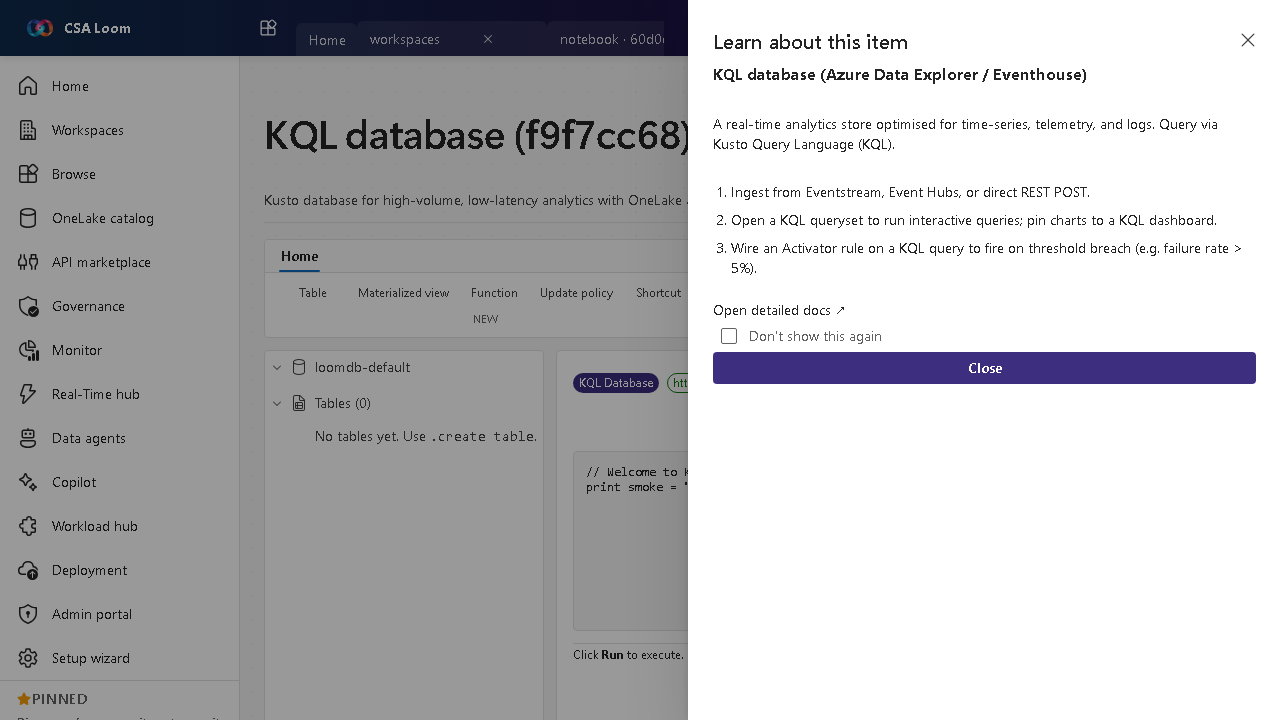
A KQL database is a Kusto store for high-volume, low-latency analytics over time-series, telemetry, and logs. In Loom it is Azure-native: it runs on the shared Loom Azure Data Explorer (ADX) cluster and is queried with KQL — no Microsoft Fabric or OneLake required.
Getting started
- Ingest data — Bring data in from an Eventstream, Event Hubs, or a direct REST POST.
- Query with KQL — Open a KQL queryset to run interactive queries and pin charts to a Real-Time dashboard.
- Wire an Activator rule — Attach an Activator on a KQL query to fire on a threshold breach such as failure rate over 5 percent.
- Detect anomalies / Forecast — Run native-KQL time-series ML over any table from the ribbon's Detect anomalies / Forecast actions —
series_decompose_anomalies/series_decompose_forecastover amake-series— then Add as tile to pin the result to a Real-Time dashboard. No external ML service required. - Make data available as Delta — Configure ADX continuous export (or an external table) to land the same data as Delta in ADLS Gen2, so it's queryable alongside lakehouses — no OneLake needed.
Learn more
- Microsoft Learn reference: https://learn.microsoft.com/azure/data-explorer/data-explorer-overview
Verified by the UAT harness
- Tested at:
2026-05-26T13:51:24.555Z - Verdict: A (renders cleanly, real backend responded)
- Test source:
apps/fiab-console/e2e/editors.uat.ts