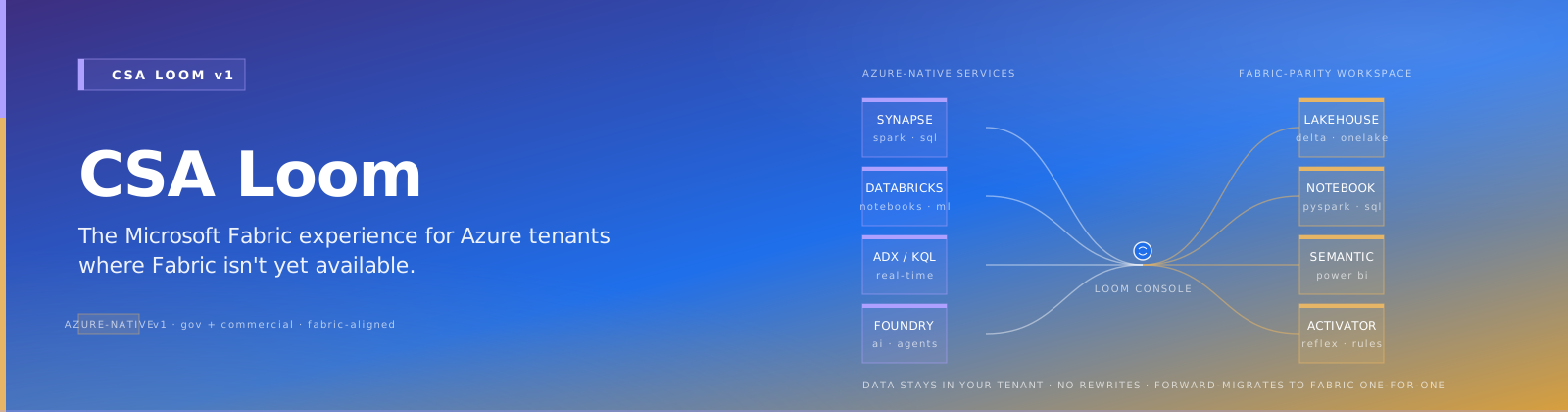
Loom Variable Library Editor — Fabric-parity build spec
Comparative positioning note
This document is written from the perspective of Microsoft Azure, Cloud Scale Analytics, and CSA Loom. Any description of third-party or competing products, services, pricing, or capabilities is derived from publicly available documentation and sources believed accurate at the time of writing, and is provided for general comparison only. We do not claim expertise in, or authority over, any non-Microsoft product or service; the respective vendor's official documentation is the authoritative source for their offerings, which may change over time. Nothing here is intended to disparage any vendor — where a competing product has genuine advantages, we aim to note them honestly. Verify all third-party details against the vendor's current official documentation before making decisions.
Reference: Microsoft Learn — What is a variable library? (
/fabric/cicd/variable-library/variable-library-overview), Variable types in variable libraries (/fabric/cicd/variable-library/variable-types), Value-sets in variable libraries (/fabric/cicd/variable-library/value-sets), Item reference variable type (preview) (/fabric/cicd/variable-library/item-reference-variable-type), Variable library permissions (/fabric/cicd/variable-library/variable-library-permissions), Variable library CI/CD (/fabric/cicd/variable-library/variable-library-cicd), Variable library definition (/rest/api/fabric/articles/item-management/definitions/variable-library-definition), Automate variable libraries by using APIs (/fabric/cicd/variable-library/automate-variable-library). Documented 2026-05-26 by catalog agent.
Overview
A Fabric Variable Library is a workspace-scoped item that holds named configuration parameters consumed by other items in the same workspace — pipelines, notebooks, dataflows Gen2, shortcuts, and Spark Job Definitions. The library solves two problems: (1) share a single configuration value across many items in a workspace (one shortcut data-source URL, many lakehouses point at it), and (2) vary that value by deployment stage (dev/test/prod) without editing the consuming items. Exactly one value set is "active" per workspace at runtime; deployment pipelines flip the active set as part of promoting to the next stage.
The library is created from New item → Develop data → Variable library. It opens with a left-rail of value sets (Default, plus any alternative sets) and a central variables grid. A user can switch the displayed value set, edit per-variable values for that set, and mark one as the workspace's active set.
Fabric Variable Library UX inventory
Page chrome
- Page title shows the library name (editable inline)
- Capacity badge, workspace breadcrumb, global action bar
- Top-right: Save, Share, Comments, Settings (controls active value set and item-level options)
Left-rail — value sets
| Element | Purpose |
|---|---|
Default value set (always present, can't be renamed/deleted) | Holds the canonical value for each variable |
+ New value set button | Creates an alternative set (e.g. dev, test, prod) |
| Per-set context menu | Rename · Delete · Set as active for this workspace |
| Active-set chip | Marks which value set the workspace currently resolves at runtime |
Naming rules: not empty, no leading/trailing spaces, starts with letter or underscore, only letters/digits/underscores/hyphens, ≤256 chars, unique within library.
Main grid — variables
| Column | Behavior |
|---|---|
| Name | Variable name, unique within library, case-sensitive |
| Type | Dropdown: String · Integer · Number · Boolean · DateTime (ISO 8601) · Guid · Item reference (preview, advanced) · Connection reference (preview, advanced) |
Value ({activeSetName}) | Editor varies by type — text input, number spinner, toggle, ISO datetime picker, GUID input, or "..." picker for item/connection reference |
| Note | Free-form description, ≤2,048 chars |
| Row actions | Delete · Duplicate |
A consent dialog appears when changing the type of a variable that already has values — the change resets all values across all sets and is flagged as a potential breaking change for consumers.
Item-reference picker (advanced type, preview)
Opens a dialog listing every Fabric item the caller has read on, scoped by left-side workspace tree + top-right item-type filter. Selecting an item stores { workspaceId, itemId }. Different value sets may point to different items of the same type (e.g. Lakehouse_Dev vs Lakehouse_Prod).
Connection-reference picker (advanced type, preview)
Same pattern but stores a connection ID for an external data connection (Snowflake, Azure SQL, etc.) so consumers can resolve credentials without embedding strings.
Value set tabs (top of grid)
- One tab per value set
- Active-set tab is highlighted with an "Active" badge
- Empty cells in an alternative set inherit from
Default; only diverging values are persisted in that set's JSON file
Settings flyout
- Active value set (per workspace) — radio list of all sets
- Read-only from notebooks banner (informational — notebooks consume but can't mutate)
- Size limits indicator — up to 1,000 variables and 1,000 value sets per library; max 10,000 cells; 1 MB total payload
Downstream consumption surfaces
| Consumer | How it references a variable |
|---|---|
| Data Pipelines | Library variables tab → + New → pick {library, variable, type}; reference as @pipeline().libraryVariables.NAME |
| Notebooks | notebookutils.variableLibrary.getLibrary("name").variableName (Python/Scala/R) or notebookutils.variableLibrary.get("$(/**/lib/var)") |
| Dataflow Gen2 (CI/CD) | Reference inside mashup.pq only; basic types only; no connection mutation; no schema-mapping mutation |
| Shortcuts | Manage shortcut → Edit target → Assign variable to a property (connection ID, target location) |
Permissions
Aligned with workspace roles — Viewer reads, Contributor edits, Member/Admin edit + reshare. Item-reference variables additionally require read permission on the referenced item; missing perms don't fail consumers but suppress extended metadata. There's no per-variable permission — the library is the unit.
Git integration
On commit, the library serializes as a folder containing: - variables.json — variable definitions + default values - settings.json — library-level settings (active value set name, etc.) - valueSets/{name}.json — one file per alternative set, containing only diverging values - .platform — auto-generated item-platform metadata
What Loom has today
Loom's VariableLibraryEditor (apps/fiab-console/lib/editors/phase4-editors.tsx line 552) is C-grade — renders, saves to Cosmos, but doesn't match Fabric semantics:
- Variable types limited to
string | number | bool | secret-ref— missingInteger,DateTime,Guid,ItemReference,ConnectionReference - Value sets hard-coded to four tabs:
default | dev | test | prod— no rename, no add, no delete, no per-workspace "active" toggle - No
notecolumn on variables - No per-variable type-change consent dialog
- No item-reference picker; no connection-reference picker
- No size-limit enforcement, no settings flyout
- No git-shape serialization (Loom persists a single Cosmos doc — not the
variables.json/valueSets/{name}.jsonshape) - No downstream consumption wiring — Loom's notebook, data-pipeline, and dataflow editors don't have a
Library variablestab to bind a variable to an activity input - Single
defaultfield on each variable plus optionaldev/test/prodstrings — values are always strings even forboolandnumber
Gaps for parity
- Expand the type system to the seven Fabric types:
String,Integer,Number,Boolean,DateTime,Guid,ItemReference,ConnectionReference. Render type-specific editors (number spinner, toggle, ISO datetime, GUID input). - Dynamic value sets — remove the hard-coded
dev/test/prodtabs. Add+ New value setbutton. Per-tab context menu: Rename, Delete (blocked if active), Set as active. Persist the workspace's active set on the workspace document (workspace.state.activeValueSetByLibraryId[libraryId] = setName). - Active-set indicator — chip on the active value-set tab + Settings flyout radio list to switch.
Notecolumn — 2,048-char description per variable.- Type-change consent dialog — when a user changes a variable's type and values exist, prompt + reset all sets' values for that variable.
- Item-reference picker — dialog listing Loom catalog items, workspace tree on left, item-type filter on right. Persist
{ workspaceId, itemId }. Validate read-perm on save. - Connection-reference picker — list APIM/data-product connections + external connections registered in Loom. Persist connection ID.
- Size limits — enforce ≤1,000 variables, ≤1,000 value sets, ≤10,000 cells, ≤1 MB payload; surface a MessageBar at 80% capacity.
- Git-shape serialization — on save, project Cosmos doc into the four-file structure (
variables.json,settings.json,valueSets/{name}.json,.platform) so a future Fabric-Git mirror can round-trip. - Downstream
Library variablespanel in consuming editors (pipeline, notebook, dataflow, SJD) — picker that binds a consumer parameter to{library, variable}. At run time, the executor resolves through the workspace's active value set. - Notebook NotebookUtils stub — emit a
notebookutils.variableLibrary.getLibrary(name)shim in the Loom-managed Spark session that hits a Loom resolve endpoint instead of Fabric. - Permission enforcement — restrict edit operations to Contributor+, surface missing item-reference reads on the row.
- Naming validation — enforce the value-set naming rules and uniqueness checks client-side and server-side.
Backend mapping
| Fabric concept | Loom backend |
|---|---|
| Create variable library | ✅ /api/items/variable-library (Cosmos CRUD via item-crud lib) |
| Get / Update library | ✅ /api/items/variable-library/[id] GET / PUT |
| Variables collection | EXTEND state.variables[] = { name, type, note, defaultValue } — type widened to the seven Fabric types |
| Value sets | NEW state.valueSets = { Default: {...overrides}, dev: {...overrides}, ... } — Default always present; only diverging values stored in alternative sets |
| Active value set (per workspace) | NEW persist workspace.state.activeValueSet[libraryId] = setName on the workspace document |
| Item reference value | NEW stored as { workspaceId, itemId }; picker reads from Loom catalog /api/items/list |
| Connection reference value | NEW stored as connection ID; picker reads from APIM connections + external-connection registry |
| Resolve variable at runtime | NEW GET /api/items/variable-library/[id]/resolve?valueSet={name} returns { name: resolvedValue } map for a given set (defaults to active set) |
| Bind consumer to variable | NEW consumers persist { libraryId, variableName } references; resolve at submit/run time |
| Git serialization | NEW GET .../[id]/git-shape projects Cosmos doc to the four-file structure (read-only export for now); roundtrip deferred |
| Permissions | EXTEND Loom RBAC — viewer/contributor/member/admin map to existing workspace-role gate |
| Size limits | NEW server-side validation in PUT handler |
Required Azure resources
- ✅ Loom Cosmos
itemscontainer (already) - ✅ Loom workspace document (already) — needs
state.activeValueSetsub-doc - NEW No new Azure resource needed for v1 — variable resolution is in-process on the BFF. v2 (when notebook/Spark session integration lands) needs the same Spark/Synapse infra Loom already provisions.
- Optional Azure Key Vault — if
ConnectionReferenceresolves to a secret-bearing connection, the BFF can mint a KV-backed reference instead of returning a raw string. KV is already in the Loom bicep.
Estimated effort
2 focused sessions.
- Session 1 (~2.5h): Backend — widen type system, dynamic value sets, active-set persistence on workspace, item-reference + connection-reference resolvers, size-limit validation, resolve endpoint, git-shape export. Cosmos schema migration to
valueSetsmap. - Session 2 (~2.5h): Frontend rebuild — dynamic value-set tabs (add/rename/delete/active toggle), type-specific value editors, item-reference picker dialog, connection-reference picker dialog, consent dialog on type change, settings flyout, downstream
Library variablestab stub in pipeline/notebook editors. UAT harness coverage + A11y audit.
Drops Loom Variable Library from C (saves, but partial type system + hard-coded sets) to A (full Fabric type fidelity, dynamic sets, active-set switching, downstream binding).