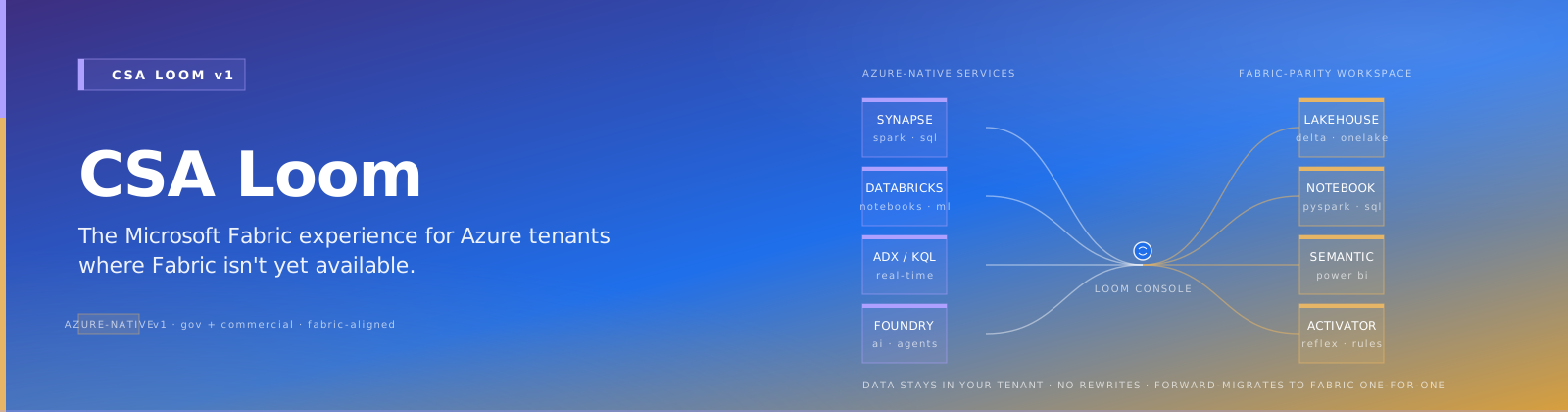
Runbook — Forward migrate to Microsoft Fabric
When to use
Microsoft Fabric has reached GA in your audit boundary (verify via Azure Government product GA roadmap). You're ready to migrate workloads from Loom to Fabric.
Pre-migration checklist
| Item | Verify |
|---|---|
| Fabric GA in target boundary | Microsoft Learn audit-scope page |
| F-SKU Fabric capacity provisioned | Fabric Admin portal |
| Power BI Premium F-SKU (current Loom) | matches Fabric capacity tier |
| Loom is on v1.1+ | fiab-migrate CLI requires v1.1 |
| Git repo for notebooks + TMDL + rules + agent configs | source-of-truth for migration |
| OneLake shortcut quota | tenant-level shortcut limits |
| Test workspace in Fabric | for parallel-run validation |
Procedure
Step 1 — Snapshot the Loom estate
Captures: - Workspace definitions - Domain hierarchy - Activator rule definitions - Mirroring configs - Data Agent configs - TMDL semantic-model files (from Git) - Lineage exports from Purview - Sensitivity-label mappings
Step 2 — Plan migration
fiab-migrate plan \
  --snapshot ./loom-state-20260901.json \
  --target-fabric-tenant <TENANT-ID> \
  --target-capacity F128 \
  --output ./migration-plan.json
Plan output: - Per-item verdict (Direct / Manual / Skip) - Estimated migration effort per item - Dependency order (some items must migrate before others)
Review with stakeholders before proceeding.
Step 3 — Execute (dry-run first)
# Dry-run — shows what would happen
fiab-migrate execute --plan ./migration-plan.json --dry-run

# Commit
fiab-migrate execute --plan ./migration-plan.json --commit
Execution order (default): 1. Create Fabric workspaces (mirror Loom workspaces 1:1) 2. Create OneLake shortcuts pointing at Loom ADLS Gen2 paths 3. Import Activator rules → Fabric Reflex 4. Import Data Agents → Fabric Data Agents REST API 5. Re-author TMDL semantic models for Direct Lake on OneLake 6. Re-bind Power BI reports to new semantic models 7. Re-deploy notebooks via Git folder bind to Fabric workspace 8. Migrate Mirroring sources per-source (some switch to Fabric Mirroring; others stay on Loom)
Step 4 — Verify
Verifies: - Workspace counts match - Sample queries return same results across both systems - Activator rules fire equivalently - Data Agent answers benchmark questions identically - Semantic model query latency meets SLA on Fabric
Step 5 — Cutover
For each workload: 1. Point downstream consumers (BI clients, scheduled jobs, ETL pipelines) at the Fabric workspace 2. Side-by-side run for 30-90 days (per workload risk) 3. Monitor parallel-run diff; investigate any divergence 4. Decommission Loom workload after clean parallel-run period
Step 6 — Decommission Loom
After all workloads migrated: - Stop Loom Console + parity services - Tear down Loom Admin Plane RG - Keep ADLS Gen2 lakehouses (now accessed via OneLake shortcut from Fabric) - Keep Purview (Fabric uses the same Purview)
Hybrid run pattern
Most customers don't fully decommission Loom. Hybrid pattern: - Migrate primary workloads to Fabric - Keep Loom for workloads Fabric doesn't yet cover (e.g., custom Activator rules using primitives Fabric Reflex doesn't support) - Run hybrid indefinitely
Rollback
If a workload migration causes issues: 1. Stop directing traffic at Fabric for that workload 2. Re-point at original Loom workspace (still operational) 3. Investigate; fix; retry migration
Related
- ADR: fiab-0012 Forward migration
- Operations: Forward to Fabric
- Use case: Hybrid topology