Home > Docs > Architecture Decision Records
Architecture Decision Records (ADRs)
Comparative positioning note
This document is written from the perspective of Microsoft Azure, Cloud Scale Analytics, and CSA Loom. Any description of third-party or competing products, services, pricing, or capabilities is derived from publicly available documentation and sources believed accurate at the time of writing, and is provided for general comparison only. We do not claim expertise in, or authority over, any non-Microsoft product or service; the respective vendor's official documentation is the authoritative source for their offerings, which may change over time. Nothing here is intended to disparage any vendor — where a competing product has genuine advantages, we aim to note them honestly. Verify all third-party details against the vendor's current official documentation before making decisions.
Architects, platform engineers, auditors, federal customers preparing ATO packages
Note
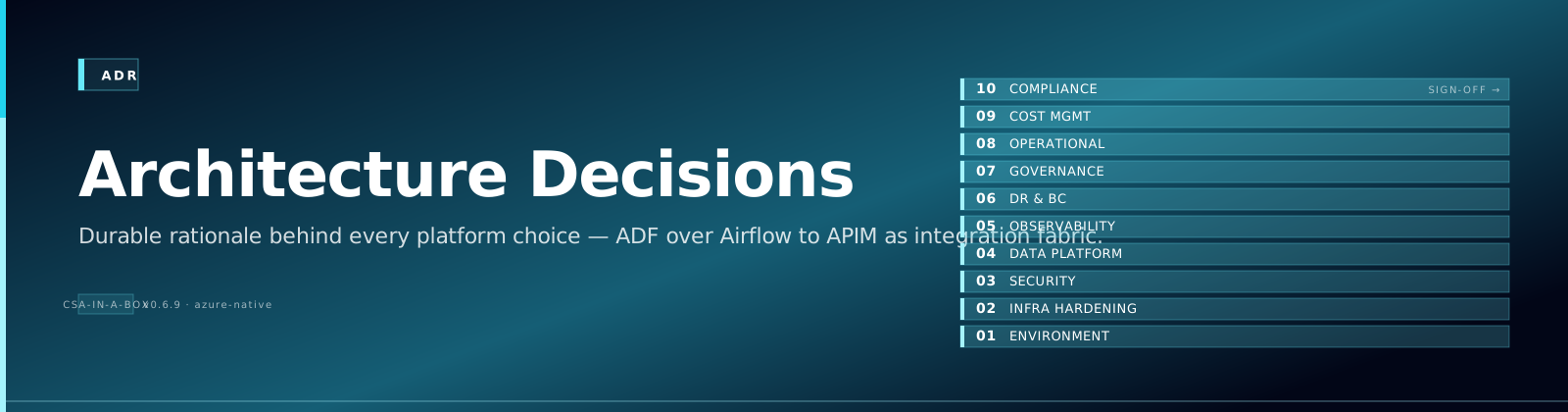
Quick Summary: This directory captures the why behind the core technology choices in CSA-in-a-Box. Each record follows the MADR format. Records are immutable once accepted — revisions happen by adding a superseding ADR with an incremented number.
Index
| # | Title | Status | Date | One-line summary |
|---|---|---|---|---|
| 0001 | ADF (+ dbt) over Airflow as primary orchestration | accepted | 2026-04-19 | Managed Gov PaaS orchestrator with SQL-native transforms and Purview lineage. |
| 0002 | Azure Databricks over open-source Spark-on-AKS for heavy compute | accepted | 2026-04-19 | Managed Spark + Unity Catalog + Photon in Gov; OSS Spark on AKS is too operationally expensive. |
| 0003 | Delta Lake over Iceberg and Parquet as canonical table format | accepted | 2026-04-19 | Delta is Databricks- and Fabric-OneLake-native with ACID MERGE and Purview lineage. |
| 0004 | Bicep over Terraform as primary IaC (for now; Terraform path planned) | accepted | 2026-04-19 | Day-one Azure API coverage, no state-file custody, aligned to Enterprise-Scale Landing Zone. |
| 0005 | Event Hubs over open-source Kafka for streaming ingestion | accepted | 2026-04-19 | Managed PaaS broker with Kafka-protocol endpoint, Capture to Bronze, Gov-GA. |
| 0006 | Microsoft Purview over Apache Atlas for data catalog and lineage | accepted | 2026-04-19 | Gov-GA catalog with MIP label propagation and native Azure scanners. |
| 0007 | Azure OpenAI over self-hosted LLM for AI integration | accepted | 2026-04-19 | FedRAMP High inference endpoint with Private Endpoints; self-hosted fallback remains open. |
| 0008 | dbt Core over dbt Cloud for transformations | accepted | 2026-04-19 | Open-source CLI keeps metadata inside the tenant boundary; no SaaS FedRAMP surface to clear. |
| 0009 | SQLite (portal dev) → Postgres (portal prod) phased database strategy | accepted | 2026-04-19 | Zero-install dev loop; managed Postgres PaaS in Gov for production durability. |
| 0010 | Microsoft Fabric as strategic target; current build as Fabric-parity on Azure PaaS | accepted | 2026-04-19 | Every primitive (Delta, Purview, dbt, Spark) maps forward into Fabric when Gov GA lands. |
| 0011 | Multi-cloud scope: OneLake shortcuts + Purview scans only; defer federated compute | accepted | 2026-04-20 | Honest scope — ships governance story for S3/GCS/Snowflake/BigQuery/Redshift; defers cross-cloud compute. |
| 0012 | Data-mesh federation model: contract-driven, Purview-governed, portal-surfaced | accepted | 2026-04-20 | Contract-first in-monorepo mesh — contract.yaml → CI validates → Purview registers → marketplace surfaces; per-domain CODEOWNERS. |
| 0013 | dbt Core as the canonical transformation layer | accepted | 2026-04-20 | Deduplicates Bronze → Silver → Gold logic — dbt owns medallion transforms; Spark notebooks are deprecated for that path and reserved for exploration / provisioning / ML. |
| 0014 | MSAL Backend-for-Frontend (BFF) auth pattern | accepted | 2026-04-20 | Phased CSA-0020 remediation — Phase 1 strict CSP + Trusted Types on the SPA; Phase 2 server-side Auth Code + PKCE flow with an httpOnly csa_sid session cookie. Tokens never reach the browser. |
| 0015 | Portal persistence: StoreBackend protocol + SQLite (dev) + Postgres Flexible Server (prod) | accepted | 2026-04-20 | CSA-0046 implementation — dual-backend Protocol, managed-identity AAD tokens for Azure Database for PostgreSQL Flexible Server, Alembic migrations, SQLite kept as the zero-install dev loop. |
| 0016 | Async StoreBackend canonical; sync layer transitional | accepted | 2026-04-20 | CSA-0046 follow-on — AsyncStoreBackend Protocol + AsyncSqliteStore (aiosqlite) + AsyncPostgresStore (asyncpg + SQLAlchemy AsyncEngine); FastAPI routers go async def via Depends; migration CLI ships; sync layer kept one release for backward compat. |
| 0017 | RAG pipeline service-layer extraction (CSA-0133) | accepted | 2026-04-20 | Split the 1,285-line pipeline.py god-class into six submodules behind a RAGService facade; legacy pipeline module is preserved as a compat shim for one release. |
| 0018 | Fabric Real-Time Intelligence adapter (pre-GA, env-gated) | accepted | 2026-04-20 | CSA-0137 follow-on — ship FabricRTISource today behind FABRIC_RTI_ENABLED; raise-with-pointer when the flag is unset so Gov tenants fail loudly until RTI Gov-GA lands. |
| 0019 | BFF reverse-proxy + HMAC-sealed MSAL token cache | accepted | 2026-04-20 | CSA-0020 Phase 3 — mount /api/* proxy behind BFF_PROXY_ENABLED; persist MSAL SerializableTokenCache to Redis with HMAC sealing so a Redis compromise is tamper-evident. Completes AQ-0012's long-term column — tokens never reach the browser. |
| 0020 | Portal observability (OTel + Prometheus) and per-principal rate limiting | accepted | 2026-04-20 | CSA-0042 / CSA-0061 / CSA-0030 — OpenTelemetry with OTLP exporter + W3C trace-context, Prometheus /metrics on a private registry, per-principal sliding-window rate limiter on every write endpoint. All three feature-flagged and lazy-imported so the portal still boots without the optional extras. |
| 0021 | Two rate limiters are intentional, not duplicates | accepted | 2026-04-23 | The portal write-path limiter (per-principal, sliding-window, observability) and the AI router limiter (per-IP, fixed-window, abuse-defense) protect orthogonal failure modes; do not collapse them. |
| 0022 | Copilot surfaces vs. docs-site widget are intentional, not duplicates | accepted | 2026-04-23 | The Azure Function (func-csa-inabox-copilot-fg) is the production chat backend; the docs-site widget (docs/javascripts/copilot-chat.js) is a thin client that talks to it. Two artifacts, one service. |
| 0023 | release-please PRs auto-pass required status checks | accepted | 2026-04-27 | GITHUB_TOKEN-created PRs don't trigger downstream workflows, leaving release PRs permanently BLOCKED. The release-please workflow itself posts success commit statuses for each required check on the PR head SHA, gated on a strict allow-list of three version-metadata files. |
Format
All records follow MADR 3.x. Each ADR has frontmatter (status, date, deciders, consulted, informed) and these sections:
- Context and Problem Statement
- Decision Drivers
- Considered Options
- Decision Outcome
- Consequences (positive and negative)
- Pros and Cons of the Options
- Validation (how we'll know the decision was right)
- References (decision trees, concrete code, compliance-control mappings)
Status lifecycle
- proposed — open for comment on a PR.
- accepted — merged; the decision is in effect.
- deprecated — no longer in effect; no replacement chosen yet.
- superseded by NNNN — replaced by a newer ADR. The superseding ADR states what changed and why; the superseded ADR stays on disk as history.
ADRs are immutable once accepted. Corrections are made by authoring a new ADR that supersedes the old one. Typos and broken links may be fixed without superseding.
Authoring a new ADR
- Copy
0001-adf-dbt-over-airflow.mdas a template. - Increment the number (4-digit, zero-padded).
- Slugify the title (
NNNN-short-slug.md). - Keep the frontmatter + section order identical to 0001.
- Cite at least one concrete artifact in the repo and at least one compliance-control mapping from
governance/compliance/*.yamlwhen the decision maps to a control family. - Link forward to any relevant decision tree under
docs/decisions/. - Open a PR. Reviewers from security, governance, and dev-loop are expected. Status stays
proposeduntil the PR merges.
Cross-references
- Decision trees (scenario-driven, "which option for what situation"):
docs/decisions/. - Architecture reference (current-stack narrative):
docs/ARCHITECTURE.md. - Compliance control matrices:
governance/compliance/—nist-800-53-rev5.yaml,hipaa-security-rule.yaml,cmmc-2.0-l2.yaml.
Upstream references
- MADR documentation
- adr-tools (CLI for managing ADRs)
- Michael Nygard's original ADR essay: "Documenting Architecture Decisions"