What is CSA Loom
The problem
Microsoft Fabric is the strategic unified analytics SaaS platform. As of 2026-05-22, Fabric is not generally available in any US Government cloud:
| Cloud / boundary | Microsoft Fabric (F-SKU platform) | Power BI (component) | CSA Loom |
|---|---|---|---|
| Azure Commercial | GA | GA | GA |
| GCC (Azure Commercial under M365 GCC identity — most GCC customers run here) | GA via Commercial regions; identity flows need Loom bridge | GA — P-SKU only (no F-SKU in GCC) | GA |
| Azure Government — FedRAMP High (GCC-pair Azure Gov regions) | Forecasted (no public quarter) | GA — P-SKU only | Available v1 |
| Azure Government — DoD IL4 (GCC-High) | Forecasted (no public quarter) | GA — F-SKU supported | Available v1 |
| Azure Government — DoD IL5 | Forecasted (no public quarter) | GA — F-SKU supported | v1.1 |
| Azure Government Secret — DoD IL6 | Forecasted | GA in specific boundaries | Not authorized (out of scope) |
Why GCC = GA for Loom
GCC ("Government Community Cloud") customers run on Azure Commercial regions under an M365 GCC identity. Fabric is Commercial-GA, but the tenant SP flows Fabric needs are gated by GCC identity rules. Loom is the bridge — the post-deploy bootstrap issues the AAD app-roles the GCC tenant requires, and the same Bicep deploys against the same regions. Both Azure Commercial and GCC are GA for CSA Loom.
Federal civilian, DoD, intelligence-community, ITAR-bound, and many state and local-government customers — every customer that needs FedRAMP High, IL4, IL5, ITAR, CJIS, IRS 1075, CMMC L2/L3, or sovereignty controls — cannot adopt Fabric today, and Microsoft has not published a commitment date for Fabric GA in Gov.
What CSA Loom is
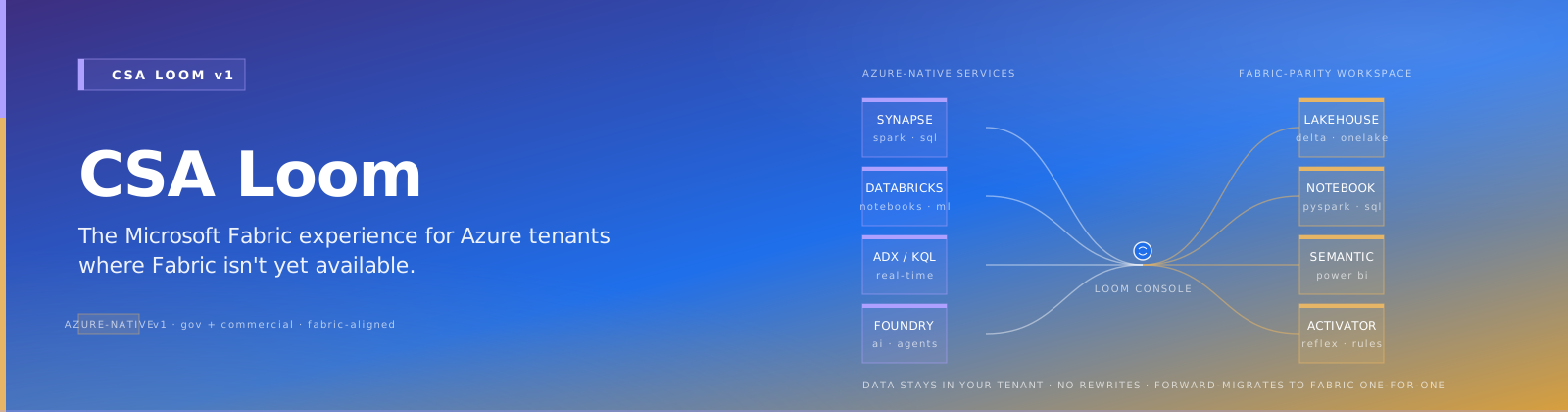
CSA Loom is a productized, Azure-native, Gov-deployable Microsoft Fabric parity layer that fills every one of those gaps, shipped as four things working together:
1. A push-button deployment
azd upCLI for platform engineersaz deployment sub createfor CLI-first / pipeline deploys- Lands the full Loom stack into your own Azure subscription
- 60–100 minutes from "begin" to "Loom Console open and ready"
- Two-tier surface (
azd up+az deployment sub create); Azure Marketplace Managed Application listing deferred to backlog per locked decision LD-4 — Loom is currently free; you pay only for the underlying Azure consumption it stands up
2. A custom SaaS-feel front end (Loom Console)
A Next.js + Fluent UI v9 application that gives you the Fabric workspace experience sitting on top of the Azure-native stack underneath:
- Workspace browser
- Lakehouse pane (Delta tables, files, SQL endpoint)
- Warehouse pane (Databricks SQL Warehouse or Synapse Serverless)
- Notebook pane (embedded Databricks notebook with SSO)
- KQL pane (ADX query editor + dashboards)
- Semantic Model designer (TMDL + DAX editor)
- Catalog (UC managed + Purview overlay in Commercial; Purview- primary in Gov)
- Data Marketplace
- Activator rule designer
- Data Agents pane
- Monitoring Hub
- Admin
3. A Copilot-driven WYSIWYG setup wizard (Loom Setup Wizard)
A conversational deploy surface:
- Greets you, interviews about tenant + subs + regions + boundary + capacity sizing + networking + naming
- Renders the
.bicepparamit's building live in a right-pane preview - Validates via Azure Bicep MCP before deploy
- Calls Azure ARM through a self-hosted Azure MCP server inside your Admin Plane
- Streams progress narratively back to chat
- Narrates next steps post-deploy
The same conversational agent persists in the Console as the Loom Copilot — chat with the platform.
4. Parity services that fill the Fabric-only gaps
Custom apps that deliver the Fabric-only experience even though the underlying Fabric SaaS isn't available in Gov:
| Loom service | What it parities | How |
|---|---|---|
| Direct-Lake Shim | Direct Lake mode in Power BI | Power BI Premium Import + Event Grid → TOM partition-scoped refresh (5–30 s freshness; honest gap vs Fabric's sub-second documented openly) |
| Activator Engine | Reflex / Data Activator | NRules + Redis state + Function dispatcher backed by ADX |
| Mirroring Engine | Zero-ETL Mirroring | OSS Debezium + Event Hubs + Spark Structured Streaming + Delta MERGE; honors Fabric's Open Mirroring publisher contract |
| Loom Data Agents | Fabric Data Agents | Extension of the existing apps/copilot/ + azure-functions/copilot-chat/ scaffold with NL2SQL / NL2DAX / NL2KQL tools; identity-passthrough |
Who CSA Loom is for
| Segment | Why Loom fits |
|---|---|
| Federal civilian agencies (FedRAMP High / IL4) | Fabric is Forecasted in your boundary; Loom is available today in your existing Azure Gov tenant |
| DoD components (IL4 / IL5) | Same — and IL5 Loom support lands in v1.1 |
| State + local government (StateRAMP / CJIS) | StateRAMP and CJIS-aligned audit baselines work; Loom honors per-boundary control mappings |
| Federal contractors (CMMC L2/L3, ITAR) | GCC-High deploys carry ITAR-eligible Azure Gov regions; Loom is deployable there today |
| Regulated commercial verticals | Healthcare (HIPAA), financial services with regional sovereignty needs, pharma (FDA Part 11) |
Who CSA Loom is not for
- Customers already on Azure Commercial with no sovereignty constraints who can adopt Microsoft Fabric directly — use Fabric
- Customers who want a managed-SaaS analytics product they don't operate themselves — Loom runs in your tenant; you operate it
- Customers needing IL6 / Top Secret — Loom is not authorized in Azure Government Secret; sponsor-specific deploys only
- Customers wanting a non-Microsoft data platform — Loom is Fabric-aligned; if you're betting on a non-Microsoft future, Loom isn't the right product
What Loom is not trying to be
- Not a replacement for Microsoft Fabric when Fabric is available. Once Fabric reaches your audit boundary, Loom becomes a forward- migration source, not a competing destination.
- Not a re-implementation of every Fabric workload. Some Fabric- only items have honest gaps (notably Direct Lake's sub-second freshness). Loom documents those gaps explicitly; it does not claim parity it can't deliver.
- Not a general-purpose data platform. Loom is specifically a Fabric parity layer — its scope is bounded by what Fabric does today.
- Not multi-cloud. Loom is Azure-only. Cross-cloud read scenarios (S3, GCS) work via ADLS Gen2 shortcuts; they are not the target.
Why now
Three things converged in 2025-2026 to make Loom the right move:
- Fabric's strategic position is locked. Microsoft has committed Fabric as the unified analytics target — it's where Synapse + Power BI converge.
- The Gov gap is real and persistent. No published Microsoft commitment for Fabric Gov GA; Microsoft's normal pattern (Commercial → GCC-H → IL5 → IL6) suggests 12–36 months from initial rollout.
- The CSA-in-a-Box stack is mature. Databricks + Synapse Serverless + ADX + Purview + Power BI is what csa-inabox already deploys via Bicep. Loom productizes that stack with the Console + parity services + Setup Wizard on top.
Adopting Loom today is investing in a year of head-start on the Fabric experience, not a year of waiting.
How Loom relates to the rest of CSA in a Box
CSA Loom is a new top-nav pillar on csa-inabox, sitting alongside:
- Get Started (existing)
- Architecture (existing)
- Build (existing)
- Use Cases & White Papers (existing)
- CSA Loom (new — this pillar)
- Operate (existing)
The other pillars stay focused on the reference architecture + patterns + migrations. Loom adds the productized, deployable, Fabric-feel layer.
Customers who only need the reference architecture pick the existing CSA-in-a-Box pillars. Customers who need the productized SaaS-feel + custom Console + Setup Wizard pick Loom.