CSA Loom — Whitepaper
Comparative positioning note
This document is written from the perspective of Microsoft Azure, Cloud Scale Analytics, and CSA Loom. Any description of third-party or competing products, services, pricing, or capabilities is derived from publicly available documentation and sources believed accurate at the time of writing, and is provided for general comparison only. We do not claim expertise in, or authority over, any non-Microsoft product or service; the respective vendor's official documentation is the authoritative source for their offerings, which may change over time. Nothing here is intended to disparage any vendor — where a competing product has genuine advantages, we aim to note them honestly. Verify all third-party details against the vendor's current official documentation before making decisions.
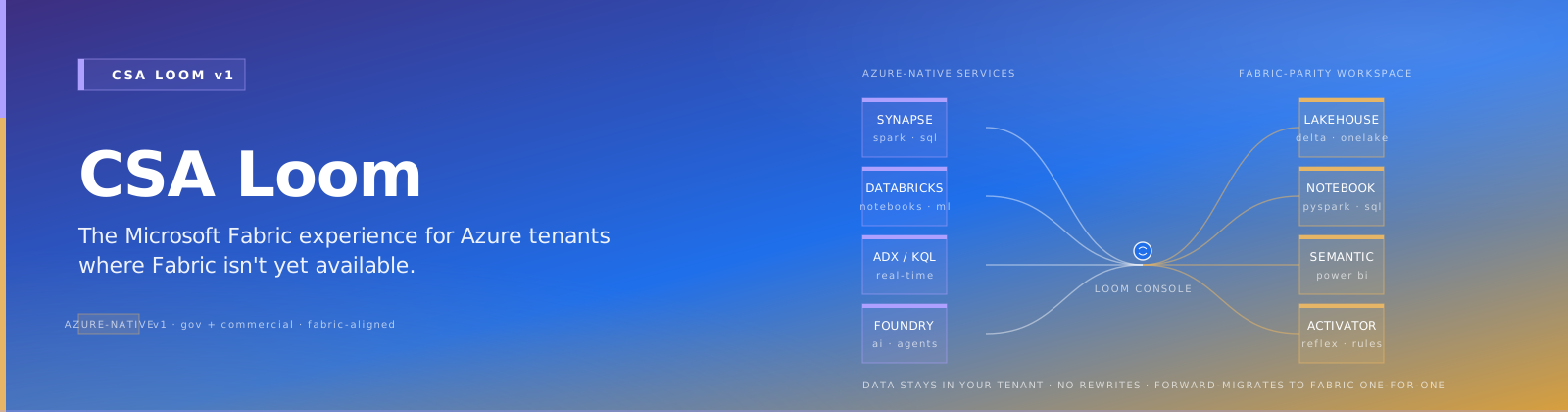
Cloud Scale Analytics Loom — the Microsoft Fabric experience inside any Azure tenant where Fabric isn't yet available
Version 1.0 — 2026-05-22
Executive summary
Microsoft Fabric is the strategic unified analytics SaaS platform. As of mid-2026 it is Forecasted in every US Government cloud and not yet authorized at FedRAMP High, DoD IL4/IL5/IL6, or Secret. Federal, DoD, intelligence-community, ITAR-bound, and many state + local government customers cannot adopt Fabric today, and Microsoft has not published a commitment date for Fabric Gov GA.
CSA Loom is the productized answer to that gap. It is an Azure-native + open-source layer that delivers a Microsoft Fabric parity experience inside any Azure tenant — Commercial, GCC, GCC-High, IL4, IL5 (v1.1). It ships as a deployable pillar on Cloud Scale Analytics in a Box: a Bicep platform, a Next.js Console that mimics the Fabric workspace UX, a conversational Setup Wizard, and parity services for the Fabric-only items that have no first-party equivalent today (Direct Lake, Reflex, Data Agents, Mirroring).
Loom is designed for forward migration first: when Microsoft Fabric reaches your audit boundary, your Delta tables become OneLake shortcuts (zero data movement), your dbt models port 1:1, your KQL queries port 1:1, your semantic models re-author with minimal effort, and you can run hybrid (Fabric in Commercial + Loom in Gov) during the transition. You are not trapped in Loom; you are bridged into Fabric.
The strategic context
Where Fabric is
Microsoft Fabric has crystallized in the 2025–2026 wave into a true unified SaaS data platform — OneLake as the storage namespace, F-SKU capacities as the unified compute pool, and roughly a dozen workloads sharing the same governance, identity, and lifecycle plane.
In Azure Commercial, Fabric is GA across the full surface area:
- OneLake unified storage namespace
- Data Factory pipelines, Dataflows Gen2, Copy Job, Mirroring
- Data Engineering / Lakehouse (Spark notebooks, environments, MLVs)
- Data Warehouse (Polaris engine, T-SQL over Delta)
- Real-Time Intelligence (Eventstream, Eventhouse, KQL, Real-Time Dashboards, Activator)
- Data Science (notebooks, MLflow, AI Functions, Semantic Link)
- Power BI in Fabric — including Direct Lake mode
- Copilot in Fabric (per-workload AI surfaces)
- Data Agents (formerly AI Skills; renamed/GA'd in 2026)
- Fabric Databases (SQL DB, Cosmos DB, HorizonDB preview)
- Fabric IQ family (Ontology, Graph, Plan, Operations Agent) — FabCon 2026 first-class items
Where Fabric isn't
In Azure Government and the M365 government tenants paired with it, Fabric is Forecasted — Microsoft has set an internal GA date but has not published it. Power BI is the only Fabric-platform component that is already Gov-GA, and even Power BI carries boundary-specific limits (no F-SKU in GCC; no Azure Maps visual in any Gov boundary; etc.).
Microsoft's normal Gov authorization pattern is Commercial → GCC-H → IL5 → IL6, with 12–36 months between rungs. Even an optimistic Fabric Gov rollout puts IL5 GA in 2027 at the earliest.
What customers are doing today
The existing recommendation in docs/fabric-in-gov-cloud.md Option 3 is to build on the Synapse + ADF + Databricks + Purview + Power BI stack inside Azure Government. That recommendation works, but it leaves customers with:
- Five separate operating surfaces (Azure portal + Databricks workspace + Synapse Studio + Power BI service + Purview Studio) instead of Fabric's single SaaS plane
- A Bicep + GitHub-Actions deployment path that needs platform- engineer skills — not the one-click-from-Marketplace experience commercial customers see for Fabric
- No equivalent for the Fabric-unique experiences customers explicitly ask for: OneLake unified namespace, Direct Lake sub- second Power BI, Reflex / Data Activator declarative rules, Fabric Data Agents over the lakehouse, Mirroring zero-ETL CDC, AI Skills (now subsumed into Data Agents), Fabric IQ family
- No forward-migration story when Fabric Gov GA finally arrives
CSA Loom is the answer to those gaps.
Architecture overview
Loom deploys as a two-plane architecture aligned with Microsoft's Cloud Adoption Framework Data Management Zone + Data Landing Zone pattern:
- Loom Admin Plane — one subscription per organization. Hosts the Loom Console, Setup Wizard, MCP server, Copilot runtime, catalog overlay, AI Foundry / Azure ML Hub, AI Search, monitoring, Key Vault, and shared services.
- Loom Data Landing Zones (DLZs) — one subscription per domain / agency / mission area. Each carries a Databricks workspace + Synapse Serverless SQL pool + ADX database + ADLS Gen2 lakehouses + Power BI Premium workspaces + the per-DLZ parity services (Activator, Mirroring, Direct-Lake Shim).
Inside each DLZ, Loom workspaces (the per-team "data product" unit) compose lakehouses, warehouses, notebooks, semantic models, KQL DBs, activator rules, and data agents — mirroring the Microsoft Fabric workspace concept.
Per-boundary dispatch
Loom's Bicep is parameterized per audit boundary. The same main.bicep deploys differently in Commercial vs Gov vs IL5 because the underlying Azure services aren't uniform across boundaries:
| Component | Commercial / GCC | GCC-High / IL4 | DoD IL5 (v1.1) |
|---|---|---|---|
| Compute — Spark | Databricks Premium (Photon) | Databricks classic (no UC) | Databricks classic (no UC) |
| Compute — SQL | Databricks SQL Warehouse | Synapse Serverless SQL | Synapse Serverless SQL |
| Catalog | UC managed + Purview overlay | Purview primary | Self-hosted Atlas on AKS |
| Container compute | Container Apps | AKS | AKS |
| Agent orchestration | Foundry Agent Service | Microsoft Agent Framework + AOAI direct | MAF + AOAI direct |
| Direct Lake parity | Premium Import + warm-cache | Premium Import + warm-cache | Premium Import + warm-cache |
Per-boundary .bicepparam files (commercial.bicepparam, gcc.bicepparam, gcc-high.bicepparam, il5.bicepparam) ship the right values for each boundary.
How Loom is built
Compute (LD-2)
Hybrid by workload:
- Azure Databricks — primary Spark compute + (Commercial only) SQL Warehouse + Unity Catalog managed + MLflow
- Synapse Serverless SQL — ad-hoc SQL over Delta, primary SQL surface in Gov where Databricks SQL Warehouse is unavailable
- Azure Data Explorer (Kusto) — KQL DB / Real-Time Intelligence parity; the same engine Fabric Eventhouse runs on
- Power BI Premium — semantic models, reports, dashboards; F-SKU in GCC-H + IL5; P-SKU in GCC (Direct Lake unavailable in GCC even structurally because of the F-SKU rule)
Catalog (LD-8)
Two-track architecture:
Track A — Commercial / GCC (and Gov when UC managed Gov-GA arrives): Databricks Unity Catalog managed as the operational catalog + Microsoft Purview as the sensitivity / sovereignty / audit overlay. UC's Iceberg REST endpoint + Delta UniForm exposes the catalog to non-Databricks engines (Synapse Serverless, ADX, Trino, DuckDB).
Track B — Gov-IL4 interim (until UC managed Gov-GA): Microsoft Purview as the primary catalog. Databricks runs with workspace-scoped Hive metastore. Lineage published from Spark / ADF via Atlas REST API → Purview.
Track C — DoD IL5 (v1.1): Self-hosted Apache Atlas on AKS as primary catalog (Purview is not in IL5 audit scope). Solr + HBase + Kafka stack as Atlas dependencies.
Direct Lake parity (LD-7)
This is the hardest single workload to match. Fabric's Direct Lake mode uses the proprietary VertiPaq transcoder to read Delta-Parquet files directly from OneLake at sub-second latency, with framing-not- refresh sync semantics.
Loom delivers the best tractable parity: Power BI Premium Import semantic models + a notification-driven warm-cache materializer (apps/fiab-direct-lake-shim) that subscribes to Storage Event Grid notifications on _delta_log writes and issues TOM partition-scoped refreshes against the associated semantic model. Result: 5–30 second freshness from new commit to refreshed model for partition-aware tables.
Loom is honest about this gap: sub-second freshness is not achievable without owning the VertiPaq transcoder, and we document that openly. Customers who need Fabric-native sub-second freshness wait for Fabric Gov GA.
Reflex / Data Activator parity (LD-N/A)
Per research/03-fabric-only-internals.md, Fabric's Activator is a thin scheduling layer over Eventhouse (Kusto/ADX) + per-object state tracking. Loom replicates with:
- Azure Data Explorer as the query engine (the same Kusto engine Eventhouse runs on)
- NRules (.NET production-grade Rete rules engine) for rule evaluation
- Azure Cache for Redis Premium for per-object state
- Azure Functions for action dispatch (Teams / Email / Power Automate / Logic App / Databricks job / ADF pipeline / UDF / webhook)
All 8 Fabric Reflex rule primitives are implemented: increasesAbove, decreasesBelow, is above, is below, changesTo, andStays, noPresenceOfData, everyNthTime.
End-to-end latency: 5–30 seconds, matching Fabric Reflex.
Mirroring parity (LD-9)
Loom delivers zero-ETL CDC from operational databases into the lakehouse using OSS Debezium + Event Hubs + Spark Structured Streaming + Delta MERGE. Sources covered in v1: Azure SQL, Azure SQL MI, SQL Server 2016-2025, Postgres, MySQL, Cosmos DB, Snowflake, Oracle.
Loom honors Fabric's Open Mirroring publisher contract: partners can drop Parquet files with the __rowMarker__ column to a documented landing zone path and Loom Mirroring picks them up — the same protocol Fabric Mirroring exposes for SAP and partner sources.
Data Agents parity (extends apps/copilot)
Fabric Data Agents (renamed from "AI Skills" in 2026) are NL-to-query agents over Lakehouse, Warehouse, Power BI semantic models, and KQL databases. Loom delivers parity by extending the existing csa-inabox copilot scaffold (apps/copilot/ PydanticAI agent + azure-functions/copilot-chat/ Function backend) with:
nl2sql(question, data_source_id, user_token)— SQL over Databricks SQL Warehouse (Commercial) or Synapse Serverless (Gov)nl2dax(question, semantic_model_id, user_token)— DAX over Power BI Premium semantic model via XMLAnl2kql(question, adx_cluster, database, user_token)— KQL over ADXgraph_searchandcustom_searchfor non-tabular sources
Identity passthrough (OBO) throughout — every tool call carries the calling user's Entra token. Per-agent few-shot example queries. Foundry integration in Commercial; AOAI-direct in Gov.
Copilot orchestration (Wizard + runtime)
Two-tier:
- Commercial / GCC: Foundry Agent Service (GA Mar 2026) hosts the Loom Setup Wizard agent + Loom Copilot runtime. Wired to the self-hosted Azure MCP server + Azure Bicep MCP.
- GCC-High / IL5: Microsoft Agent Framework 1.0 (Apr 2026) orchestrator + Azure OpenAI direct (gpt-4o / gpt-4.1 in
usgovvirginia). Same wizard UX, same MCP backend.
Push-button deployment (LD-4)
Two-tier surface:
azd upCLI — power-user path; full Bicep visibility- "Deploy to Azure" template button — portal click; pre-rendered ARM template
Both deploy into the customer's own Azure subscription. Customer pays only for Azure consumption underneath; Loom IP + Console + parity services + Setup Wizard are free in v1. The Azure Marketplace Managed Application path is deferred to backlog per LD-4 — to be revisited once the product matures and a pricing model is decided.
Forward migration
Loom is designed under ADR fiab-0012 to migrate forward into Microsoft Fabric with low rewrite cost.
| Loom artifact | Fabric equivalent | Migration mechanism |
|---|---|---|
| Loom lakehouse Delta tables | OneLake Delta tables | OneLake shortcut → zero data movement |
| dbt Core models | dbt in Fabric Data Factory | dbt-fabric adapter; change connection string |
| Databricks notebooks | Fabric Spark notebooks | Git binding port; runtime swap |
| Databricks SQL Warehouse tables | Fabric Warehouse | T-SQL DDL ports; light syntax adjustments |
| Synapse Serverless external tables | Fabric Warehouse / SQL endpoint | Re-create as Fabric Warehouse tables |
| ADX databases / KQL queries | Fabric Eventhouse | Same engine; databases attach as Eventhouse |
| Power BI semantic models | Power BI in Fabric (Direct Lake) | Re-author TMDL for Direct Lake on OneLake |
| Loom Activator rules | Fabric Reflex | JSON export from Loom → Reflex definition import |
| Loom Data Agents | Fabric Data Agents | Agent config JSON → Fabric Data Agents REST API |
| Loom Mirroring configs | Fabric Mirroring | Per-source case-by-case (some sources Fabric GA-mirrors today; some don't) |
| Purview catalog | Fabric Purview | Same engine; Fabric items auto-register |
The asymmetry is honest: Fabric-only artifacts (Direct Lake sub- second freshness, Fabric IQ family) don't reverse-map cleanly back to Loom. But the forward direction is clean enough that Loom is a defensible head-start, not a detour.
Hybrid topology — Fabric Commercial + Loom Gov
The most likely real-world pattern for federal customers with both commercial and Gov estates:
- Commercial tenant runs Microsoft Fabric for public datasets, cross-agency analytics, executive Power BI dashboards
- Gov tenant runs CSA Loom for CUI / classified mission data, agency-internal analytics, ITAR-eligible workloads in GCC-High
- Cross-cloud B2B invitations bridge identity
- APIM Premium in each cloud brokers controlled cross-cloud API calls
- Data residency policies determine where each dataset lives
This pattern lets customers move at their own audit-review cadence rather than a forced cutover. Full architecture detail in Hybrid Fabric Commercial + Loom Gov.
Compliance posture
Per-boundary deploy variants carry the inherited compliance attestations of the underlying Azure services:
| Boundary | Attestations |
|---|---|
| Commercial | FedRAMP High + DoD IL2 (Azure public baseline) |
| GCC (Azure Commercial under M365 GCC) | FedRAMP High + DoD IL2 |
| GCC-High / IL4 (Azure Government) | FedRAMP High + DoD IL4 + ITAR-eligible |
| DoD IL5 (Azure Government — v1.1) | FedRAMP High + DoD IL5 + CNSSI 1253 |
| HIPAA BAA | Available in all boundaries via Microsoft Product Terms |
The single notable Gov gap is Defender for Cloud AI Threat Protection (Commercial-only). Loom ships a manual SOC pipeline (Sentinel + Content Safety log wiring + self-hosted Presidio for PII detection) as the equivalent for Gov customers. Full detail in Defender AI workaround.
Cost model
v1 pricing model is pay-as-you-go with no Loom IP fee:
- Underlying Azure consumption (Databricks DBU, Synapse Serverless DPU, ADX vCore-seconds, Power BI Premium memory, ADLS storage, AOAI tokens, Function invocations) bills directly to the customer's Azure subscription
- Loom IP (Console, Setup Wizard, parity services, Copilot runtime, documentation, workshop materials) is free in v1
- Marketplace Managed Application + pricing model deferred to backlog per LD-4; will be revisited once the product matures
This means Loom v1 has no procurement friction beyond the customer's existing Azure agreement.
Cost-optimization patterns (pause-resume Databricks, ADX hot/cold tiering, Power BI smoothing, AOAI provisioned vs PAYG) are documented in Cost management.
Risks the design addresses
| Risk | Mitigation |
|---|---|
| Direct Lake's sub-second freshness genuinely can't be matched | Honest gap + best-effort parity via warm-cache materializer; documented openly in Direct Lake parity |
| UC managed not in Gov today (CY2026 commitment, no quarter) | Two-track catalog (UC managed + Purview overlay Commercial; Purview-primary Gov until UC managed Gov-GA) |
| Container Apps not at IL4/IL5 | AKS dispatch for IL4+; same workload, different host |
| Foundry Agent Service not confirmed in Gov | Microsoft Agent Framework + AOAI direct as Gov orchestrator with identical wizard UX |
| Microsoft trademark risk on the name | Public brand CSA Loom (not "Fabric-in-a-Box"); fallback TapestryOne reserved |
| Fabric continues shipping new workloads | Quarterly Build / FabCon / Ignite freshness rescans; v2 catches up on Fabric IQ family |
| Customer adoption velocity | Marketing + workshop investment; framing as "head-start, not detour" |
What's next
Loom is currently in v1 build wave 0 (foundation + ADRs). The full build plan:
- v1 — Commercial + GCC + GCC-High (6-9 months) — full Console, Setup Wizard, all parity services, 8 industry examples, dual workshops, full documentation
- v1.1 (+3 months) — DoD IL5 — Marketplace Managed App, Power BI Embedded panes, remaining 17 industry examples,
fiab-migrateCLI, Operations Agent - v2 (+6 months) — Fabric IQ family — Ontology, Graph, Plan, Maps, HorizonDB-equivalent
Per PRP-00 README for the full PRP decomposition + wave schedule.
Get involved
- GitHub epic: #279 — CSA Loom v1 build roadmap
- Branch:
csa-loom-pillar - Source documents: PRD, Research wave, PRPs