Activator (Reflex) editor
Superseded by the hands-on tutorial
This workload overview is superseded by the hands-on Activator tutorial (UAT-dated). See that guide for the current step-by-step.
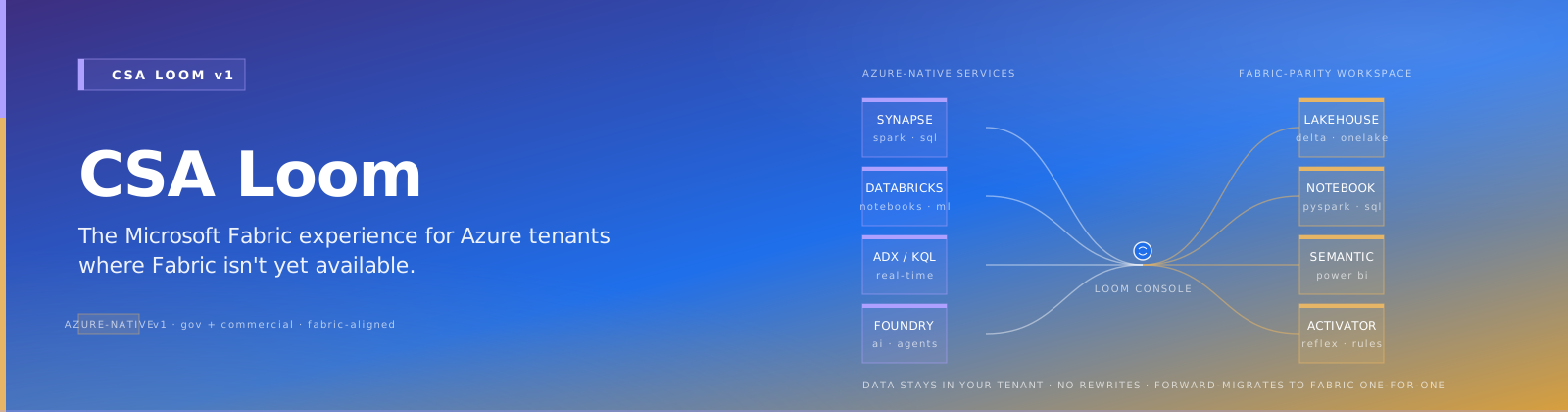
The Activator editor is the rules engine over real-time data. Each activator (also called a "reflex") owns 0..N rules ("triggers"); a rule binds a data condition to an action. It runs Azure-native by default — no Microsoft Fabric required (per .claude/rules/no-fabric-dependency.md).
Backend
The Azure-native default backs each activator with a Cosmos item plus real Azure Monitor scheduled-query alert rules. The rule source is an Eventhouse / KQL database on Azure Data Explorer (ADX) by default, with Log Analytics KQL and Event Hub as alternatives.
| Layer | Implementation (Azure-native default) |
|---|---|
| Item store | Cosmos item — the activator definition + its rules |
| Rules surface | Microsoft.Insights/scheduledQueryRules (+ action group) per rule |
| Rule source | ADX Eventhouse / KQL database (default); Log Analytics KQL; Event Hub |
| Auth | Console UAMI (LOOM_UAMI_CLIENT_ID), Monitoring Contributor on the alert RG |
| BFF routes | GET/POST /api/items/activator (list / create), GET/PUT/DELETE /api/items/activator/[id] (read / update / delete), GET/POST /api/items/activator/[id]/rules (list / add rule), GET /api/items/activator/[id]/history (fired-alert instances) |
Fabric opt-in: set
LOOM_ACTIVATOR_BACKEND=fabricto route to real Fabric Reflexes (/v1/workspaces/{ws}/reflexes) instead. When that env is unset — the default — Loom never callsapi.fabric.microsoft.com.
What works today
| Action | Backend call (Azure-native default) | Status |
|---|---|---|
| List activators in workspace | Cosmos query (+ opt-in Fabric reflexes merged on top when enabled) | live |
| Create activator | Cosmos upsert | live |
| Update activator | Cosmos upsert | live |
| Delete activator | Cosmos delete (+ best-effort remove of backing scheduledQueryRules) | live |
| List rules | Rules persisted on the Cosmos item | live |
| Add rule (KQL / condition + action) | PUT Microsoft.Insights/scheduledQueryRules/{n} (+ action group) | live |
| Trigger rule now | Evaluates the rule query on demand against the source | live |
| Run history | GET fired/resolved instances from Azure Monitor Alerts Management | live |
Pre-requisites for real data
The Azure-native default needs an Azure Monitor target, not a Fabric tenant:
- Set
LOOM_LOG_ANALYTICS_RESOURCE_ID+LOOM_ALERT_RGon the Console (andLOOM_ADX_ALERT_SCOPEfor hands-off ADX scheduled evaluation). - Grant the Console UAMI Monitoring Contributor on
LOOM_ALERT_RGso it can createscheduledQueryRules+ action groups (and Database Viewer on the ADX cluster for the alert identity).
If a prerequisite is missing, the editor surfaces a precise MessageBar naming the exact env var / role to set — no mock data is shown, and no Fabric action is ever required.
Bicep
- Alert resource group + Log Analytics workspace:
platform/fiab/bicep/modules/admin-plane/monitor.bicep - UAMI + role grant:
platform/fiab/bicep/modules/admin-plane/uami.bicep
Env vars
| Variable | Purpose |
|---|---|
LOOM_UAMI_CLIENT_ID | Console UAMI client id (workload identity) |
LOOM_LOG_ANALYTICS_RESOURCE_ID | Log Analytics workspace for scheduled-query alert rules |
LOOM_ALERT_RG | Resource group where scheduledQueryRules + action groups are created |
LOOM_ADX_ALERT_SCOPE | ADX cluster resource id for hands-off scheduled ADX rule evaluation |
LOOM_ACTIVATOR_BACKEND | Opt-in only — set to fabric to use real Fabric Reflexes instead of the Azure-native default |