Day 1 — Foundation & Deploy (Federal CoE)
Track: 5-Day Federal CoE Workshop · Day 1 of 5 · Foundation & Deploy
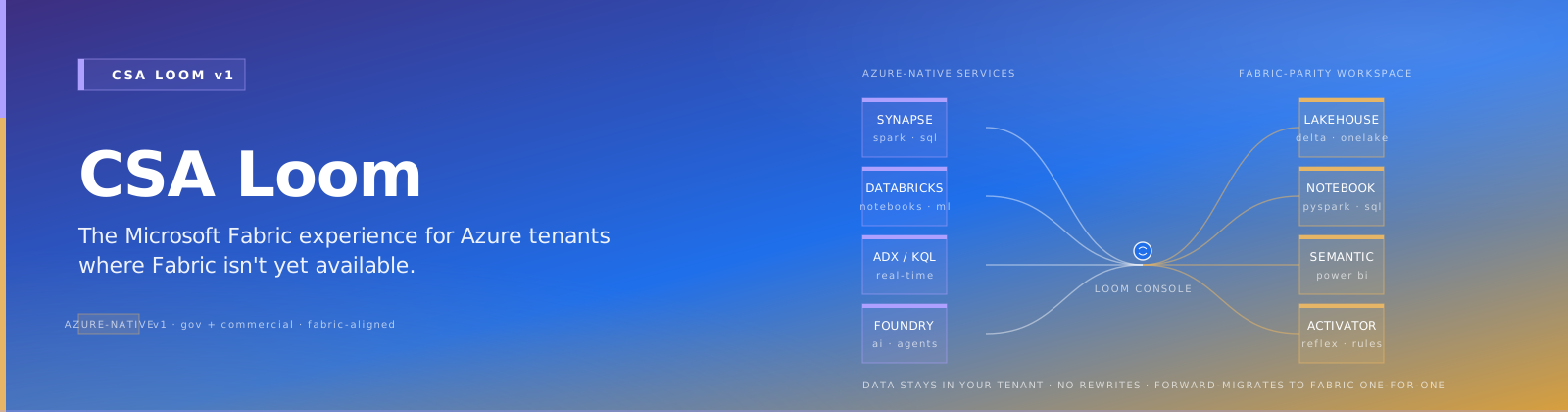
Day 1 takes the customer from an empty Azure Government subscription to a running CSA Loom Admin Plane plus the first Data Landing Zone (DLZ). By the end of the day the Loom Console is operational and a platform engineer has deployed it themselves.
Azure-native by default
Every deploy in this workshop runs on Azure-native backends (ADLS Gen2 + Delta, Synapse, Azure Data Explorer, Azure OpenAI Gov). No Microsoft Fabric capacity or workspace is required. Fabric appears only on Day 5 as a forward-migration target (Forecasted in Gov).
Learning objectives
By end of Day 1, each participant can:
- Explain the CSA Loom architecture (Admin Plane + DLZ) and the per-boundary support matrix.
- Verify an Azure Government subscription meets Loom's prerequisites.
- Choose the correct
.bicepparamfor their boundary (GCC / GCC-High / IL5). - Deploy the Loom Admin Plane via
azd up(or the Setup Wizard). - Confirm the Console is healthy and sign in with their Entra Gov identity.
Facilitator guide
Timing (8-hour day)
| Time | Activity | Mode |
|---|---|---|
| 09:00 | Kickoff with exec sponsor — mission framing, week outcomes | Plenary |
| 09:30 | Loom architecture + per-boundary matrix walkthrough | Lecture |
| 10:30 | Break | — |
| 10:45 | Prerequisites verification (roles, CIDR, Entra group, capacity) | Lab |
| 11:45 | Lunch | — |
| 12:45 | .bicepparam deep-dive — choose + edit the boundary param | Lab |
| 13:45 | azd up Admin Plane deploy (runs ~20-35 min) | Lab |
| 14:30 | While deploy runs: Setup Wizard conceptual tour + DLZ design | Lecture |
| 15:15 | Break | — |
| 15:30 | First DLZ deploy + Console health validation | Lab |
| 16:30 | Day-1 wrap-up + Day-2 preview + homework | Plenary |
Talking points
- Why Loom exists in Gov: Microsoft Fabric is
Forecastedfor FedRAMP High / IL4 / IL5 / IL6 on the Azure Government product roadmap — there is no public GA date. Loom gives mission teams the Fabric experience on Azure-native services today, and forward-migrates 1:1 when Fabric reaches their boundary. - Admin Plane vs DLZ: The Admin Plane is the shared control surface (Console, catalog overlay, cost/monitoring rollup, governance). Each DLZ is an isolated per-domain landing zone. This is the federation model expanded on Day 5 and in the Federal Data Mesh use case.
- F-SKU honesty: GCC / GCC-High have no Power BI F-SKU — semantic models use the Loom-native tabular layer (P-SKU optional). Do not promise Direct Lake on OneLake in Gov; that is a forward-migration capability, covered honestly on Day 4.
Exercises (facilitator-led)
- Have each participant read the per-boundary matrix and state which row their agency falls in and why.
- Run a
what-ifagainst the chosen.bicepparamand read the resource diff aloud as a group before the real deploy.
Common pitfalls
- Missing User Access Administrator on the target sub → role-assignment steps fail mid-deploy. Verify in the prereq lab, not during
azd up. - Entra group-claim emission disabled in the tenant → set
LOOM_TENANT_ADMIN_OIDso the first admin can reach/admin/permissions. - ACR public-access propagation delay on first image pull (~30-90s) — expected; do not abort the deploy.
Participant lab — deploy the Admin Plane
Prerequisites (customer-completed before the workshop): see the pre-workshop readiness checklist.
- Clone + init.
- Select your boundary param. Copy the matching file from
platform/fiab/bicep/params/—gcc.bicepparam,gcc-high.bicepparam, or (v1.1)il5.bicepparam. SetadminEntraGroupIdto your Loom Admins group object ID. LeaveLOOM_DEFAULT_FABRIC_WORKSPACEunset — Loom runs Azure-native. - Preview.
azd provision --previewand review the resource diff with the facilitator. - Deploy.
azd up. Expect ~20-35 minutes for the Admin Plane. - Sign in. Browse to the Console URL emitted by
azd up, authenticate with your Entra Gov identity, and confirm the Workspaces pane (/workspaces) renders. - Health check. Open Monitor → Service health (
/monitor) and confirm the service-health probes report the deployed backends as reachable. Any amber tile shows the exact env var / role to set — record it; you will resolve gates as they appear through the week.
Validation (Day-1 done): Console reachable, you are signed in, Workspaces pane renders, and the first DLZ appears under Workspaces.
Troubleshooting
| Symptom | Fix |
|---|---|
azd up fails on role assignment | Grant the deploying principal User Access Administrator; re-run azd up (idempotent). |
Console 403 on /admin/* | Set LOOM_TENANT_ADMIN_OID to your user OID; restart the Console revision. |
| Image pull timeout | Wait for ACR public-access propagation; re-run the failed deploy step. |
Datasets
Day 1 uses no business data — only deployment. The synthetic datasets you load from Day 2 onward are described in Workshop datasets (all CUI-safe synthetic).
Homework
- Read the governance overview.
- Confirm your DLZ CIDR ranges and ER/VPN connectivity with your network team.
Federal-specific emphasis
- Boundary param walkthrough: GCC-High vs IL5 differences (network egress allow-list, CMK requirements, Purview-primary catalog).
- ATO framing: capture the deployed resource inventory from the
azd upoutput as a starting artifact for the System Security Plan. - ITAR: GCC-High deploys keep all data and identities in the US sovereign boundary; no Commercial fallback endpoints are configured.
Slide deck
Render the Day-1 facilitator deck: make loom-decks DECK=docs/fiab/workshops/5-day-federal-coe/day-1-foundation.md.