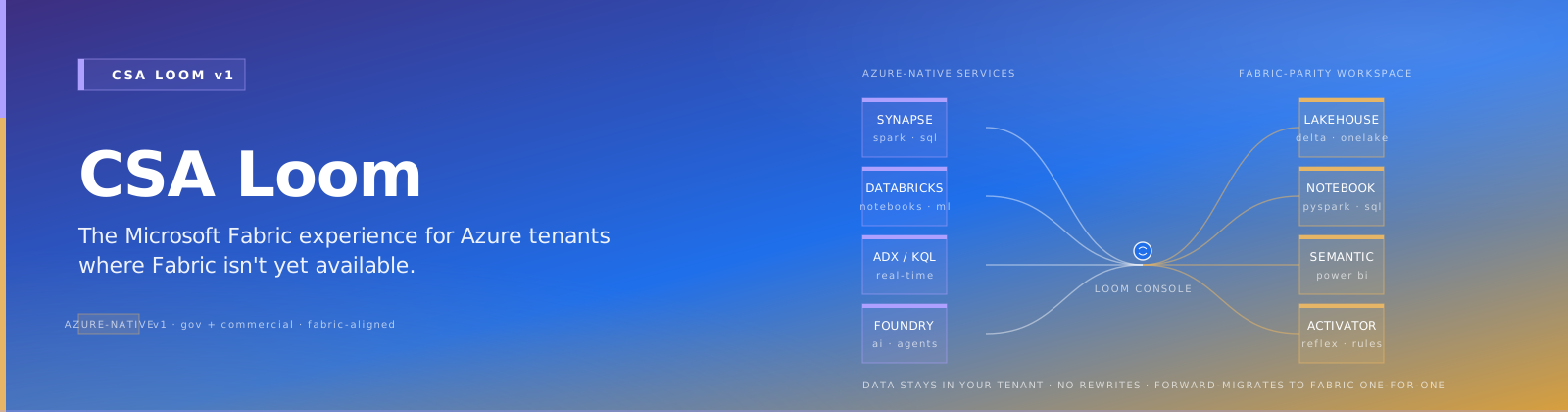
CSA Loom — Pitch Deck (20 slides)¶
30-minute pitch to federal CIO / CDO / architect audiences. Outline + speaker notes. Render to .pptx / .pdf with make loom-decks DECK=docs/fiab/marketing/pitch-deck.md (or python scripts/csa-loom/build-decks.py), which transforms this markdown into a Marp slide deck. Artifacts land in build/decks/ (gitignored) — regenerate from source, never hand-edit.
Deck outline¶
Slide 1 — Title¶
"CSA Loom: The Microsoft Fabric Experience in Your Azure Government Tenant"
- Speaker note: "Today I'll show you how to get the Microsoft Fabric workspace experience inside your existing Azure tenant — even though Fabric isn't yet generally available in any US Government cloud."
- 1 min
Slide 2 — The problem¶
Chart: Fabric Gov availability vs. the rest of Azure.
- Fabric Commercial: GA
- Fabric GCC / GCC-H / IL4 / IL5 / IL6:
Forecasted— no public commitment date - Speaker note: "Microsoft hasn't announced a date for Fabric in Gov. Based on Microsoft's normal Commercial → GCC-H → IL5 pattern, this is likely 2027 or later for IL5."
- 2 min
Slide 3 — The vision¶
"Any federal tenant whose audit boundary blocks Microsoft Fabric can deploy CSA Loom in under one day, give domain teams the Fabric workspace experience, and forward-migrate 1:1 when Fabric Gov GAs — with no rewrites."
- Speaker note: Read the slide. "Three things matter: deploy fast, feel like Fabric, migrate cleanly. We'll cover all three."
- 1 min
Slide 4 — What customers actually get¶
5 product screenshots side-by-side with equivalent Microsoft Fabric screenshots: - Loom Console Workspaces ↔ Fabric Workspaces - Loom Console Lakehouse ↔ Fabric Lakehouse - Loom Console Notebook ↔ Fabric Notebook - Loom Console Semantic Model ↔ Power BI Direct Lake - Loom Console Activator ↔ Fabric Reflex
- Speaker note: "This is the look-and-feel parity. Same Fluent UI v9 library Microsoft Fabric uses."
- 3 min
Slide 5 — The architecture¶
Single diagram from Reference Architecture §4.1.
- Speaker note: "Three layers: Admin Plane in one sub; Data Landing Zones per domain (each in its own sub); workspaces inside DLZs. Aligns with Microsoft CAF Data Landing Zone pattern."
- 2 min
Slide 6 — Three deployment surfaces¶
azd upCLI for platform engineers- "Deploy to Azure" button for evaluators
- Loom Setup Wizard for conversational deploy
Show wizard screenshot.
- Speaker note: "Pick the path that fits your team. All deploy into your own Azure sub; you pay only for Azure consumption underneath."
- 2 min
Slide 7 — Per-boundary support¶
Per-boundary feature matrix simplified:
| Boundary | Loom v1 | Loom v1.1 |
|---|---|---|
| Commercial | ✅ | ✅ |
| GCC | ✅ | ✅ |
| GCC-High | ✅ | ✅ |
| IL5 | — | ✅ |
- Speaker note: "v1 covers Commercial through GCC-H. v1.1 adds IL5 three months later. IL6 is out of scope."
- 1 min
Slide 8 — Honest gaps¶
- Direct Lake sub-second freshness — not achievable; we offer 5-30s warm-cache parity
- Fabric IQ family (Ontology, Graph, Plan) — deferred to v2
- Marketplace listing — deferred to backlog (free in v1)
-
GCC structurally no Direct Lake (F-SKU prohibition)
-
Speaker note: "We're explicit about what we can't match. This is not snake oil — it's a parity layer with documented edges."
- 2 min
Slide 9 — The Loom Setup Wizard¶
Screenshot of the conversational deploy experience. Live demo (if time).
- Speaker note: "User talks to the wizard; wizard renders Bicep live in a preview pane; user confirms; wizard deploys via Azure MCP."
- 2 min
Slide 10 — The Loom Console panes¶
Overview of 12 v1 panes. Click-through demo (if time).
- Speaker note: "The Fabric workspace experience translated to your Azure stack. Familiar to anyone who's used Fabric Commercial."
- 3 min
Slide 11 — The custom parity services¶
- Activator Engine (Reflex parity)
- Mirroring Engine (Mirroring parity)
- Direct-Lake Shim (Direct Lake parity)
-
Data Agents (Fabric Data Agents parity)
-
Speaker note: "Where Azure-native doesn't cover Fabric capabilities, we built custom services. All open-source-friendly under the covers."
- 2 min
Slide 12 — Hybrid topology¶
Diagram from Hybrid topology use case.
- Speaker note: "Most federal customers run Fabric in Commercial for public datasets + Loom in Gov for CUI / classified / ITAR. Bridged via cross-cloud B2B + OneLake shortcuts."
- 2 min
Slide 13 — Forward migration¶
| Loom artifact | Migration mechanism | Effort |
|---|---|---|
| Delta tables | OneLake shortcut | Zero data movement |
| dbt models | dbt-fabric adapter | Low |
| KQL queries | Same engine (ADX → Eventhouse) | Low |
| Semantic models | Re-author for Direct Lake on OneLake | Medium |
| Activator rules | JSON port to Reflex | Low-Medium |
- Speaker note: "When Fabric reaches your boundary, your Delta data becomes OneLake shortcuts. Zero copy. Your dbt + KQL + Purview carry forward 1:1."
- 2 min
Slide 14 — Customer value (5 bullets)¶
- Head-start — Fabric experience today, not in 2027
- No rewrites — forward-migration via OneLake shortcut
- Sovereignty — all controls in your tenant
- Hybrid-ready — Commercial + Gov topology supported
-
Productized — not a reference architecture; a deployable product
-
2 min
Slide 15 — Total cost¶
Sample \(/month for F8 Commercial baseline (~\)3-5K).
- Loom IP is free in v1
- Customer pays only for Azure consumption underneath
-
Marketplace listing + pricing model deferred to backlog
-
Speaker note: "No procurement friction. Use your existing Azure agreement."
- 2 min
Slide 16 — Adoption path¶
- Day 1: Deploy via
azd up(60-100 min) - Week 1: First workspace + ingest first dataset
- Month 1: Production workloads (first agency / domain)
-
Year 1: Full estate + forward-migration plan
-
1 min
Slide 17 — 5-day Cloud CoE workshop¶
Two variants: Federal CoE + Commercial CoE. Day-by-day curriculum: Foundation → Ingest → Transform → BI/AI → Operate.
- Speaker note: "We deliver a 5-day workshop to stand up your Loom Center of Excellence. Federal-focused variant for federal customers."
- 2 min
Slide 18 — References & resources¶
docs/fiab/documentation pillar- GitHub repo + epic #279
- Azure MCP server self-host
-
Microsoft federal account team
-
1 min
Slide 19 — Q&A¶
Open the floor. Common questions: - "Why not wait for Fabric Gov GA?" - "How does this work with our existing Databricks investment?" - "What's the lock-in?" - "Will my audit team accept it?"
Cross-reference seller playbook for objection handling.
- 5 min
Slide 20 — Backup slides¶
- Per-boundary compliance details
- Fabric IQ v2 roadmap
- Integration with existing Microsoft Purview / Defender deployments
- Cost calculator detail
- Pre-built KQL queries
Production notes¶
- PPTX generated via mkdocs-pptx plugin from this markdown
- Per-slide speaker notes are the paragraphs above
- Time estimates total ~30 min
- Branding: existing CSA dark navy (#0A1126) + indigo + amber palette
- Per-section hero images from
docs/assets/images/hero/fiab/
Variants¶
- Federal account-team variant — emphasizes FedRAMP / IL4 / IL5 / ITAR / CMMC
- 15-min lightning version: skip slides 6, 9, 13, 16, 17
- 60-min deep-dive: add slides on per-workload parity (5 extra)
Related¶
- Demo script — three demo variants
- Battlecard vs Fabric Commercial
- One-pager
- Seller playbook