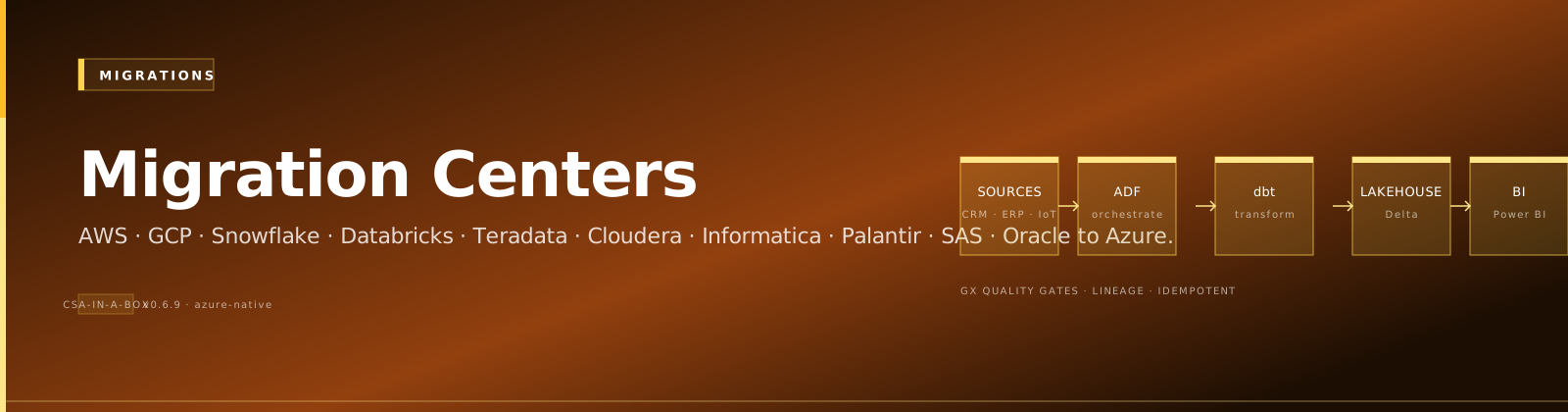
Migrations to Azure
Comparative positioning note
This document is written from the perspective of Microsoft Azure, Cloud Scale Analytics, and CSA Loom. Any description of third-party or competing products, services, pricing, or capabilities is derived from publicly available documentation and sources believed accurate at the time of writing, and is provided for general comparison only. We do not claim expertise in, or authority over, any non-Microsoft product or service; the respective vendor's official documentation is the authoritative source for their offerings, which may change over time. Nothing here is intended to disparage any vendor — where a competing product has genuine advantages, we aim to note them honestly. Verify all third-party details against the vendor's current official documentation before making decisions.
Field-tested migration playbooks from common on-prem and other-cloud platforms onto the CSA-in-a-Box Azure stack. Each playbook covers assessment → design → migration → cutover → decommission with realistic timelines and pitfalls.
-
Data, AI & Analytics
Core CSA-aligned playbooks for cloud-scale analytics, data platforms, AI/ML, and the operational data stores that feed them. Hyperscalers, warehouses, lakehouses, BI, ETL, and operational DBs.
Data, AI & Analytics migrations
Core CSA-aligned playbooks for cloud-scale analytics, data platforms, AI/ML, and the operational data stores that feed them.
Migrating to Microsoft Fabric?
Several playbooks below target Microsoft Fabric directly. For additional Fabric-specific migration guides, planning worksheets, and tutorials, see the Supercharge Microsoft Fabric companion site — including the Migration Planning Tutorial and Migration Patterns.
Hyperscaler & cloud platforms (analytics workloads)
| Source | Target | Playbook |
|---|---|---|
| AWS (Redshift, S3, Glue, EMR) | Synapse, ADLS, ADF, Databricks | aws-to-azure.md |
| GCP (BigQuery, GCS, Dataflow) | Synapse/Fabric, ADLS, ADF | gcp-to-azure.md |
Data warehouses & lakehouses
| Source | Target | Playbook |
|---|---|---|
| Snowflake | Fabric / Synapse + Databricks | snowflake.md |
| Databricks (other clouds or AWS) | Microsoft Fabric | databricks-to-fabric.md |
| Teradata | Synapse Dedicated SQL Pool / Fabric Warehouse | teradata.md |
| Palantir Foundry | Azure data mesh + Purview | palantir-foundry.md |
Big data ecosystems
| Source | Target | Playbook |
|---|---|---|
| Hadoop / Hive (Cloudera, HDInsight, on-prem) | Synapse Spark + Delta / Fabric Lakehouse | hadoop-hive.md |
| Cloudera / CDH (Impala, NiFi, CDP) | Synapse + Databricks + ADF | cloudera-to-azure.md |
ETL & data integration
| Source | Target | Playbook |
|---|---|---|
| Informatica PowerCenter / IICS | Azure Data Factory / Fabric Data Pipelines | informatica.md |
Business intelligence
| Source | Target | Playbook |
|---|---|---|
| Tableau | Power BI | tableau-to-powerbi.md |
| Qlik | Power BI | qlik-to-powerbi.md |
Analytics & statistical computing
| Source | Target | Playbook |
|---|---|---|
| SAS (9.4 / Viya) | Azure ML / Fabric | sas-to-azure.md |
Operational databases (analytics sources)
| Source | Target | Playbook |
|---|---|---|
| SQL Server (on-prem) | Azure SQL DB / MI / VM | sql-server-to-azure.md |
| Oracle Database | Azure SQL MI / PostgreSQL / Oracle@Azure | oracle-to-azure.md |
| IBM Db2 (z/OS, LUW, i) | Azure SQL | db2-to-azure-sql.md |
| MongoDB | Cosmos DB (vCore / RU) | mongodb-to-cosmosdb.md |
| MySQL (on-prem / cloud) | Azure Database for MySQL / PostgreSQL | mysql-to-azure.md |
What every migration has in common
Regardless of source, every migration follows the same 5 phases:
flowchart LR
    A[1. Assessment<br/>2-4 weeks] --> B[2. Design<br/>2-3 weeks]
    B --> C[3. Migration<br/>4-16 weeks]
    C --> D[4. Cutover<br/>1-2 weeks]
D --> E[5. Decommission<br/>4-8 weeks]| Phase | Goal | Output |
|---|---|---|
| Assessment | Inventory current state — workloads, data sizes, dependencies, cost | Migration backlog (CSV / Azure Migrate output), workload tier, target architecture options |
| Design | Map source primitives to Azure primitives | Target architecture diagram, security model, network topology, sizing assumptions |
| Migration | Move data + code in waves | Working pipelines, dbt models, dashboards on Azure for each wave |
| Cutover | Stop writes to source, freeze, switch consumers | Read-only source, consumers on Azure |
| Decommission | Verify, archive, delete | Source archived, contracts cancelled, runbooks updated |
Sequencing rule
We always migrate consumers before producers, going upstream:
- First: read-only consumers (BI dashboards, downstream APIs) — point them at a shadow Azure copy
- Then: transformations (dbt / SQL / Spark)
- Then: ingestion (the actual writes from source systems)
- Finally: freeze the source and decommission
This minimizes the window where any single workload depends on both clouds simultaneously.
Cost during migration
Plan for ~140% of your steady-state Azure cost during the migration window because both source and target run in parallel. Tag every resource created during migration with purpose=migration-from-<source> so you can report on it separately.
See also Best Practices — Cost Optimization for tagging and reserved-capacity strategy.
Compliance during migration
Migration is the highest-risk window for data exposure. Read these before starting:
- Best Practices — Security & Compliance
- Compliance — your relevant framework
- Runbook — Security Incident
Specifically: never open a public IP on the source side to "make it easier to copy data over." Use ExpressRoute / VPN / Private Link.
Need a playbook for something not listed?
Open an issue at https://github.com/fgarofalo56/csa-inabox/issues with the source platform, approximate data volume, and target Azure services. We add playbooks based on demand.