CSA Loom
Platform at a glance
The Loom Console is deployed and running live on Azure-native backends. It ships 117 catalog item-type editors across 22 categories — Lakehouse (ADLS Gen2 + Delta), Warehouse (Synapse), Notebooks (Databricks / Synapse Spark), Pipelines (ADF), Real-Time Intelligence (Azure Data Explorer / Kusto), a Loom-native report designer (Azure Analysis Services — no Power BI workspace required), the Fabric IQ ontology / graph / plan / map / data-agent family, governance on Microsoft Purview + a sovereign RBAC reconciler, Unity Catalog, Azure ML, security (MIP / DLP / DSPM), a data + API Marketplace, a Learning Hub, an MCP server catalog, and Copilot throughout. Everything is Azure-native by default, with no hard Microsoft Fabric dependency, across Azure Commercial and Government. Recent release notes → · UAT coverage matrix → · Walk a test script →
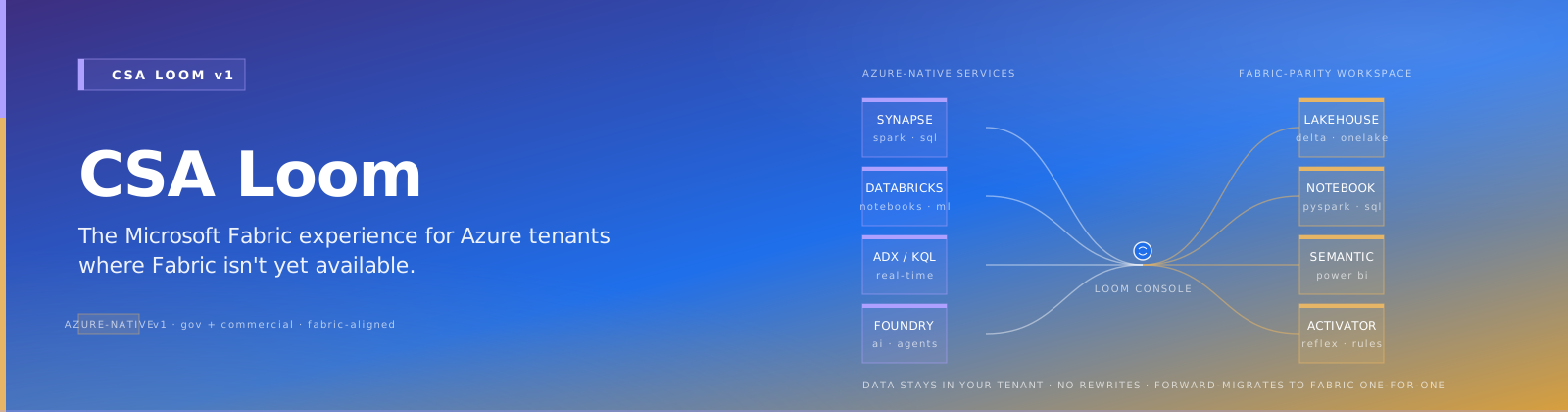
CSA Loom is the Cloud Scale Analytics platform that delivers the Microsoft Fabric experience inside any Azure tenant where Fabric isn't yet generally available — federal civilian, DoD, intelligence community, state + local government, defense industrial base, and regulated commercial verticals.
Loom is Azure-native + open source under the covers and ships as a deployable pillar of Cloud Scale Analytics in a Box. You deploy it into your own subscription; you pay only for what your Azure consumption underneath uses; you migrate forward to Microsoft Fabric one-for-one when Fabric reaches your audit boundary.
What you get
-
One unified workspace experience
A Fluent UI v9 console that mirrors the Microsoft Fabric workspace layout — Lakehouse, Warehouse, Notebooks, Semantic Models, Real-Time Intelligence, Data Agents, Activator — over your existing Azure stack.
-
Push-button deploy
azd upor a singleaz deployment sub createstands the whole platform up in your tenant in 60–100 minutes. A conversational Setup Wizard guides you through capacity sizing, networking, and identity. -
Built for sovereignty
Designed from day one for FedRAMP High, DoD IL4, and DoD IL5 (in v1.1). Per-boundary
.bicepparamfiles. Self-hosted everything; no commercial-cloud dependencies. -
Forward migration is the goal
When Microsoft Fabric reaches your audit boundary, your Delta tables become OneLake shortcuts. Your dbt models, KQL queries, and semantic models port 1:1. You are not trapped in Loom; you are bridged into Fabric.
The pitch in one sentence
Any federal tenant whose audit boundary blocks Microsoft Fabric can deploy CSA Loom into its existing Azure Government tenant in under one day, give its domain teams a workspace experience that looks-and-feels like Fabric, and migrate forward to Fabric one-for-one when Fabric reaches Gov GA — with no rewrites to Delta tables, dbt models, semantic models, or runbooks.
Why "CSA Loom"
The name is two halves working together.
CSA — Cloud Scale Analytics. This is the broader Microsoft pattern family this product ships under. Loom is one pillar of Cloud Scale Analytics in a Box, alongside the data landing zones, the data management zone, and the platform-as-a-product reference architectures. Calling it CSA <something> keeps the lineage explicit: this is the same platform philosophy customers already trust at scale, just shaped for a different audit boundary.
Loom — a weaving machine. A loom is the device that takes many parallel threads and produces a single integrated fabric. That is exactly what this product does:
- The threads are your existing Azure-native services — Synapse Spark + Synapse Serverless SQL, Azure Databricks, Azure Data Explorer, Microsoft Fabric Foundry, Azure Analysis Services (Power BI Premium opt-in), ADF, APIM, Purview, AI Search, Azure OpenAI, Dataverse, Copilot Studio. Each one is a powerful primitive on its own.
- The fabric is a single Fluent UI workspace that looks and feels like Microsoft Fabric — Lakehouse, Notebook, Warehouse, Semantic Model, Real-Time Intelligence, Data Agents, Activator — sitting on top of those threads.
- The loom itself is the orchestration layer: the Cosmos-backed catalog, the BFF, the per-editor wiring, the OneLake-equivalent path conventions, the forward-migration manifests.
Three layers of meaning sit on top of that metaphor, all intentional:
- It rhymes with "Fabric" without colliding with it. Fabric is a Microsoft product brand. Loom is what makes fabric. The name communicates "you get the Fabric experience" without overloading Microsoft's trademark — a requirement of the Microsoft brand-review process this product is going through (LD-1).
- It signals integration over invention. A loom doesn't manufacture the thread, it weaves what's already there. Loom does not replace your Synapse or your Databricks; it weaves them into a single experience. This matters for customers who have spent years standardizing on those services and don't want a re-platforming project.
- It points at the forward-migration story. A loom produces fabric. When Microsoft Fabric reaches your audit boundary, the thing your team has been weaving on Loom is already a fabric — your Delta tables, your dbt models, your TMDL semantic models, your KQL queries port forward 1:1.
The repo-internal nickname is fiab ("Fabric-in-a-Box") because that was the working title during research wave 0 — you'll still see it in folder paths, bicep modules, and image tags. The public brand is CSA Loom; fiab is purely an implementation artifact.
So when you see "CSA Loom" on a slide, hear it on a call, or type azd up against the bicep: read it as the Cloud Scale Analytics weave that produces the Fabric experience inside any Azure tenant.
Where to start
-
Five-minute overview of what Loom is, who it's for, and why now.
-
Workload-by-workload table — what Loom delivers, where there are honest gaps, where parity is exact.
-
Per-layer diagram, tenancy model, per-boundary dispatch, catalog strategy.
-
Quick start, per-path guides (azd CLI,
az deployment sub create), per-boundary deployment. -
One page per Fabric workload — how Loom delivers the parity, the honest gaps, the forward-migration path.
-
One page per cross-cutting capability — trusted answers (verified queries, GraphRAG, receipts), open-lakehouse interop, the migration on-ramp, the FinOps hub — each with its real backend, its honest gates, and its kill-switch flag.
-
5-day Federal CoE and Commercial CoE workshops to stand up your Loom Center of Excellence.
Concepts
Short, accurate answers to the most common questions:
- What is CSA Loom? — five-minute overview with deployment, console, parity services, tenancy model, and Gov boundaries.
- dbt in CSA Loom — how the dbt job item type works, what backends it supports, and how dbt fits the medallion architecture.
- Data Mesh on Azure — what data mesh is, how CSA Loom implements it (domains → DLZs, data products, Marketplace, federated governance), and step-by-step setup.
- Federal Use Cases — federal and government use cases including the FedRAMP Tracker, Federal Data Mesh, Multi-Agency Onboarding, and Sovereign AI Agents app bundles.
Locked architecture (15 decisions)
| # | Decision | Locked value |
|---|---|---|
| LD-1 | Public brand | CSA Loom (repo-internal nickname: fiab) |
| LD-2 | Primary compute | Azure Databricks + Synapse Serverless + Azure Data Explorer + Azure Analysis Services (Power BI opt-in for Direct Lake parity) |
| LD-3 | Cloud boundaries (v1) | Azure Commercial + GCC + GCC-High — GCC is supported-in-code, never exercised — no tenant (recorded decision, 2026-09-03) |
| LD-4 | Deployment shape | Two-tier (azd CLI + az deployment sub create); Marketplace listing deferred to backlog |
| LD-5 | Console framework | Next.js 14 + Fluent UI v9 + MSAL BFF |
| LD-6 | Tenancy | Single-sub + multi-sub modes |
| LD-7 | Direct Lake parity | Azure Analysis Services warm-cache materializer (default); Power BI Premium Import Direct-Lake-Shim (opt-in) |
| LD-8 | IL5 catalog (v1.1) | Apache Atlas on AKS |
| LD-9 | Mirroring engine | OSS Debezium + Spark Structured Streaming + Delta MERGE |
| LD-10 | ADX model | Shared cluster per Admin Plane; database-per-DLZ |
| LD-11 | Workshops | Federal CoE + Commercial CoE day-one |
| LD-12 | Industry examples | 8 in v1; 17 in v1.1 |
| LD-13 | Forward migration | Both directions + hybrid topology first-class |
| LD-14 | Copilot identity | OBO throughout |
| LD-15 | Per-boundary params | Separate .bicepparam files per boundary |
Full architectural decision records: ADRs.
Status
| Item | Status |
|---|---|
| PRD | v1.0 — finalized 2026-05-22 |
| Public brand | CSA Loom (Microsoft brand-review submission tracked under PRP-01) |
| Console build | Live — 117 item-type editors across 22 categories running on Azure-native backends (Azure Commercial reference deployment; Government-ready). Report designer, Fabric IQ family, Marketplace, Learning Hub, MCP catalog, and Copilot all shipped |
| v1 status | Feature-complete across the core Fabric workloads; per-service depth + hardening ongoing (see the parity matrix) |
| v1.1 target | +3 months — DoD IL5 |
| v2 target | +6 months — Fabric Databases (HorizonDB-equivalent). The Fabric IQ family (Ontology / Plan / Graph / Map / Data Agent / Workshop / Slate / OSDK / Release-environment / Health-check / AIP Logic) has already shipped with real Azure-native backends — see the parity matrix |
How Loom relates to Microsoft Fabric
Loom is strictly Fabric-aligned, not Fabric-competing. Every primary design choice (Delta tables, OneLake-equivalent path layout, TMDL semantic models, KQL queries, dbt models, Activator rule JSON, Data Agent configs) is portable to Microsoft Fabric when Fabric reaches your boundary. Customers who run Loom today are investing in a head-start, not a detour.
For the side-by-side: CSA-in-a-Box vs Microsoft Fabric + the new CSA Loom vs Microsoft Fabric.
Related
- GitHub epic: #279 — CSA Loom v1 build roadmap
- Source documents: PRD, Research wave, PRPs
- Existing context: Fabric in Azure Government, CSA-in-a-Box vs Fabric comparison, ADR-0010 Fabric strategic target