What is CSA Loom?
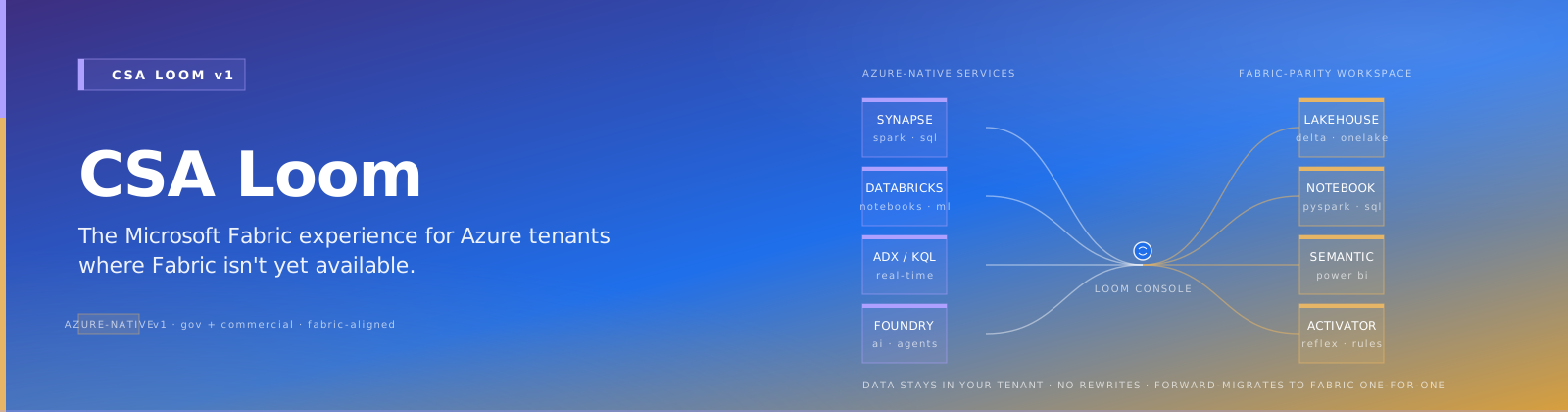
CSA Loom is the Cloud Scale Analytics platform that delivers the Microsoft Fabric experience inside any Azure tenant where Fabric is not yet generally available — federal civilian, DoD, state/local government, regulated commercial, and other sovereignty-constrained environments.
The problem it solves
Microsoft Fabric is not GA in any US Government cloud as of 2026. The Azure Government (GCC-High / IL4, FedRAMP High) and DoD IL5 boundaries all have Fabric listed as Forecasted with no published GA date. Every federal customer that requires FedRAMP High, IL4, IL5, ITAR, CJIS, IRS 1075, CMMC L2/L3, or data-sovereignty controls cannot adopt Fabric today.
CSA Loom fills that gap now, running entirely in your existing Azure Government tenant with no dependency on Microsoft Fabric.
What Loom is
Loom is four things working together:
1. A push-button deployment. azd up or the "Deploy to Azure" button stands the full Loom stack up in your Azure subscription in 60–100 minutes. No Fabric capacity or Fabric workspace is required — everything runs on Azure-native services.
2. A Fluent UI v9 console (Next.js on Azure Container Apps or AKS) that mirrors the Fabric workspace layout: Lakehouse, Warehouse, Notebook, Semantic Model, KQL database, KQL dashboard, Real-Time Intelligence, Data Agents, Activator, and Data Marketplace — all over your existing Azure stack.
3. A conversational Setup Wizard (Loom Copilot) that interviews you about your tenant, subscriptions, boundary, and capacity sizing, renders a live .bicepparam preview, and deploys via a self-hosted Azure MCP server inside your Admin Plane.
4. Parity services that deliver Fabric-only capabilities on Azure-native backends:
| Loom service | What it delivers | Backend |
|---|---|---|
| Direct-Lake Shim | Power BI Direct Lake freshness | Power BI Premium Import + Event Grid TOM refresh |
| Activator Engine | Reflex / Data Activator rules | NRules + Redis + Azure Functions backed by ADX |
| Mirroring Engine | Zero-ETL database mirroring | OSS Debezium + Event Hubs + Spark + Delta MERGE |
| Loom Data Agents | NL2SQL / NL2DAX / NL2KQL chat | Azure OpenAI + AI Search + identity passthrough |
The Azure-native backend
Every Loom item type maps to an Azure service — Fabric is strictly opt-in, never required:
| Loom item | Azure-native backend |
|---|---|
| Lakehouse | ADLS Gen2 + Delta tables |
| Warehouse | Synapse Dedicated SQL pool |
| KQL database / eventhouse | Azure Data Explorer (ADX) |
| Data pipeline | Synapse pipeline or ADF |
| Eventstream | Azure Event Hubs + Stream Analytics |
| Semantic model | Loom-native tabular layer over warehouse/lakehouse |
| Report | Loom-native report renderer; Power BI Premium optional |
| Catalog / domains | Microsoft Purview (Commercial/GCC/GCC-H) or Apache Atlas on AKS (IL5) |
Tenancy model
Loom aligns with Microsoft CAF's Cloud Scale Analytics pattern:
- Admin Plane — one subscription per organization (the Data Management Zone); hosts the Console, MCP server, Copilot, shared catalog, and shared ADX cluster.
- Data Landing Zone (DLZ) — one subscription per domain, agency, or mission; each DLZ's spoke VNet peers to the Admin Plane hub VNet.
- Workspace — a data product inside a DLZ (a resource group with Loom items: lakehouses, warehouses, notebooks, pipelines, etc.).
Gov boundaries
| Boundary | Loom availability | Container compute | Catalog |
|---|---|---|---|
| Azure Commercial / GCC | GA (v1) | Container Apps | Databricks Unity Catalog + Purview overlay |
| FedRAMP High / GCC-H / IL4 | v1 | AKS | Microsoft Purview (primary) |
| DoD IL5 | v1.1 | AKS | Apache Atlas on AKS |
Forward migration
When Microsoft Fabric reaches your audit boundary, your Loom investment ports forward 1:1: Delta tables become OneLake shortcuts, dbt models run unchanged, TMDL semantic models are identical, KQL queries are identical. You are not trapped in Loom — Loom is the bridge to Fabric.
Get started
- Reference architecture — per-layer diagram, per-boundary dispatch matrix, catalog strategy.
- Deployment quickstart —
azd upor Deploy-to-Azure button. - Parity matrix — workload-by-workload coverage and honest gaps.
- Workloads — one page per Fabric workload.