Portal architecture — where admins and users go
The customer-facing answer to: "Where is the admin portal? Where is the user portal? How is this SaaS-like the way Fabric is?"
The short answer: ONE portal
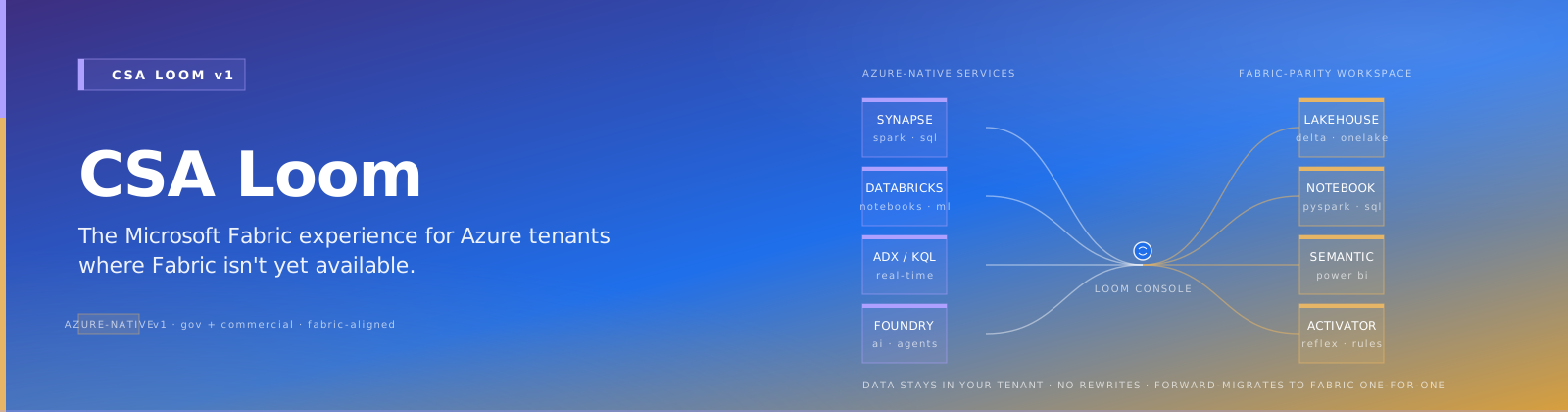
Loom Console is the single SaaS-style entry point — same UI as Microsoft Fabric's workspace experience. There is NOT a separate "admin portal" and "user portal" — there's one Console with role-gated panes, exactly the way Fabric works:
| What you see depends on... | Loom group membership | Fabric equivalent |
|---|---|---|
| Setup Wizard pane | Loom Admins | Fabric Admin Portal |
| Lakehouse / Warehouse / Notebook | Workspace member | Fabric workspace items |
| Semantic Model pane | Workspace member with build perm | Fabric semantic model |
| Activator pane | Workspace member with build perm | Reflex / Data Activator |
| Data Agent pane | Workspace member | Fabric Data Agents |
| Workspaces (home) | Anyone with any workspace assignment | Fabric Home |
The 8 panes are coded in apps/fiab-console/lib/panes/ and the nav visibility is controlled at the BFF layer (route guards in app/api/workspaces/route.ts filter workspaces by caller's oid + group membership in Cosmos).
URL
After successful deploy with deployAppsEnabled=true:
The <random-suffix> is the Container Apps Env default-domain (deterministic per-env). Example from iter #8: https://loom-console.delightfulmoss-96202bfd.eastus2.azurecontainerapps.io
Why VNet-internal
By design (security baseline for federal customers): Console ingress is external: false in app-deployments.bicep. The ingress only accepts traffic from inside the Hub VNet. Three access patterns for end users:
Pattern A — Bastion + jumpbox (default, federal)
Operator deploys a Windows or Linux jumpbox VM in snet-workloads, end users RDP/SSH via Azure Bastion, then browse to the Console URL from the jumpbox.
Pros: full network isolation; aligns with FedRAMP High / IL5 access patterns; only Bastion is internet-exposed (with MFA).
Cons: ceremony for end users; not a true "click a link" SaaS UX.
Pattern B — Azure Front Door + WAF + Private Link Origin (production)
Operator adds: - An Azure Front Door (Standard/Premium) with WAF Premium - A Private Link service from the Container Apps Env - A Front Door origin pointing at the Private Link service - Front Door custom domain (e.g., loom.yourorg.com)
End users browse https://loom.yourorg.com from anywhere; Front Door terminates TLS + applies WAF rules + tunnels through Private Link to the internal Console. This is what makes it feel like Microsoft Fabric — public hostname, but private origin.
Bicep stub provided at platform/fiab/bicep/modules/admin-plane/public-frontdoor.bicep (gated behind publicFrontdoorEnabled = false by default).
Pattern C — Demo/POC: flip ingress to external
For first-touch demos only, operator can flip the Container App ingress to external: true temporarily:
az containerapp ingress update --name loom-console \
  --resource-group rg-csa-loom-admin-eastus2 \
  --type external
# After demo:
az containerapp ingress update --name loom-console \
  --resource-group rg-csa-loom-admin-eastus2 \
  --type internal
Now https://loom-console.<env-default>.eastus2.azurecontainerapps.io is reachable from any browser. MSAL auth still required — non-members get an Entra-side login redirect.
Role-based pane visibility
Mirrors Fabric's Member / Contributor / Admin / Viewer model.
| Loom group | Console panes visible | Action permissions |
|---|---|---|
| Loom Admins (tenant) | All 8 panes including Setup Wizard | Provision DLZs, manage capacity, manage RBAC |
| Loom Workspace Admins (per-WS) | 7 panes (no Setup Wizard) | Full CRUD inside workspace |
| Loom Workspace Members (per-WS) | 7 panes | Create + edit items |
| Loom Workspace Viewers (per-WS) | 7 panes | Read-only |
| Loom Domain Stewards (per-domain) | Governance pane + read all WS in domain | Cross-workspace policy |
These groups are Entra security groups; assignment is the operator's responsibility (typical: tied to existing AD groups).
SaaS-feel design choices that match Fabric
- Persistent left nav with item-type icons (Workspaces, Lakehouse, Warehouse, Notebook, Semantic Model, Activator, Data Agent, Setup) — matches Fabric's left rail
- Fluent UI v9 components throughout — Microsoft's official UI library, same library Fabric uses
- Dark/light theme auto-detected from OS preference — like Fabric
- Brand top bar with woven motif (CSA Loom identity) — analogous to Fabric's "Microsoft Fabric" header
- MSAL BFF auth — same SSO flow as Fabric (Entra ID redirect → session cookie → server-side token exchange)
- OBO identity throughout — every Data Agent query, every Activator action runs as the calling user (RLS/CLS applies), same as Fabric
What this means for "have we built the Fabric experience?"
✅ Yes for the architecture + code: - 8 panes coded matching Fabric's surface - Auth, telemetry, RBAC, branding all in place - Connects to real backing services (Databricks, Synapse, ADX, Cosmos, Event Hubs, Power BI XMLA)
⏳ Pending for the running experience: - Container images need to be built + pushed to ACR (in flight via full-app-deploy-commercial workflow) - Bicep needs to re-deploy with deployAppsEnabled=true (the workflow does this in its redeploy-with-apps job) - End user needs Bastion access OR Front Door deployed (operator decision)
Related
- App code:
apps/fiab-console/ - Bicep app deploy:
platform/fiab/bicep/modules/admin-plane/app-deployments.bicep - Console pane catalog: Loom Console panes
- Operator deploy playbook: First Deploy
- Iteration log: Deploy Iteration Log