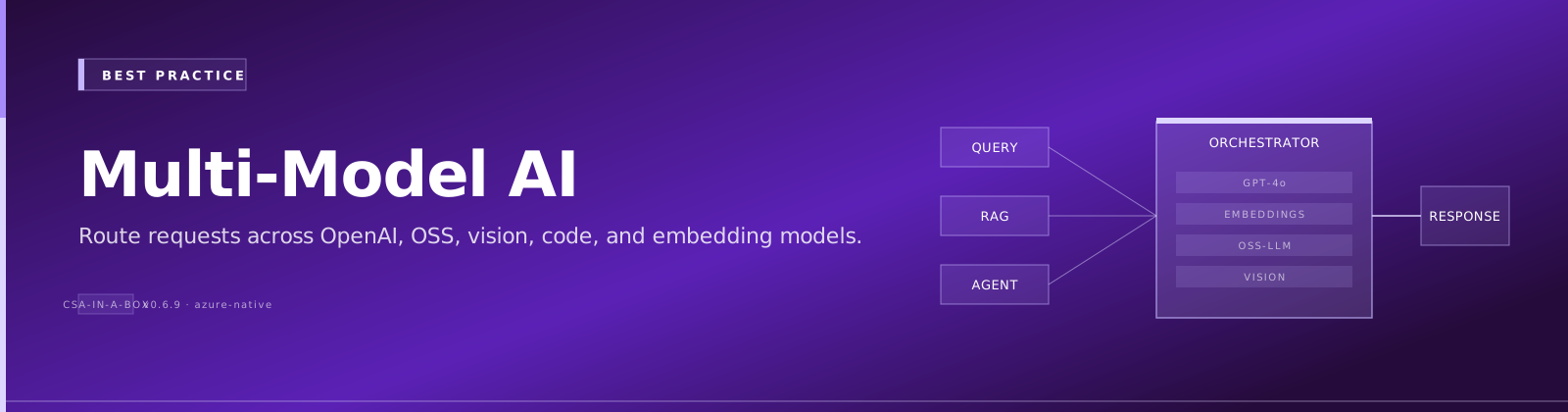
Best Practice — Multi-Model AI Orchestration
Comparative positioning note. This document is written from the perspective of Microsoft Azure, Cloud Scale Analytics, and CSA Loom. Any description of third-party or competing products, services, pricing, or capabilities is derived from publicly available documentation and sources believed accurate at the time of writing, and is provided for general comparison only. We do not claim expertise in, or authority over, any non-Microsoft product or service; the respective vendor's official documentation is the authoritative source for their offerings, which may change over time. Nothing here is intended to disparage any vendor — where a competing product has genuine advantages, we aim to note them honestly. Verify all third-party details against the vendor's current official documentation before making decisions.
The principle
No single model wins every task. The platform decision is the model-routing layer, not the model. Build the routing layer on day one; pick models as commodities.
Three years into the LLM era, frontier, open-weight, sovereign, and small task models all coexist in production. A serious enterprise architecture treats the model as a configurable backend, not a hardcoded dependency. This page is the opinionated playbook for orchestrating multiple models behind a single gateway on Azure.
The model portfolio
Most production deployments end up with five tiers of models in parallel:
| Tier | Examples | Hosting | Typical use |
|---|---|---|---|
| Frontier general | GPT-4o, GPT-4.1, o-series, Claude (via Foundry MaaS where available) | Azure OpenAI / Foundry MaaS | Reasoning, broad NL, code, agentic |
| Open-weight (cost / sovereign) | Llama 3.x, Mistral Large, DeepSeek-V3, Phi-4 | Foundry MaaS | Cheaper inference, data-boundary sensitivity |
| Small task-specific | Phi-4-mini, distilled classifiers, embedding models | Foundry MaaS or containerized | High-volume cheap inference; edge |
| Domain fine-tunes | Custom-tuned models on enterprise data | Foundry custom-deployment | Specialized tasks (legal, scientific, mission) |
| External / sovereign | Bedrock-hosted, sovereign LLM gateways, partner-hosted | Brokered via APIM | Existing investments, sovereign accreditation |
Each tier has cost / latency / capability / boundary characteristics. Routing decisions select among them at runtime.
The routing layer — APIM as multi-model gateway
The routing layer lives in APIM, not in application code. Reasons:
- One identity / governance / observability surface across every model call
- Token budgets per consumer apply across all backends — the consumer is bounded regardless of which model they hit
- Caching, content safety, and metric emission apply at the gateway with no per-application code
- Model swap-outs happen in policy, not in code — no redeployments to switch a workload from GPT-4o to Mistral
Minimum policy set for a multi-model API
<policies>
  <inbound>
    <base />
    <validate-jwt header-name="Authorization" failed-validation-httpcode="401">
      <openid-config url="https://login.microsoftonline.com/{tenant}/v2.0/.well-known/openid-configuration" />
    </validate-jwt>
    <!-- Per-subscription token budget — protects against runaway agent loops -->
    <azure-openai-token-limit
        counter-key="@(context.Subscription.Id)"
        tokens-per-minute="100000"
        estimate-prompt-tokens="true"
        remaining-tokens-header-name="x-ratelimit-remaining-tokens" />
    <!-- Semantic cache — cuts cost 30-70% on repeated questions -->
    <azure-openai-semantic-cache-lookup
        score-threshold="0.85"
        embeddings-backend-id="aoai-embeddings"
        embeddings-deployment-id="text-embedding-3-large"
        ignore-system-messages="true" />
    <!-- Content safety inline -->
    <llm-content-safety backend-id="content-safety">
      <categories>
        <category name="Hate" threshold="4" />
        <category name="Violence" threshold="4" />
        <category name="SelfHarm" threshold="4" />
        <category name="Sexual" threshold="4" />
      </categories>
    </llm-content-safety>
    <!-- Backend pool selection by route -->
    <set-backend-service backend-id="aoai-pool" />
  </inbound>
  <backend><forward-request /></backend>
  <outbound>
    <base />
    <!-- Cache the response keyed by semantic similarity -->
    <azure-openai-semantic-cache-store duration="3600" />
    <!-- Emit token usage for chargeback -->
    <azure-openai-emit-token-metric>
      <dimension name="subscription-id" />
      <dimension name="model-id" />
      <dimension name="api-name" />
    </azure-openai-emit-token-metric>
  </outbound>
</policies>
This is the production-grade answer to four hard problems at once: cost control, latency control, content safety, and chargeback telemetry. No native equivalent exists on a competing cloud's API gateway, nor on a competing integration platform.
Routing strategies
Pick one explicit strategy per API endpoint. Mixed strategies in one code path are a pathology.
Strategy A — Static routing
One endpoint → one model. Simplest. Use for capability-bound workloads (e.g., a vision-capable endpoint that requires GPT-4o).
Strategy B — Cost-aware tiered routing
Default to a cheaper model; escalate to frontier on signal:
graph LR
    REQ[Request] --> CLASS[Classifier<br/>Phi-4-mini · 1ms]
    CLASS -->|simple| SMALL[Mistral / Phi]
    CLASS -->|complex| LARGE[GPT-4o]
    CLASS -->|reasoning| REASON[o-series]
Use when: workload has a wide cost / complexity distribution; latency tolerates an extra hop.
Strategy C — Capability-bound routing
Choose model per declared capability requirement in the request:
APIM evaluates the header and routes to the matching backend.
Strategy D — Multi-region fallback pool
One logical model, several regional deployments behind it. APIM backend pool with circuit breakers handles 429 / quota exhaustion automatically:
graph LR
    CLIENT --> APIM
    APIM --> AOAI1[AOAI East US]
    APIM --> AOAI2[AOAI West US]
    APIM --> AOAI3[AOAI Europe]
    AOAI1 -.-> CB[Circuit breaker on 429]
    AOAI2 -.-> CB
    AOAI3 -.-> CB
Use as the default for any production AOAI deployment.
Strategy E — Tenant-bound routing
Different consumers route to different backends — for sovereign-data boundaries, partner-specific fine-tunes, or cost tiering by SLA.
<choose>
  <when condition="@(context.Subscription.Name == "tenant-sovereign")">
    <set-backend-service backend-id="aoai-sovereign-pool" />
  </when>
  <when condition="@(context.Subscription.Name == "tenant-cost-tier")">
    <set-backend-service backend-id="maas-mistral-pool" />
  </when>
  <otherwise>
    <set-backend-service backend-id="aoai-default-pool" />
  </otherwise>
</choose>
Cost governance
Token budgets
Every consuming subscription has a token-per-minute budget enforced at APIM. Tiers:
| Tier | Tokens/min | Tokens/month | Typical use |
|---|---|---|---|
| Sandbox | 10,000 | 5M | Developer exploration |
| Dev / test | 50,000 | 50M | Application QA |
| Production small | 100,000 | 500M | Standard production workload |
| Production large | 1,000,000 | Negotiated | Heavy production workload |
Budgets are enforced not requested. Consumers who blow past their budget get 429; FinOps reviews escalations.
Semantic caching
For FAQ-style traffic and repeated agent prompts, semantic caching cuts cost 30–70%:
score-threshold0.85 is a sane default; 0.9 for higher safety, 0.8 for higher hit rateignore-system-messagestrue — most prompt variation is in system role- TTL — 1 hour for highly dynamic data, 24 hours for stable knowledge
Measure hit rate per API; tune threshold per workload.
Chargeback
azure-openai-emit-token-metric with subscription-id, model-id, and api-name dimensions feeds a chargeback dashboard. Hook into FinOps monthly reporting:
| Dimension | What it shows |
|---|---|
subscription-id | Which consuming application |
model-id | Cost driver: frontier vs commodity |
api-name | Which workload (chat, embeddings, etc.) |
tenant (custom) | Per-tenant billing in multi-tenant scenarios |
Content safety
Three layers, applied in order:
- Prompt-side guard — APIM
llm-content-safetypolicy on inbound request body - Model-side guard — Azure OpenAI / Foundry built-in content filters at model invocation
- Response-side guard — APIM
llm-content-safetyon outbound response body
For agentic workloads, add prompt-injection detection via Azure AI Content Safety Prompt Shields on tool-call inputs and outputs.
For mission / regulated environments, the policy thresholds tighten:
| Category | Standard | Mission / regulated |
|---|---|---|
| Hate | 4 | 2 |
| Violence | 4 | 2 |
| Self-harm | 4 | 2 |
| Sexual | 4 | 2 |
| Prompt-injection | On | On with response blocking, not just annotation |
Evaluation discipline
Models are commodity; prompts and tools are the differentiated asset. Treat them as code:
- Prompts versioned in source control
- Eval datasets versioned in source control
- Foundry Evaluations runs continuously in CI on prompt or model changes
- Regression on capability metrics blocks deployment
- A/B testing in production with shadow traffic before flipping route weights
The eval-on-every-prompt-change discipline catches the silent regressions that destroy agent workloads.
Lifecycle management
Model versions, fine-tunes, prompt versions, and agent definitions all need lifecycle treatment:
| Artifact | Lifecycle |
|---|---|
| Model deployment | Version-pinned in APIM backend; rotation via new deployment + DNS swap |
| Prompt | Versioned in repo; deployed via CI; A/B tested |
| Fine-tune | Catalogued in Purview AI registry; eval results attached |
| Agent | Catalogued in Foundry Agent registry; tied to MCP tool definitions; lifecycle owner named |
| MCP server | Catalogued in APIM as an API; OpenAPI / tool manifest published |
Retirement is announced. Deprecated artifacts return 410 after sunset.
The MCP layer
Model Context Protocol servers — exposing tools and resources to model clients — sit behind APIM in the recommended architecture:
graph LR
    AGENT[Agent] --> APIM
    APIM --> MCP1[MCP: Dataverse]
    APIM --> MCP2[MCP: Graph]
    APIM --> MCP3[MCP: Databricks]
    APIM --> MCP4[MCP: EAM]
    APIM --> MCP5[MCP: Web]
APIM in front of MCP gives:
- Token budgets across all MCP tool calls per consumer
- Per-tool authorization via Entra scope mapping
- Observability per tool with App Insights dimensions
- Easy retirement / replacement of one MCP server without changing the agent
- Versioning of tool catalogs
See the APIM + MCP guide for implementation.
Anti-patterns to refuse
| Anti-pattern | Refuse because |
|---|---|
| Hardcoding a model SDK in the application | Wrong layer; the model should be configurable backend |
| Letting each app implement its own token budgeting | Re-implements platform capability; loses cross-app limits |
| Skipping semantic cache "until we measure cost" | The cost shows up when it's too late; semantic cache is cheap to enable and cheap to remove |
| Letting each app implement its own content safety | Inconsistent; an audit finding waiting to happen |
| Letting each app log its own token usage | Chargeback breaks at the moment you need it |
| Deploying a fine-tune without an eval baseline | Regression-prone; impossible to operate at scale |
| "We don't need MCP yet" | Build the gateway with MCP in mind; bolting it on later costs more |