Cloud Scale Analytics in a Box
Comparative positioning note
This document is written from the perspective of Microsoft Azure, Cloud Scale Analytics, and CSA Loom. Any description of third-party or competing products, services, pricing, or capabilities is derived from publicly available documentation and sources believed accurate at the time of writing, and is provided for general comparison only. We do not claim expertise in, or authority over, any non-Microsoft product or service; the respective vendor's official documentation is the authoritative source for their offerings, which may change over time. Nothing here is intended to disparage any vendor — where a competing product has genuine advantages, we aim to note them honestly. Verify all third-party details against the vendor's current official documentation before making decisions.
A deployable, Azure-native data platform — Data Mesh, Data Fabric, and Data Lakehouse — for teams who can't get Microsoft Fabric yet, or who deliberately don't want SaaS and need full control of their environment.
CSA-in-a-Box assembles Azure PaaS/IaaS services and open-source tooling into an opinionated, end-to-end platform that delivers Data Mesh, Data Fabric, and Data Lakehouse capabilities today, on services available in Azure Government (IL4/IL5) now. It follows the same data-mesh, data-fabric, and lakehouse principles as Microsoft's Cloud Adoption Framework data-platform guidance. Use it as an on-ramp to Microsoft Fabric (migrate workload by workload as Fabric reaches your cloud) or as a permanent, self-operated alternative when SaaS isn't an option — by mandate or by choice.
Personal project — not an official Microsoft offering
CSA-in-a-Box and CSA Loom are a personal, community reference project maintained by @fgarofalo56. They are not official Microsoft products, services, or guidance, are not endorsed or supported by Microsoft, and do not represent Microsoft's positions. Compliance pages are reference control mappings to help you build toward an authorization — not attestations, certifications, or authorizations to operate (ATO).
New: CSA Loom — the productized Microsoft Fabric parity layer
For federal / DoD / IC / state + local customers blocked from Microsoft Fabric: CSA Loom is the productized SaaS-feel deployment of CSA-in-a-Box. Loom Console (Fabric workspace experience), Loom Setup Wizard (conversational deploy), parity services for Direct Lake / Activator / Mirroring / Data Agents. Free in v1. Learn more →
Fork it, deploy it, customize it. Production-grade Bicep + reference code you own and operate.
Maturity — read this before you plan a rollout (as of 2026-06-02)
Be clear-eyed about what is battle-tested versus what is reference material. This repo mixes both on purpose, and the line matters when you scope a deployment.
Production-tested and deployed (run live, validated against real Azure backends):
- The landing-zone Bicep (ALZ + DMLZ + DLZ) and the medallion ADLS Gen2 / Delta storage layout — these deploy end-to-end and are the foundation everything else sits on.
- The dbt medallion transforms (Bronze → Silver → Gold), data-quality gates (dbt tests + Great Expectations), and data contracts — exercised by the vertical examples.
- CSA Loom console service navigators over real Azure/Fabric REST and data-plane calls — Databricks, Synapse, Azure SQL, Cosmos DB, AI Search, ADX, APIM, Event Hubs, Power BI/Fabric semantic. These are deployed and verified live (see the parity scorecard). Their depth varies — most sit at B/C grade with genuine missing breadth, not at full 1:1 Azure parity.
Reference-only / illustrative (sound patterns, but treat as a starting point — adapt and harden before production):
- The vertical examples (USDA, NOAA, EPA, casino, tribal-health, etc.) ship seed-data generators and synthetic data — they demonstrate end-to-end patterns, not certified workloads.
- Compliance pages are control mappings to help you build toward an authorization. They are not attestations, certifications, or an ATO.
- The Terraform path and Fabric Deployment Pipelines Git/CI integration are on the roadmap, not built — see the parity matrix below for the honest per-capability state. (The Mapping Data Flow and Synapse-notebook visual designers and the Unity Catalog write surface have since shipped — real ADF data-flow REST, Synapse notebook authoring, and Unity Catalog create/GRANT — and are graded in the matrix below.)
Start the 30-min tour Quickstart (5 min) View on GitHub
Start here
Four pages cover the full path from "what is this?" to "deployed in production."
-
Quickstart
Deploy a working CSA platform end-to-end in 60–90 minutes — infra, seed data, dbt medallion, streaming.
-
Architecture
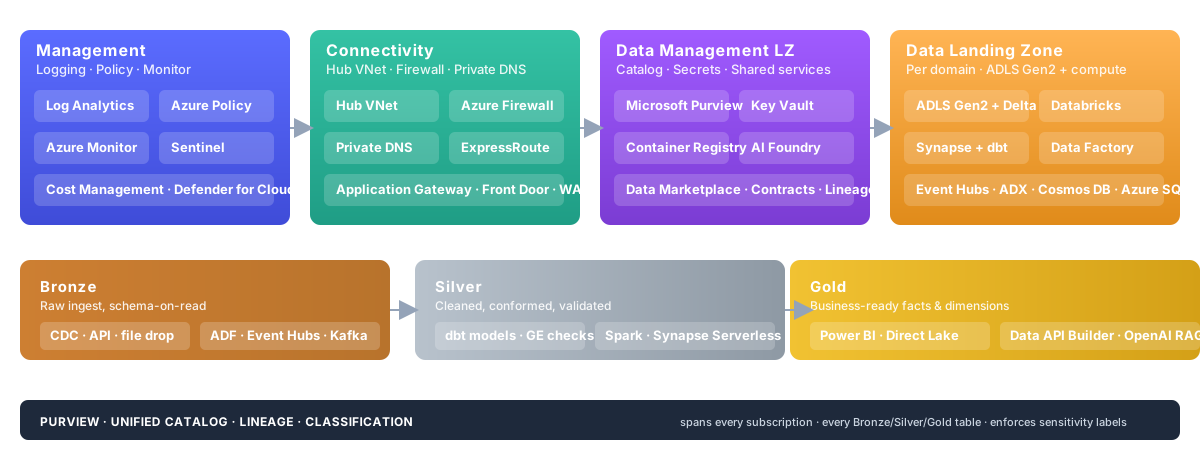
Four-subscription landing zone: Management, Connectivity, Data Management LZ, Data Landing Zone — with Delta Lake medallion layers.
-
Compliance
NIST 800-53, FedRAMP, CMMC 2.0 L2, HIPAA, SOC 2, PCI-DSS, and GDPR — control mappings with Azure-native implementations.
-
AI Copilot
Ask questions about the codebase, architecture, and troubleshooting with the in-page AI assistant.
Why teams use it
-
Azure Government gap-filler
Microsoft Fabric is forecast — not GA — in Azure Government. This repo ships the Fabric-parity stack (lakehouse, mesh, streaming, AI/ML, governance) on Azure PaaS services available in Gov (IL4/IL5) today.
-
CAF "Unify Your Data Platform" reference
The CAF Cloud-Scale Analytics scenario was deprecated in April 2026 in favor of Fabric-first guidance. For teams who need an end-to-end Bicep reference that is not yet a Fabric workspace, CSA-in-a-Box fills that gap.
-
Incremental on-ramp to Microsoft Fabric
Every capability maps to a Fabric equivalent. Teams that start here migrate one workload at a time into Fabric as Gov availability lands or Commercial procurement fits. See the Supercharge Microsoft Fabric companion site for hands-on Fabric tutorials and best practices.
The principles behind the platform
CSA-in-a-Box is not just a collection of Bicep modules — it is a working implementation of three converging data architecture paradigms that together define what "cloud-scale analytics" means in practice.
flowchart LR
    classDef mesh   fill:#0078D4,stroke:#003E6F,color:#FFFFFF,stroke-width:2px,font-weight:bold
    classDef fabric fill:#5C2D91,stroke:#3A1B5F,color:#FFFFFF,stroke-width:2px,font-weight:bold
    classDef lake   fill:#0099BC,stroke:#005A6E,color:#FFFFFF,stroke-width:2px,font-weight:bold
    classDef hub    fill:#FFB900,stroke:#7A3F00,color:#1F1F1F,stroke-width:3px,font-weight:bold

    M1[Domain-owned<br/>data products]:::mesh
    M2[Self-serve<br/>infrastructure]:::mesh
    M3[Federated<br/>governance]:::mesh

    F1[Purview<br/>catalog]:::fabric
    F2[Lineage +<br/>classification]:::fabric
    F3[Marketplace<br/>API]:::fabric

    L1[Delta Lake on<br/>ADLS Gen2]:::lake
    L2[Medallion<br/>Bronze→Silver→Gold]:::lake
    L3[Databricks +<br/>Synapse engines]:::lake

    HUB((CSA-in-a-Box<br/>Azure platform)):::hub

    M1 --> HUB
    M2 --> HUB
    M3 --> HUB
    F1 --> HUB
    F2 --> HUB
    F3 --> HUB
    L1 --> HUB
    L2 --> HUB
    L3 --> HUB

    subgraph MESH["Data Mesh — domain ownership"]
        M1
        M2
        M3
    end
    subgraph FABRIC["Data Fabric — unified governance"]
        F1
        F2
        F3
    end
    subgraph LAKE["Data Lakehouse — Delta medallion"]
        L1
        L2
        L3
    end
Data Mesh — domain-oriented ownership
Data Mesh treats data as a product owned by the domain that produces it, not a centralized team. In CSA-in-a-Box:
- Domain-oriented Data Landing Zones — each business domain (finance, sales, inventory) owns its own DLZ subscription with its own ADLS Gen2 storage, compute, and pipelines.
- Self-serve data infrastructure — domain teams deploy from shared Bicep modules and dbt project templates without waiting on a central platform team.
- Federated computational governance — Purview enforces classification, lineage, and access policies across all domains from the central DMLZ, while domain teams retain ownership of their data products.
- Data product contracts — YAML-defined contracts specify schema, SLAs, freshness guarantees, and ownership, enabling consumers to discover and trust data across domain boundaries.
Data Fabric — unified metadata & governance
Data Fabric provides an integrated layer of metadata, governance, and automation that spans all data assets regardless of where they live. In CSA-in-a-Box:
- Microsoft Purview is the unified catalog — scanning, classifying, and tracking lineage across ADLS Gen2, Databricks, Synapse, Azure SQL, and Cosmos DB.
- Automated governance — sensitivity labels, access policies, and compliance controls propagate across data assets without manual tagging.
- Cross-domain data discovery — the Data Marketplace API enables self-service search, access requests, and data product registration.
- Lineage from source to dashboard — end-to-end tracking from ingestion (ADF) through transformation (dbt/Spark) to consumption (Power BI, APIs).
Data Lakehouse — Delta Lake medallion
The Data Lakehouse unifies data lakes (scalable, open storage) with data warehouses (ACID transactions, schema enforcement, BI performance). In CSA-in-a-Box:
- Delta Lake on ADLS Gen2 — open-format, ACID-compliant tables on low-cost cloud storage, readable by Spark, Synapse Serverless SQL, and Power BI without data movement.
- Medallion architecture (Bronze / Silver / Gold) — raw → validated → business-ready, with quality gates enforced by Great Expectations at each transition.
- Unified batch and streaming — the same Delta tables serve both batch pipelines (ADF + dbt) and streaming workloads (Event Hubs + Spark Structured Streaming).
- Compute diversity — Databricks, Synapse Spark, and Synapse Serverless SQL all query the same lakehouse, so teams pick the engine that fits their workload without duplicating data.
Why "one-stop shop"? Most reference implementations cover one of these paradigms. CSA-in-a-Box implements all three — plus AI/ML integration, control mappings across the major federal and commercial compliance frameworks, a library of migration playbooks and end-to-end vertical examples, and production runbooks — in a single, fork-ready repository.
Choose your path
-
Tutorials
11 step-by-step tutorials from Foundation to Data API Builder.
-
End-to-end examples
18 vertical implementations across federal, healthcare, financial, gaming, and more.
-
Best practices
9 guides covering medallion, engineering, governance, security, cost, and more.
-
Migrations
11 playbooks for AWS, GCP, Snowflake, Databricks, Teradata, Hadoop, and more.
-
Production checklist
Pre-production readiness, FinOps guidance, and operational runbooks.
-
Troubleshooting
Common issues, fixes, and the developer pathway by role.
Use Fabric, or use this?
CSA-in-a-Box is not a blanket substitute for Microsoft Fabric. If Fabric is GA in your cloud and you're comfortable with SaaS, Fabric is usually the right answer — and the Supercharge Microsoft Fabric companion site has the hands-on tutorials, POC agendas, and notebooks for it.
Choose CSA-in-a-Box when either is true:
- Fabric isn't available to you — Azure Government / DoD / IC, or a region where Fabric isn't GA yet.
- You won't run on SaaS — sovereignty, data residency, custom networking, dedicated capacity, or full operational control mean a multi-tenant managed plane is off the table. Here CSA-in-a-Box is a permanent choice, not a stopgap.
Which one do I use?
| Your situation | Use |
|---|---|
| Fabric is GA in your cloud and you want it (SaaS, Microsoft-managed) | Microsoft Fabric + Supercharge Microsoft Fabric |
| Fabric isn't available in your cloud yet (Gov / DoD / IC) | CSA-in-a-Box (this repo) |
| You could get Fabric but won't take SaaS — control / sovereignty / custom networking | CSA-in-a-Box (permanent, by design) |
| You want the CSA stack with a Fabric-like console + guided deploy | CSA Loom |
For the full decision logic see the Fabric vs. Databricks vs. Synapse decision tree and ADR-0010: Fabric Strategic Target. The Fabric-equivalent capability matrix is immediately below.
Fabric parity matrix
This is the honest, capability-by-capability map of where CSA-in-a-Box / CSA Loom stands against each Microsoft Fabric workload. Fabric capabilities and workload names are grounded in Microsoft Learn — What is Microsoft Fabric? and the end-to-end Fabric architecture. The "CSA/Loom equivalent" column names the actual Azure service plus the Loom editor that surfaces it. Status is candid, not aspirational, and is derived from the live parity scorecard:
- ✅ At parity — real control + real Azure backend, deployed and verified. Depth may still trail the richest Azure tabs; the per-service parity docs record exactly what.
- ⚠️ Honest gate / partial — the surface renders and works, but a flagship sub-feature is read-only, infra-gated (a Fluent MessageBar naming the env var/role to provision), or routed out. Not a dead button.
- ➖ Not built — no Loom surface for this Fabric capability yet; on the roadmap.
| Fabric capability | Fabric workload/feature | CSA/Loom equivalent (Azure service + Loom editor) | Status |
|---|---|---|---|
| Lakehouse | OneLake Lakehouse — Tables/Files explorer, SQL analytics endpoint, Load-to-Tables | ADLS Gen2 (Delta) + Synapse Serverless SQL · Loom Lakehouse editor | ✅ explorer, preview, T-SQL, upload, context menu, download all real. OneLake shortcuts now ship as a real lakehouse-shortcut item — a named abfss:// pointer resolved + verified against ADLS Gen2 (read-in-place, no copy) with no OneLake/Fabric dependency. |
| Warehouse | Fabric Warehouse — T-SQL editor, CTAS, save-as-view, Open-in-Excel, relationships/permissions | Synapse Dedicated SQL pool (TDS) · Loom Warehouse editor | ✅ B+ — SQL authoring, CTAS, .iqy export, relationships, permissions all real. ➖ no-code visual Power Query canvas not built; Git is workspace-level (honest-gate). |
| Data Factory — Pipelines | Fabric/ADF data pipelines — orchestration, control flow, copy activity | Azure Data Factory · Loom pipeline editor (React Flow canvas) | ⚠️ pipeline canvas built on real ADF REST; Copy Data Tool wizard, Add-Dynamic-Content expression builder, connector galleries + Test-Connection, and Publish/Git/ARM are not yet built. |
| Data Factory — Mapping Data Flow | Visual source→transform→sink dataflow with data preview/debug | ADF Mapping Data Flow · Loom Mapping Data Flow designer | ✅ real React Flow source→transform→sink designer that round-trips DFS to the ADF data-flow REST (Microsoft.DataFactory/factories/dataflows). Data preview/debug is an honest gate (needs an ADF debug session). |
| Dataflows Gen2 | Power Query Online ETL (visual, reusable) | Power Query / ADF · (no dedicated Loom Dataflow canvas) | ➖ not built as a visual surface. dbt + ADF pipelines are the supported transform path today. |
| Notebooks / Spark (Data Engineering) | Fabric notebooks — cells, %% magics, attach-pool, Run/Run-all, viz | Azure Databricks (notebooks/Spark, Unity Catalog) + Synapse Spark · Loom Databricks + Synapse editors | ✅ Databricks Spark/notebook surface is the strongest service (grade A); the Synapse notebook authoring editor now ships (cells + per-cell run over the Synapse notebook/Livy REST). Databricks Unity Catalog write surface ships — create catalog/schema/table (column designer), GRANT/REVOKE, external locations / storage credentials / Lakehouse Federation connections, governed tags + ABAC, registered-model securables, and lineage (B+). |
| Real-Time Intelligence / KQL | Eventhouse + KQL database, eventstreams, KQL query | Azure Data Explorer (Kusto) + Event Hubs + Stream Analytics · Loom ADX (Kusto) + Eventstream editors | ⚠️ real .show / KQL execution + DB policies built (C+). Rich results grid (sort/group/pivot/profile), Open-in-Excel/Power BI export, and cluster lifecycle/RBAC not yet built. |
| Eventstreams | No-code stream ingest/transform/route | Event Hubs · Loom Eventstream + Event Hubs editors | ⚠️ Eventstream React Flow canvas built; Event Hubs Send is real REST. Data Explorer receive is an honest AMQP-dependency gate; SAS/connection-string copy, Capture authoring, auto-inflate not built. |
| Semantic models / Power BI | Direct Lake semantic models, reports, Power BI service | Azure Analysis Services + Synapse / Databricks SQL (over Delta) · Loom semantic-model / report designer / scorecard editors | ⚠️ A Loom-native report designer now ships — report pages, a visual gallery, field wells, live DAX, save, and an in-editor Power BI-style Copilot — running on Azure Analysis Services with no Power BI or Fabric workspace required; semantic-model list/detail and scorecard surfaces built (B). Lineage view, sensitivity labels, and gateway-credential sign-in not yet built. |
| OneLake | Single logical lake, zero-copy across workloads | ADLS Gen2 + Unity Catalog (conceptual unified metadata) | ⚠️ the storage substrate (ADLS Gen2 + Delta + Unity Catalog) is real and deployed; there is no single-namespace OneLake equivalent — it is multiple storage accounts unified by Unity Catalog, not one logical lake. |
| Data Activator | Reflex — detect conditions in data, trigger alerts/actions | csa_platform/data_activator/ (Event Grid + Functions + Teams/email) · Loom Activator surface | ⚠️ event-driven alerting deployed via Azure-native services; not a 1:1 of the Fabric Activator rule-authoring UX. |
| Purview governance | Built-in Purview — catalog, classification, lineage, sensitivity labels | Microsoft Purview · Loom unified-catalog / governance surfaces | ⚠️ Purview scan/classify/lineage deployed in the DMLZ; sensitivity-label apply is honestly omitted (no public apply REST) and cross-tenant OneLake sharing has no equivalent. |
| Data Science / ML | Fabric Data Science — MLflow experiments, SynapseML, model registry, batch scoring | Azure ML + Azure Databricks (MLflow) · csa_platform/ai_integration/ | ⚠️ Azure ML + Databricks MLflow are the deployed ML path; there is no unified Loom Data-Science editor matching the Fabric notebook-to-registry-to-Direct-Lake loop. |
| Copilot / Data Agents | Copilot across workloads, Fabric Data Agents (NL→SQL/KQL/DAX) | Azure OpenAI + AI Foundry agents · Loom AI Foundry + docs Copilot | ⚠️ AI Foundry agent editor built on real foundry-agent-client.ts (C+); fine-tuning, evals, and 7-of-8 playgrounds are deep-link or not built. No tenant-wide cross-workload Copilot. |
| Git / CI-CD deployment pipelines | Fabric Deployment Pipelines + Git integration (dev→test→prod promotion, source control) | Fabric Deployment Pipelines REST + ARM deployments · Loom deployment-pipelines pane | ⚠️ stage→items→deploy→history promotion workflow is fully built on real Fabric REST; Git source-control config / CI integration / pipeline create-delete admin lifecycle are not built (done in Fabric). |
| API for GraphQL / Data API Builder | Fabric API for GraphQL — auto-generated GraphQL over SQL/Warehouse/Lakehouse | Data API Builder (DAB) over Azure SQL / Cosmos · Loom GraphQL API editor | ✅ DAB-backed REST+GraphQL generation is a supported Loom surface (schema explorer + query playground per the parity spec). Fabric-managed-resolver depth still trails. |
Honest summary: What is built is genuine (no fake data; gates are honest), and the former headline gaps — the visual designers (Mapping Data Flow, Synapse notebooks) and the Unity Catalog write surface — have since shipped with real backends. The remaining breadth gaps are mostly per-service admin blades and the deepest RTI/BI tabs. See the Master Scorecard for per-service grades and the prioritized build backlog.
See also:
- → Next: Getting Started (30-min tour)
- ⌂ Index: Documentation home