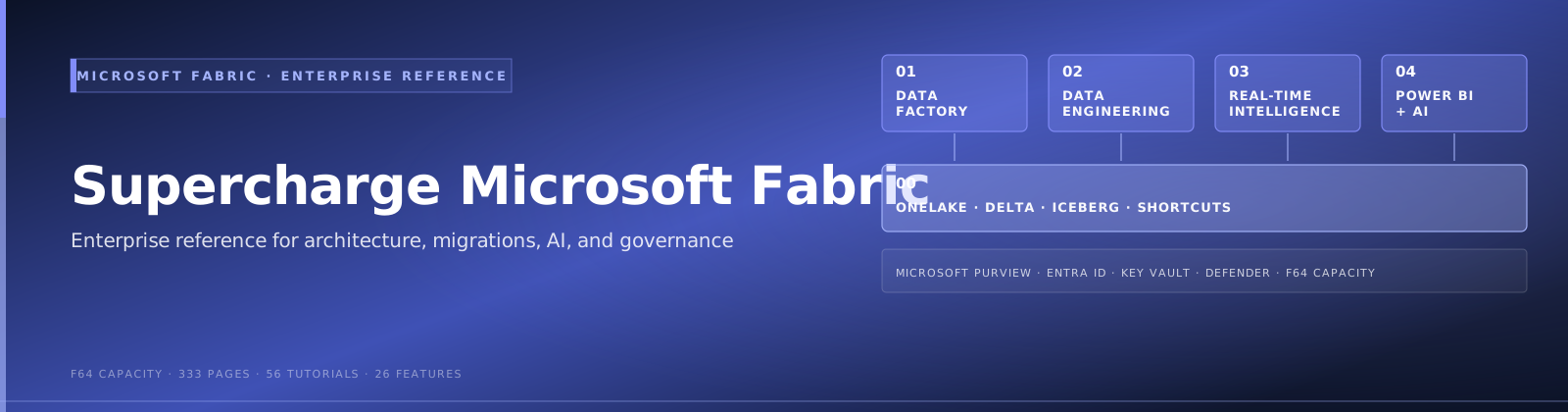
Supercharge Microsoft Fabric
A hands-on Microsoft Fabric reference for data teams in regulated industries — it starts in casino & gaming, bridges through Tribal Nations gaming and health, and extends out to federal agency analytics. Same medallion + governance backbone, applied across each domain.
Real-time insights · Medallion Architecture · Regulatory Compliance · Direct Lake BI
Personal project — not an official Microsoft product
This is a personal, community-built reference maintained by Frank Garofalo. It is not a sanctioned Microsoft deliverable, nor official Microsoft Fabric product documentation, and opinions here are the author's own. The compliance pages (FedRAMP, HIPAA, NIST 800-53, NIGC MICS, Title 31/BSA, etc.) are reference control mappings for education and POC scoping — not authorizations, attestations, or certifications.
Three Core Paradigms
This reference is built on three paradigms that define how data flows from source to insight inside Microsoft Fabric.
OneLake is the unified storage layer. It's Delta Lake–native — Fabric engines read and write Delta tables to a single lake with no data movement — and interoperates with Apache Iceberg via metadata virtualization (shortcuts and the Iceberg/Delta translation layer), so Iceberg readers and writers can work against the same data.
Medallion Architecture (Bronze → Silver → Gold) organizes that data by quality tier. Bronze captures raw ingestion, Silver cleanses and validates, Gold produces business-ready KPIs and star schemas.
Direct Lake connects Power BI semantic models straight to Gold-layer Delta tables in OneLake — low-latency analytics with no import step and no scheduled refresh. (On large or over-limit models it can fall back to DirectQuery, and cold caches warm on first access.)
Together they give you a single pipeline from raw events to executive dashboards, with governance enforced by Microsoft Purview at every layer.
How this relates to CSA-in-a-Box
This project is a Microsoft Fabric reference — use it once you've committed to Fabric (the SaaS, Microsoft-managed platform) and want hands-on patterns, tutorials, POC agendas, and governance mappings on F64 capacity.
Its sibling, CSA-in-a-Box, is the Azure-native, build-your-own PaaS/IaaS alternative: the same Data Mesh + Data Fabric + Data Lakehouse capabilities assembled from Azure services you own and operate — for teams who can't get Fabric yet, or who deliberately don't want SaaS and need full control of the environment. CSA Loom is the productized, Fabric-like console layer over CSA-in-a-Box.
Which one do I use?
| Your situation | Use |
|---|---|
| Fabric is GA in your cloud and you want it (SaaS, Microsoft-managed) | Microsoft Fabric — and this repo for hands-on depth |
| Fabric isn't available in your cloud yet (Azure Government / DoD / IC) | CSA-in-a-Box |
| You could get Fabric but won't take SaaS — you need control / sovereignty / custom networking | CSA-in-a-Box (a permanent choice, by design) |
| You want the CSA stack with a Fabric-like console + guided deploy | CSA Loom |
Start Here
-
Quick Start
Prerequisites, Azure setup, one-click Bicep deployment
-
Tutorials
50+ self-paced, hands-on tutorials from Bronze ingestion to AI/ML
-
Architecture
System design, component overview, data flow diagrams
-
3-Day POC Agenda
A curated subset of the tutorials, packaged as a guided workshop: Foundation → Transformation → BI & Governance
Choose Your Path
-
Data Engineers
PySpark notebooks, pipelines, ETL, medallion implementation
-
BI Developers
Direct Lake, Power BI semantic models, DAX measures
-
Security & Compliance
Microsoft Purview governance, gaming internal controls (NIGC MICS), and anti-money-laundering reporting (CTR/SAR)
-
Real-Time Analytics
Eventstreams, Eventhouse, KQL for streaming workloads
Feature Documentation
-
Fabric IQ
Natural language data exploration with Ontology & Plan layers
-
Real-Time Intelligence
Eventstreams, Eventhouse, KQL, Business Events, Maps
-
AI Copilot
Copilot Studio integration and governance configuration
-
Data Mesh
Enterprise data mesh patterns with Fabric domains
Compliance & Governance
This reference covers casino/gaming regulations (NIGC MICS, Title 31/BSA, IRS Gaming) and supports 8 federal agency domains — USDA, SBA, NOAA, EPA, DOI, DOT/FAA, Tribal Healthcare, and DOJ.
These are reference mappings, not authorizations
The compliance and governance pages illustrate how Fabric controls can map to each framework, for education and POC scoping. They are not ATOs, attestations, audits, or certifications, and they don't represent the compliance posture of any production system.
| Framework | Coverage |
|---|---|
| NIGC MICS | Minimum Internal Control Standards |
| Title 31/BSA | Anti-money laundering, CTR/SAR |
| IRS Gaming | W-2G, 1042-S reporting |
| State Gaming Commissions | Jurisdiction-specific requirements |
Quick Links
-
GitHub Repository
Source code, issues, and releases
-
Documentation
Full documentation index and guides
-
Infrastructure
Bicep IaC modules for Azure deployment
-
Cost Estimation
F64 capacity sizing, commercial vs Azure Government. Pricing changes often — verify current rates on the Azure pricing calculator.
Currency: Last reviewed 2026-05-29. Microsoft Fabric features and pricing change frequently — verify against Microsoft Learn and the Azure pricing calculator before relying on any figure here.
License: MIT · Maintained by: Frank Garofalo · A personal/community project — not affiliated with, sponsored by, or endorsed by Microsoft.