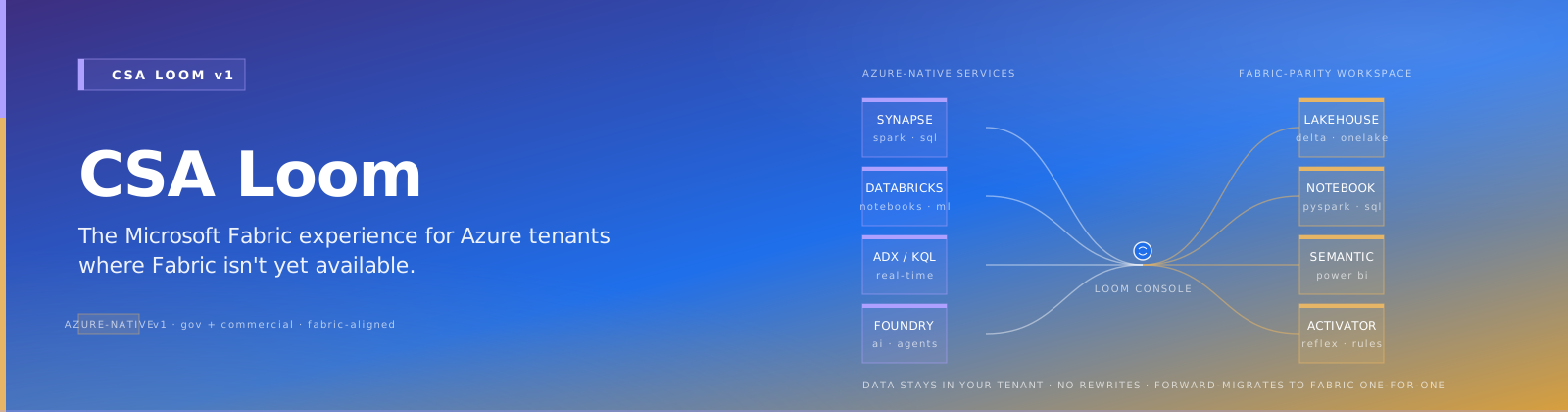
deploy-planner — parity with Azure portal "Create a resource" config blades + custom-template deployment
Source UI: - Azure portal Create a resource → per-service "Basics / Networking / Tags" blades (SKU, tier, version, runtime pickers): https://learn.microsoft.com/azure/azure-resource-manager/templates/deploy-portal - Azure portal Deploy a custom template (edit parameters → Review + create): https://learn.microsoft.com/azure/azure-resource-manager/templates/deploy-portal - Resource group map / visualizer (architecture overview): https://learn.microsoft.com/azure/azure-resource-manager/management/resource-graph-visualizer
The Loom Deployment planner is the architecture-builder counterpart: lay out subscriptions → domains → services on a canvas, configure each resource's SKU/tier/runtime, draw dependency arrows, validate, save, and export a real .bicepparam that az deployment sub create -f platform/fiab/bicep/main.bicep consumes. It is Azure-native end to end (no Microsoft Fabric dependency — see .claude/rules/no-fabric-dependency.md).
Azure feature inventory → Loom coverage
| Azure capability | Loom coverage | Backend |
|---|---|---|
| Browse a catalog of Azure resource types, grouped/searchable | ✅ Palette: 6 categories, search + filter chips, 81 service types | service-catalog.ts |
| Place resources into a scope (subscription / RG) | ✅ Canvas: subscription → domain → service containers (React Flow) | deploy-plan-nodes.tsx, deploy-planner-view.tsx |
| Pick a resource SKU / pricing tier | ✅ Per-service config panel — Dropdown bound to the module's @allowed set (Redis SKU, App Service plan, Postgres/MySQL version + storage) | ConfigFieldControl, configFor() |
| Pick a runtime / version / capacity | ✅ App Service + Functions runtime, Postgres/MySQL version, storage GB (SpinButton bounded by @minValue/@maxValue) | ConfigFieldControl |
| Region selection | ✅ Per-subscription region (boundary-aware default via BOUNDARY_DEFAULT_REGION) | planToBicepparam |
| Sovereign-cloud boundary | ✅ Per-subscription Commercial / GCC / GCC-High / IL5 | PlanSubscription.boundary |
| Deployment mode (topology) | ✅ Per-subscription single-sub / multi-sub Dropdown (@allowed on main.bicep); emitted as param deploymentMode. Unset ⇒ derived from domain count (>1 ⇒ multi-sub) | PlanSubscription.deploymentMode, planToBicepparam() |
| Express dependencies between resources | ✅ Drag from a service's right handle to another → dependency arrow (React Flow edges) | onConnect, buildEdges |
| Validate before deploy ("Review + create") | ✅ Validate button — flags dangling dependencies (error), plan-only/empty/cross-subscription warnings | validatePlan() |
| Save the design | ✅ Save plan → Cosmos (deploy-plan:<tenantId> in tenant-settings) | app/api/admin/deploy-plan/route.ts (PUT) |
| Export deployable parameters | ✅ Export bicep → .bicepparam tab → real .bicepparam with feature flags and per-resource SKU/tier/runtime params, drives the maintained main.bicep | planToBicepparam() |
| Export deployable template | ✅ Export bicep → .bicep tab → standalone targetScope='subscription' template: every module-backed selected service becomes a real module, dependency arrows become module dependsOn, per-resource config threaded | planToBicep() |
| Deploy | ⚠️ Honest gate: the planner does not run the deployment. The exported file is applied with az deployment sub create or the deploy-fiab workflow (surfaced in the info bar). | — |
| Cost estimate | ✅ Estimate cost prices the selected subscription against the public Azure Retail Prices API (representative SKU) | cost-estimate.ts, /api/admin/deploy-plan/cost-estimate |
Deployment mode & DLZ-attach
The planner now emits the deploymentMode parameter that platform/fiab/bicep/main.bicep requires (@allowed(['single-sub','multi-sub']), no default), so an exported .bicepparam is deployable as-is:
- single-sub — Admin Plane + exactly one DLZ in the subscription (
rg-csa-loom-dlz-single-<location>). The default for a one-domain plan. - multi-sub — Admin Plane here + one DLZ per domain across separate subscriptions. The emitter also writes a commented
dlzSubscriptionIdsTODO (the real sub GUIDs are an operator input, not planner state — so it is an honest TODO, never a fake value).
When deploymentMode is unset on a subscription the emitter derives it from the domain count (more than one domain ⇒ multi-sub, since single-sub supports at most one DLZ). The control is a constrained Dropdown bound to the two @allowed values — no freeform.
The first-run vs DLZ-attach distinction is a Setup-Wizard / Console concept layered on top of this same template: first-run provisions the Admin Plane + the first DLZ; "Add Data Landing Zone" re-runs main.bicep with an expanded dlzSubscriptionIds / dlzDomainNames (admin plane already present → setupOrchestratorSpokeRbac + spoke peering add the new DLZ only). Both flows are diagrammed in docs/fiab/diagrams/ and taught in Tutorial 09 — Tenant topology.
Constrained-config compliance (loom_no_freeform_config)
Every config control is constrained, never freeform JSON: - select → Fluent Dropdown whose options are the exact @allowed list on the backing bicep module param (single source of truth). - number → Fluent SpinButton bounded by the module's @minValue/@maxValue. - text → only for genuinely-freeform Azure fields (Linux runtime string), validated against an Azure-format regex (NODE|20-lts shape).
coerceConfigValue() is the shared gate used by both the UI and the server sanitizer, so an out-of-range/disallowed value can never reach Cosmos or the exported .bicepparam.
Bicep sync (no-vaporware "Bicep sync")
Per-resource config is honest only because main.bicep accepts and forwards each value. For the v1 configurable services the planner adds these top-level params (each @allowed/@minValue mirrors the module decorator) and forwards them to the deploy-planner module:
| Service | Config field(s) | main.bicep param → module |
|---|---|---|
| Cache for Redis | SKU | redisSkuName → redis.bicep skuName (family + capacity derived to a valid pairing) |
| App Service | plan SKU, runtime | appServicePlanSku, appServiceLinuxFxVersion → app-service.bicep |
| Functions | worker runtime, version | functionsWorkerRuntime, functionsLinuxFxVersion → functions.bicep |
| PostgreSQL Flexible | version, storage GB | postgresVersion, postgresStorageSizeGB → postgres.bicep |
| MySQL Flexible | version, storage GB | mysqlVersion, mysqlStorageSizeGB → mysql.bicep |
| Service Bus | namespace SKU | serviceBusSkuName → service-bus.bicep skuName (Basic excluded — module provisions a starter topic) |
| Azure Firewall | tier | firewallTier → firewall.bicep firewallTier (Standard / Premium) |
| Stream Analytics | streaming units | streamAnalyticsStreamingUnits → stream-analytics.bicep startingStreamingUnits |
Interdependent knobs (Redis family/capacity, which must match the SKU) are derived in main.bicep from the chosen SKU so every exported combination compiles and deploys — the planner never emits an invalid pairing. Core (bicepFlag:null) and plan-only services expose no config knobs (a knob there would be a fake — see no-vaporware.md). The bicepparam.test.ts drift guards fail if any config field's bicepParam is missing from main.bicep.
Standalone .bicep template export (edges → dependsOn)
Alongside the primary .bicepparam, Export bicep → .bicep emits a self-contained, subscription-scoped template straight from the graph (planToBicep()):
- Every SELECTED service that has a self-contained deploy-planner module (
platform/fiab/bicep/modules/deploy-planner/<svc>.bicep) becomes a realmodulereference inside a generated resource group, with its per-resource config threaded into the module's params (verified 1:1 with howmain.bicepinvokes eachdp*module — cognitive-account'skind/nameFragmentincluded). - The canvas dependency arrows become real module
dependsOn, so the visual ordering is enforced at deploy time (an arrow A→B emitsmodule svc_A { … dependsOn: [ svc_B ] }). Edges that touch a non-module-backed service are dropped (no danglingdependsOn). - Services WITHOUT a self-contained module (AI Search, API Management, AI Foundry, … which deploy via
main.bicep's DLZ orchestrator) are listed as honest comments, never faked as modules. - Honest gate: the standalone template provisions resources only — each module's
consolePrincipalIddefaults to'', so the Loom Console UAMI role grants are skipped (disclosed in the generated header); runmain.bicep(or grant separately) to wire the Console. Deploy withaz deployment sub create -l <region> -f <file>.architecture.bicepafter saving the file next tomain.bicep.
The emitter is az bicep build-clean — verified against a representative plan covering every module file, the cognitive-account kind/nameFragment, the subscription-scoped Defender/Policy modules, and dependsOn edges (planToBicep.test.ts asserts every mapped module file exists on disk).
Per-cloud (no-fabric-dependency)
All configurable resources are ARM-native (Microsoft.Cache/redis, Microsoft.Web/*, Microsoft.DBforPostgreSQL/*, Microsoft.DBforMySQL/*, Microsoft.ServiceBus/namespaces, Microsoft.Network/azureFirewalls, Microsoft.StreamAnalytics/streamingjobs) — available in Commercial and Gov. Region defaults follow the subscription boundary (Commercial=eastus2, GCC/GCC-High=usgovvirginia, IL5=usgovarizona). fabricCapacity and Power BI stay plan-only (no emitted bicep) so the default path never requires a Fabric/Power BI tenant.
Verification
pnpm vitest run lib/components/deploy-planner— catalog/coercion, emitter config emission, edge pruning, plan validation, the bicep-sync guard, and the standalone-.bicepmodule-map integrity +dependsOnemission (planToBicep.test.ts).- Manual: select a Redis/App Service/Postgres/Service Bus/Firewall/Stream Analytics node → set SKU/tier/version → Export bicep → on the
.bicepparamtab confirm theparam <name> = <value>lines appear, on the.biceptab confirm themodule svc_<key>+dependsOnlines appear; connect two nodes → arrow renders + persists through Save; Validate flags a dangling edge after deleting a connected service. az bicep build -f platform/fiab/bicep/main.bicepcompiles with the newserviceBusSkuName/firewallTier/streamAnalyticsStreamingUnitsparams (defaults preserveparams/commercial-full.bicepparam); a representativeplanToBicep()output also compilesaz bicep build-clean.
deploy-planner — parity with the Azure deployment / architecture planning surface
Surface: apps/fiab-console/lib/components/deploy-planner/ → /admin/deploy-planner Source UI: Azure portal "Deploy to Azure" / architecture planning + the official Azure architecture icon set (Azure_Public_Service_Icons). This is a Loom-native planner (subscriptions → domains → services) that emits the real .bicepparam consumed by az deployment sub create -f platform/fiab/bicep/main.bicep.
This doc tracks audit-T119 (deep-dive functional gap #3): "deploy-planner should offer ALL Azure service types as draggable nodes and use the Atlas Diag icon API for icons, on a bounded canvas."
Feature inventory → Loom coverage
| Capability | Status | Backend / mechanism |
|---|---|---|
| All Azure service types as draggable palette nodes | ✅ | SERVICE_CATALOG (81 services across 6 categories: 12 compute · 20 data · 14 ai · 10 integration · 11 governance · 14 networking) — drag (application/x-loom-service MIME) + click + keyboard add |
| Service icons from the Atlas Diag icon API | ✅ | iconUrl(def.iconSlug ?? def.key) — canonical kebab-case iconSlug per service resolves against NEXT_PUBLIC_LOOM_ICON_BASE; was previously keyed on the camelCase key, which 404'd |
| Graceful icon fallback (no broken-image boxes) | ✅ | ServiceIconChip 3-tier chain: remote Atlas Diag <img> (with onError → fallback) → bundled /azure-icons/*.png → Fluent glyph |
| Bounded canvas (doesn't grow the page) | ✅ | body grid height: calc(100vh - 220px), palette overflowY:auto, .canvas overflow:hidden, React Flow fitView + minZoom 0.3 / maxZoom 2 |
| Search + category filter + collapsible groups | ✅ | query/catFilter/collapsedCats state; counts auto-update from SERVICE_COUNT |
| Subscriptions / domains / nested service nodes | ✅ | React Flow nested nodes (subscription → domain → service) |
| Boundary + region per subscription (sovereign clouds) | ✅ | PlanSubscription.boundary (Commercial/GCC/GCC-High/IL5), BOUNDARY_TINT, BOUNDARY_DEFAULT_REGION |
| Persist plan | ✅ | GET/PUT /api/admin/deploy-plan → Cosmos tenant-settings |
| Export bicepparam | ✅ | planToBicepparam() — unions selected services → real *Enabled flags |
| Honest deploy model (no fake auto-deploy) | ✅ | three states: toggleable bicepFlag, core (null), planOnly (real Azure, no toggle, never emits a param) |
Atlas Diag icon slug fix (defect A)
Service keys are camelCase (containerApps, aiFoundry). iconUrl() lowercases and appends .svg, producing containerapps.svg — a slug that does not exist in the Atlas Diag / Azure-architecture-icon namespace, so the remote <img> 404'd for nearly every service. Each ServiceDef now carries a canonical kebab-case iconSlug (container-apps, azure-openai, databricks-sql-warehouse, …) — mirroring the kebab-case slugs in item-type-visual's REGISTRY where one exists, otherwise the official Azure architecture-icon basename. Both render call sites use iconSlug ?? key.
Catalog breadth (defect B)
The catalog grew from 57 → 81 real Azure service types (44 with a real one-button bicepFlag toggle, the rest core or planOnly). Of these, 25 are tagged planOnly: true (real Azure, no one-button bicep toggle yet) so the plan stays honest — they never emit a bicep param. Plan-only additions span App Configuration, Container Apps Jobs, HDInsight, Data Share, Cosmos Gremlin, Azure Maps, Bot Service, Translator, AI Video Indexer, Azure Relay, Notification Hubs, API Center, Application Insights, Managed Grafana, Azure Lighthouse, Azure Bastion, NAT Gateway, Traffic Manager, ExpressRoute, and DDoS Protection.
Per-cloud notes (sovereign clouds)
- Icon hosting:
NEXT_PUBLIC_LOOM_ICON_BASEis a single public base URL. In GCC-High / IL5 the Atlas Diag icon endpoint must be hosted in-boundary (no Commercial CDN egress). Because the remote icon is progressive-only and the chip falls back to bundled/azure-iconsPNGs + Fluent glyphs (now withonError), the planner is fully functional air-gapped. - Service availability: cloud-limited services keep an honest
descriptionnote (e.g. Front Door "(Commercial)"). The palette is not gated by boundary (operators plan across clouds); the bicepparam export binds region/boundary, and an unavailable service simply should not be promoted to a real flag in that cloud's param file.
No-vaporware / no-Fabric posture
- Every toggleable
bicepFlagis a realparam <x>Enabled boolinplatform/fiab/bicep/main.bicep— guarded by a vitest drift test (bicepparam.test.ts→ "bicep drift guard"). fabricCapacityisplanOnlyand labeled "Loom never requires it; the Azure-native lake is the default" — no hard Fabric dependency.purviewDatadescribes the Azure-native ADLS lake catalog (no OneLake/Fabric requirement on the default path).
Tests
apps/fiab-console/lib/components/deploy-planner/__tests__/bicepparam.test.ts (22 cases): flag mapping, bicepparam emission, catalog breadth (≥70), plan-only honesty, per-resource config schema + coercion, iconSlug kebab-case + iconUrl round-trip (set/unset base), and the bicep drift guard. All 22 pass (node env).