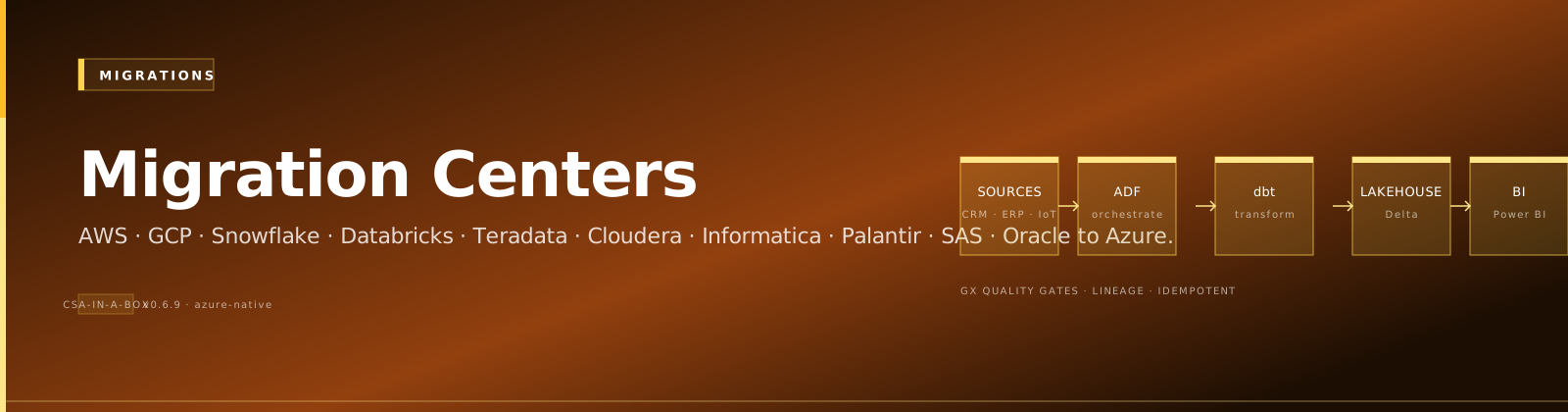
SAS to Azure Migration Center
The definitive resource for migrating from SAS Institute analytics to Microsoft Azure, Microsoft Fabric, Azure ML, and CSA-in-a-Box.
Who this is for
This migration center serves federal CIOs, CDOs, Chief Analytics Officers, statistical program directors, SAS administrators, data scientists, and SAS programmers who are evaluating or executing a migration from SAS analytics (Base SAS, SAS/STAT, SAS/ETS, SAS Viya, SAS Visual Analytics, SAS Data Integration Studio, SAS Model Manager, SAS Enterprise Guide) to Azure-native services. Whether you are pursuing a full SAS replacement to reduce licensing costs and expand your talent pool, a lift-and-shift of SAS Viya to Azure for data-center exit, or a hybrid coexistence leveraging SAS on Fabric --- these resources provide the evidence, patterns, and step-by-step guidance to execute confidently.
Quick-start decision matrix
| Your situation | Start here |
|---|---|
| Executive evaluating Azure vs SAS for analytics | Why Azure over SAS |
| Need cost justification for migration | Total Cost of Ownership Analysis |
| Need a feature-by-feature comparison | Complete Feature Mapping |
| Ready to plan a migration | Migration Playbook |
| Want to keep SAS but move it to Azure | Lift-and-Shift Migration |
| Migrating SAS statistical procedures to Python | Analytics Migration |
| Migrating SAS Data Integration to ADF/dbt | Data Management Migration |
| Migrating SAS VA to Power BI | Reporting Migration |
| Migrating SAS models to Azure ML | Model Migration |
| Federal/government-specific requirements | Federal Migration Guide |
Migration path decision framework
Before diving into specific guides, choose your migration strategy. Most organizations adopt a hybrid approach, but the dominant path depends on your SAS footprint and strategic direction.
Path 1: Lift-and-shift --- SAS on Azure
Deploy SAS Viya on Azure Kubernetes Service; programs run unchanged.
- Best for: Agencies with regulatory mandates requiring SAS output formats, heavy SAS macro investment (500+ macros), immediate data-center exit deadlines, or pending SAS Viya upgrades
- Timeline: 3--6 months
- Cost impact: Eliminates hardware costs; SAS licensing remains; Azure compute replaces on-premises servers
- SAS products required: SAS Viya 4.x license (includes Cloud-Native Architecture deployment)
- Key guide: Lift-and-Shift Migration | Tutorial: SAS Viya on Azure
Path 2: Replace --- Azure ML + Fabric + Power BI
Rewrite SAS programs in Python/R; deploy on Azure-native services.
- Best for: Organizations seeking 55--70% cost reduction, talent pool expansion (Python developers outnumber SAS programmers 20:1), AI/GenAI integration, or elimination of vendor lock-in
- Timeline: 12--24 months for full migration; can start delivering value in 8--12 weeks with pilot domain
- Cost impact: Eliminates SAS licensing entirely; one-time reskilling and migration investment pays back in 12--18 months
- Key guides: Analytics Migration | Data Management Migration | Model Migration | Reporting Migration
Path 3: Hybrid coexistence --- SAS + Azure side-by-side
SAS Viya on Azure reads/writes Fabric lakehouses; new workloads built on Azure ML; SAS programs migrated incrementally.
- Best for: Most federal agencies. Preserves existing SAS investment while building toward Azure-native over 18--36 months. Leverages the December 2025 SAS on Fabric integration.
- Timeline: 6--18 months for bridge setup; ongoing incremental migration
- Cost impact: Transitional. SAS licensing reduces as programs migrate; Azure costs ramp. Break-even typically at 40--50% program migration.
- Key guides: Lift-and-Shift Migration + Analytics Migration | Tutorial: SAS to Python
Decision matrix: which SAS products drive which path
| SAS product in use | Recommended path | Rationale |
|---|---|---|
| Base SAS + SAS/STAT (general analytics) | Replace | Python/statsmodels covers 95%+ of these capabilities |
| SAS Visual Analytics | Replace | Power BI is a direct upgrade with better Copilot integration |
| SAS Data Integration Studio | Replace | ADF + dbt is more capable, lower cost, and open-source |
| SAS Enterprise Guide | Replace | Fabric notebooks + Power BI provide equivalent point-and-click + code workflow |
| SAS Viya (cloud deployment) | Hybrid | Keep Viya for specialized procedures; build new on Azure ML |
| SAS Drug Development / Clinical | Lift-and-shift | Regulatory acceptance of SAS outputs is a hard constraint for now |
| SAS/OR (Operations Research) | Lift-and-shift or Hybrid | PuLP/OR-Tools cover basics; complex optimization stays on SAS |
| SAS Risk Management for Banking | Lift-and-shift | Domain-specific regulatory models require SAS validation |
| SAS Anti-Money Laundering | Hybrid | Core detection stays on SAS; alerting and case management can move |
| SAS Survey procedures | Hybrid | R survey package is mature; Python samplics is improving |
Strategic resources
| Document | Audience | Description |
|---|---|---|
| Why Azure over SAS | CIO / CDO / Board | Executive white paper covering open-source ecosystem advantages, cloud-native ML, cost analysis, talent availability, SAS-Microsoft partnership, and AI/GenAI integration |
| Total Cost of Ownership Analysis | CFO / CIO / Procurement | Detailed pricing: SAS licensing stack vs Azure consumption across three federal tenant sizes, 5-year TCO projections, reskilling investment, and ROI timeline |
| Complete Feature Mapping | CTO / Analytics Architecture | 40+ SAS features mapped to Azure equivalents with code examples, migration complexity ratings, and gap analysis |
Migration guides
Domain-specific deep dives covering every aspect of a SAS-to-Azure migration.
| Guide | SAS capability | Azure destination |
|---|---|---|
| Lift-and-Shift Migration | SAS Viya, SAS Grid Manager | AKS, Azure VMs, ANF storage |
| Analytics Migration | PROC MEANS/FREQ/REG/LOGISTIC/GLM/ARIMA | pandas, scikit-learn, statsmodels, PySpark |
| Data Management Migration | DATA Step, SAS DI Studio, SAS Formats | ADF, dbt, Fabric Data Pipelines, Delta tables |
| Reporting Migration | SAS Visual Analytics, ODS, SAS/GRAPH | Power BI, Fabric notebooks, matplotlib/plotly |
| Model Migration | SAS Model Manager, SAS scoring | Azure ML, MLflow, managed endpoints |
Tutorials
Step-by-step walkthroughs for common migration scenarios.
| Tutorial | Description | Time |
|---|---|---|
| Deploy SAS Viya on Azure | Deploy SAS Viya 4.x on AKS using the SAS Deployment Operator; configure persistent storage; integrate with Fabric/ADLS for data access | 4--6 hours |
| SAS Program to Python Notebook | Convert a complete SAS program (data prep, analysis, reporting) to a Python notebook in Fabric; validate output equivalence; schedule in ADF | 2--4 hours |
Government and federal
| Document | Description |
|---|---|
| Federal Migration Guide | SAS in federal agencies (FDA, CDC, Census, DoD, VA), SAS Viya on Azure Gov (January 2026), FedRAMP High, compliance analytics, statistical disclosure limitation, FISMA requirements |
Technical references
| Document | Description |
|---|---|
| Benchmarks & Performance | Statistical processing performance: SAS vs Python/PySpark for common procedures, model training times, data processing throughput, concurrent user handling |
| Best Practices | Workforce reskilling program, dual-running validation, phased migration, output reconciliation framework, CSA-in-a-Box as the unified analytics landing zone |
How CSA-in-a-Box fits
CSA-in-a-Box is the unified analytics landing zone that replaces or augments SAS capabilities. It provides the complete platform that a SAS-to-Azure migration lands on:
| SAS capability | CSA-in-a-Box replacement | Platform component |
|---|---|---|
| SAS Data Integration | ADF + dbt + Fabric Data Pipelines | Data management landing zone with medallion architecture, data-quality contracts, and Purview lineage |
| Base SAS + DATA Step | Python/PySpark in Fabric/Databricks notebooks | Compute layer with auto-scaling, notebook scheduling, and Git integration |
| SAS/STAT + SAS/ETS | Azure ML + scikit-learn + statsmodels | ML workspace with experiment tracking, model registry (MLflow), and managed endpoints |
| SAS Visual Analytics | Power BI + Direct Lake | BI layer with semantic models over Fabric lakehouses; Copilot for natural-language analytics |
| SAS Model Manager | MLflow + Azure ML model registry | Full MLOps: model versioning, champion/challenger, A/B testing, monitoring, and automated retraining |
| SAS Formats | dbt seed tables + Delta reference data | Governed lookup tables registered in Unity Catalog with Purview classification |
| SAS Macro libraries | Python packages + dbt macros | Version-controlled, tested, and CI/CD-deployed code libraries |
| SAS Grid Manager | Databricks/Fabric auto-scaling compute | Elastic compute that scales to workload; no capacity planning required |
| SAS Governance (metadata) | Purview + Unity Catalog | Unified governance with automated classification, lineage, and data-product discovery |
CSA-in-a-Box deployment for SAS migration
The standard csa-inabox deployment (make deploy-dev or Bicep modules) provisions the complete target platform:
- Data Management Landing Zone --- ADLS Gen2 storage, Fabric capacity, networking, Purview
- Data Landing Zone --- Domain-specific lakehouses, Unity Catalog, dbt project scaffolding
- ML Workspace --- Azure ML, MLflow, compute clusters, managed endpoints
- BI Layer --- Power BI Premium/Fabric capacity, semantic models, workspaces
- Governance --- Purview classification policies, lineage scanning, data-product registry
- Compliance --- NIST 800-53, FedRAMP, CMMC, HIPAA controls mapped in IaC
SAS-Microsoft partnership context
The SAS-Microsoft partnership is deepening, which creates bridge opportunities for organizations not ready for a full replacement:
| Date | Milestone | Impact |
|---|---|---|
| 2020 | SAS on Azure Marketplace | SAS Viya deployable on Azure commercial |
| 2023 | SAS + Azure strategic partnership announced | Joint go-to-market; co-engineering investment |
| Dec 2025 | SAS on Fabric | SAS Viya reads/writes OneLake lakehouses natively; shared data layer |
| Jan 2026 | SAS Viya on Azure Government | FedRAMP High authorized; federal lift-and-shift unlocked |
| 2026 (roadmap) | SAS + Fabric deeper integration | SAS procedures callable from Fabric notebooks (preview) |
This partnership means organizations can pursue a phased migration --- running SAS and Azure ML side-by-side against the same data in Fabric lakehouses --- without the all-or-nothing pressure of earlier migration windows.
Migration timeline by organization size
| Organization size | SAS programs | SAS users | Recommended path | Timeline |
|---|---|---|---|---|
| Small (department) | 10--50 | 5--20 | Replace | 3--6 months |
| Medium (agency division) | 50--200 | 20--100 | Hybrid | 6--12 months |
| Large (full agency) | 200--1,000+ | 100--500+ | Hybrid (phased) | 12--24 months |
| Enterprise (multi-agency) | 1,000+ | 500+ | Hybrid (multi-wave) | 18--36 months |
Getting started
- Read the executive brief: Why Azure over SAS --- understand the strategic case
- Build the business case: TCO Analysis --- quantify the financial impact
- Choose your path: Use the decision matrix above to select lift-and-shift, replace, or hybrid
- Run the playbook: Migration Playbook --- phased execution plan
- Start with a tutorial: SAS to Python or SAS Viya on Azure
Maintainers: csa-inabox core team Last updated: 2026-04-30