Tutorial: Your First Data Product on Azure
Comparative positioning note
This document is written from the perspective of Microsoft Azure, Cloud Scale Analytics, and CSA Loom. Any description of third-party or competing products, services, pricing, or capabilities is derived from publicly available documentation and sources believed accurate at the time of writing, and is provided for general comparison only. We do not claim expertise in, or authority over, any non-Microsoft product or service; the respective vendor's official documentation is the authoritative source for their offerings, which may change over time. Nothing here is intended to disparage any vendor — where a competing product has genuine advantages, we aim to note them honestly. Verify all third-party details against the vendor's current official documentation before making decisions.
Estimated time: 2-3 hours | Difficulty: Intermediate | Audience: Foundry users migrating to Azure
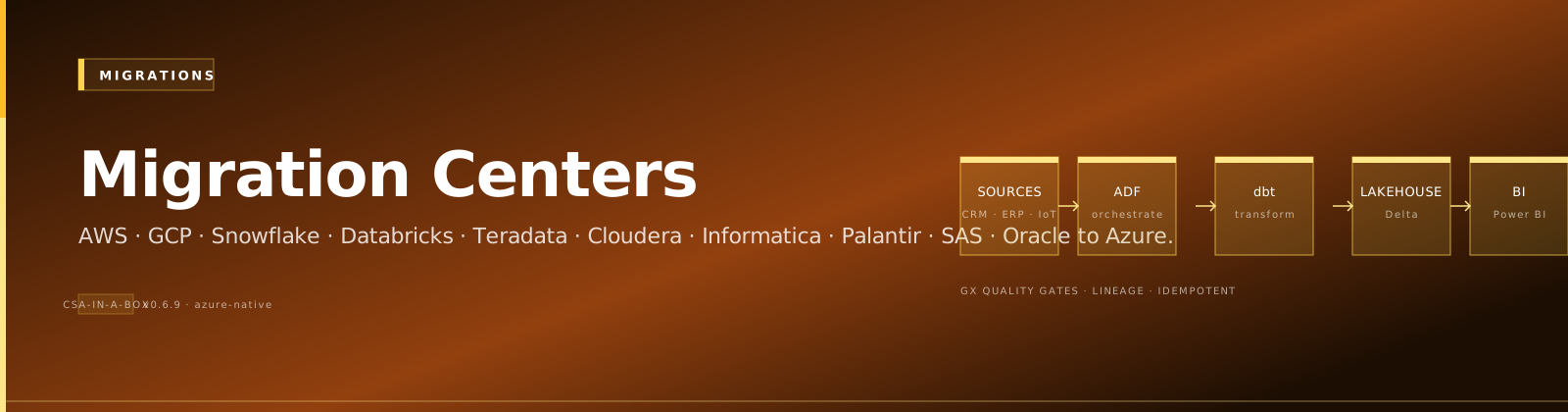
This hands-on tutorial walks you through building a complete data product on Azure using CSA-in-a-Box. By the end, you will have raw data flowing through a medallion pipeline, governed by a data contract, cataloged in Microsoft Purview, and visualized in a Power BI report -- all on Azure-native services.
If you have built datasets, transforms, and object types in Palantir Foundry, every step below maps to something you already know. Callout boxes explain what each step replaces.
Prerequisites
Before you begin, make sure you have the following:
| Tool | Minimum version | Verify |
|---|---|---|
| Azure subscription | Pay-as-you-go or Enterprise | az account show |
| Azure CLI | 2.50+ | az version |
| Bicep CLI | 0.25+ | az bicep version |
| Git | 2.x | git --version |
| Python | 3.10+ | python --version |
| dbt-core | 1.7+ | dbt --version |
| Basic SQL | Comfortable writing SELECT/JOIN/CASE statements | -- |
| Basic Python | Can read and run scripts | -- |
You should also have Contributor (or higher) access to at least one Azure resource group.
Foundry comparison: In Foundry you log in to the web UI and everything is preconfigured. On Azure you bring your own subscription and tools. The trade-off is full control over cost, networking, and compliance boundaries.
Step 1: Deploy the CSA-in-a-Box Foundation
The foundation deploys three landing zones that mirror the CSA (Cloud-Scale Analytics) reference architecture: a management zone (ALZ), a data management zone (DMLZ), and a data landing zone (DLZ). This gives you ADLS Gen2 storage, Azure Data Factory, Databricks, Key Vault, and Purview -- all wired together.
# Clone the repository
git clone https://github.com/your-org/csa-inabox.git
cd csa-inabox

# Set up the Python environment
make setup          # Linux/macOS
# make setup-win    # Windows

# Preview what will be deployed (dry run)
bash scripts/deploy/deploy-platform.sh --environment dev --dry-run

# Deploy for real
bash scripts/deploy/deploy-platform.sh --environment dev
The deploy script runs three Bicep deployments in order:
- ALZ (Management) -- logging, monitoring, policy guardrails
- DMLZ (Data Management) -- Purview, Key Vault, shared services
- DLZ (Data Landing Zone) -- ADF, Databricks, Synapse, ADLS, Event Hub
Foundry comparison: In Foundry, your platform team provisions a new "enrollment" or "space" for you. Here, the
deploy-platform.shscript is the equivalent -- it stamps out all the infrastructure from version-controlled Bicep templates underdeploy/bicep/. Everything is auditable in Git.
What success looks like:
- Three resource groups appear in the Azure portal (e.g.,
rg-alz-dev,rg-dmlz-dev,rg-dlz-dev). az group list -o tableshows all three withProvisioningState: Succeeded.
Troubleshooting:
- If Bicep fails with a quota error, request a quota increase in the Azure portal or choose a different region.
- If you see
AuthorizationFailed, confirm your account has Contributor on the target subscription. - Run with
--dry-runfirst to catch template errors before real deployment.
For full details see the CSA-in-a-Box deployment documentation.
Step 2: Create a New Domain Folder Structure
CSA-in-a-Box organizes work by domain -- a self-contained business area with its own data, pipelines, and data products. You will create a domain called my-domain.
# From the repository root
mkdir -p domains/my-domain/{dbt/models/{bronze,silver,gold},dbt/seeds,pipelines/adf,data-products}
Your folder tree should look like this:
domains/my-domain/
  dbt/
    models/
      bronze/          # Raw ingestion models
      silver/          # Cleaned, conformed models
      gold/            # Business-ready facts and dimensions
    seeds/             # CSV seed files for local development
  pipelines/
    adf/               # Azure Data Factory pipeline definitions
  data-products/       # Data product contracts
Copy the shared dbt project scaffolding:
cp domains/shared/dbt/dbt_project.yml domains/my-domain/dbt/dbt_project.yml
cp domains/shared/dbt/profiles.yml    domains/my-domain/dbt/profiles.yml
cp domains/shared/dbt/packages.yml    domains/my-domain/dbt/packages.yml
Edit domains/my-domain/dbt/dbt_project.yml to set the project name:
name: "my_domain_analytics"
version: "1.0.0"
config-version: 2
require-dbt-version: [">=1.7.0", "<2.0.0"]
profile: "csa_analytics"

model-paths: ["models"]
seed-paths: ["seeds"]
macro-paths: ["macros"]

models:
    my_domain_analytics:
        bronze:
            +materialized: incremental
            +schema: bronze
            +tags: ["bronze"]
        silver:
            +materialized: incremental
            +schema: silver
            +tags: ["silver"]
        gold:
            +materialized: table
            +schema: gold
            +tags: ["gold"]
Foundry comparison: In Foundry, you create a new "project" in the left sidebar and organize datasets into folders. Here, the domain folder structure in Git serves the same purpose but with version control, code review, and branch-based collaboration built in.
What success looks like: dbt debug --profiles-dir . runs from domains/my-domain/dbt/ without errors.
Step 3: Set Up a Data Source Connection with ADF
Azure Data Factory replaces Foundry's built-in connectors. You will create a linked service (connection), a dataset (shape of the data), and a pipeline (the copy job).
3a. Create a Linked Service
CSA-in-a-Box ships a linked service template for ADLS Gen2 at domains/shared/pipelines/adf/linkedServices/ls_adls_gen2.json. It uses Managed Identity authentication with the storage URL pulled from Key Vault.
Deploy it to your ADF instance:
az datafactory linked-service create \
    --factory-name <your-adf-name> \
    --resource-group <your-rg> \
    --name ls_adls_gen2 \
    --properties @domains/shared/pipelines/adf/linkedServices/ls_adls_gen2.json
3b. Create a Dataset
The parameterized CSV dataset lets you reuse one definition for any source file path:
az datafactory dataset create \
    --factory-name <your-adf-name> \
    --resource-group <your-rg> \
    --name ds_source_delimited \
    --properties @domains/shared/pipelines/adf/datasets/ds_source_delimited.json
3c. Create an Ingestion Pipeline
The pl_ingest_to_bronze pipeline copies CSV data from a source container to the ADLS raw container, partitioned by date:
az datafactory pipeline create \
    --factory-name <your-adf-name> \
    --resource-group <your-rg> \
    --name pl_ingest_to_bronze \
    --properties @domains/shared/pipelines/adf/pl_ingest_to_bronze.json
Trigger a test run:
az datafactory pipeline create-run \
    --factory-name <your-adf-name> \
    --resource-group <your-rg> \
    --name pl_ingest_to_bronze \
    --parameters '{
        "sourceContainer": "source-data",
        "sourceFolderPath": "my-domain/sales",
        "domainName": "my-domain",
        "entityName": "transactions"
    }'
Foundry comparison: In Foundry, you configure a "source" in the Data Connection application -- select a connector type, enter credentials, schedule a sync. On Azure, ADF linked services are the connector, datasets describe the shape, and pipelines define the copy logic. The key difference is that everything is declarative JSON checked into Git rather than configured in a UI.
What success looks like:
- The pipeline run shows
Succeededinaz datafactory pipeline-run show. - Files appear in ADLS under
raw/my-domain/transactions/year=.../month=.../day=.../.
Troubleshooting:
403 Forbiddenon ADLS: grant ADF's managed identity the Storage Blob Data Contributor role on the storage account.- If the source container does not exist, create it first:
az storage container create --name source-data --account-name <storage>.
Step 4: Build Bronze / Silver / Gold dbt Models
The medallion architecture in dbt replaces Foundry's transform pipeline. Each tier has a clear responsibility.
4a. Bronze Model (Raw Ingestion)
Create domains/my-domain/dbt/models/bronze/brz_transactions.sql:
{{
  config(
    materialized='incremental',
    unique_key='_surrogate_key',
    incremental_strategy='merge',
    tags=['bronze', 'transactions']
  )
}}

/*
  Bronze: Raw transactions ingestion.
  Reads from ADLS raw container, adds metadata columns.
*/

SELECT
    {{ dbt_utils.generate_surrogate_key(['transaction_id']) }} AS _surrogate_key,
    transaction_id,
    customer_id,
    transaction_date,
    amount,
    category,
    _ingested_at,
    now() AS _dbt_loaded_at,
    '{{ invocation_id }}' AS _dbt_run_id

FROM {{ source('raw_data', 'transactions') }}

{% if is_incremental() %}
WHERE _ingested_at > (SELECT MAX(_ingested_at) FROM {{ this }})
{% endif %}
Foundry comparison: This is your "raw dataset" in Foundry -- the first dataset that points at an external source. In Foundry you would click "New Dataset > Import" and select the source. Here you write a SQL model that dbt compiles and runs against Databricks.
4b. Silver Model (Cleaned and Validated)
Create domains/my-domain/dbt/models/silver/slv_transactions.sql:
{{
  config(
    materialized='incremental',
    unique_key='transaction_sk',
    incremental_strategy='merge',
    tags=['silver', 'transactions']
  )
}}

/*
  Silver: Conformed transactions.
  Deduplicates, casts types, and flags invalid records.
  Bad rows are NOT dropped -- they are marked with is_valid = false
  so downstream quality monitoring can track them.
*/

WITH source AS (
    SELECT * FROM {{ ref('brz_transactions') }}
    {% if is_incremental() %}
    WHERE _dbt_loaded_at > (SELECT MAX(_dbt_loaded_at) FROM {{ this }})
    {% endif %}
),

deduplicated AS (
    SELECT
        *,
        ROW_NUMBER() OVER (
            PARTITION BY transaction_id
            ORDER BY _ingested_at DESC
        ) AS _row_num
    FROM source
),

cleaned AS (
    SELECT
        {{ dbt_utils.generate_surrogate_key(['transaction_id']) }} AS transaction_sk,
        CAST(transaction_id AS BIGINT)       AS transaction_id,
        CAST(customer_id AS BIGINT)          AS customer_id,
        CAST(transaction_date AS DATE)       AS transaction_date,
        CAST(amount AS DECIMAL(18, 2))       AS amount,
        UPPER(TRIM(category))               AS category,
        _ingested_at,
        now() AS _dbt_loaded_at
    FROM deduplicated
    WHERE _row_num = 1
),

validated AS (
    SELECT
        *,
        CASE WHEN transaction_id IS NULL THEN TRUE ELSE FALSE END  AS _missing_id,
        CASE WHEN amount < 0             THEN TRUE ELSE FALSE END  AS _negative_amount,
        CASE WHEN transaction_date > CURRENT_DATE THEN TRUE ELSE FALSE END AS _future_date
    FROM cleaned
)

SELECT
    *,
    NOT (_missing_id OR _negative_amount OR _future_date) AS is_valid,
    CONCAT_WS('; ',
        CASE WHEN _missing_id       THEN 'transaction_id null' END,
        CASE WHEN _negative_amount  THEN 'amount negative' END,
        CASE WHEN _future_date      THEN 'transaction_date in future' END
    ) AS validation_errors
FROM validated
Foundry comparison: In Foundry, you write a "transform" (Python or SQL) that cleans and deduplicates data. The key difference is that CSA-in-a-Box embeds validation flags (
is_valid,validation_errors) directly in Silver rather than silently dropping bad rows. This gives you full lineage on data quality.
4c. Gold Model (Business-Ready)
Create domains/my-domain/dbt/models/gold/gld_daily_transaction_summary.sql:
{{
  config(
    materialized='table',
    tags=['gold', 'transactions', 'metrics']
  )
}}

/*
  Gold: Daily transaction summary.
  Filters to valid Silver records only, then aggregates.
*/

SELECT
    transaction_date,
    category,
    COUNT(*)                          AS transaction_count,
    SUM(amount)                       AS total_amount,
    AVG(amount)                       AS avg_amount,
    MIN(amount)                       AS min_amount,
    MAX(amount)                       AS max_amount,
    now()                             AS _dbt_refreshed_at

FROM {{ ref('slv_transactions') }}
WHERE is_valid = TRUE
GROUP BY transaction_date, category
Run the Pipeline
cd domains/my-domain/dbt
dbt deps
dbt seed             # load any CSV seed files
dbt run --select tag:bronze
dbt run --select tag:silver
dbt run --select tag:gold
dbt test
Foundry comparison: In Foundry, you click "Build" on a dataset and the platform figures out the execution graph. With dbt,
dbt run --select tag:bronzeachieves the same thing -- dbt resolves the DAG and runs models in dependency order. Thedbt teststep replaces Foundry's "Expectations" checks.
What success looks like:
dbt runcompletes withPASSfor all three tiers.dbt testshows zero failures.- Querying
gold.gld_daily_transaction_summaryreturns aggregated rows.
Troubleshooting:
Compilation Error: source raw_data.transactions not found: create asources.ymlin the bronze folder that defines theraw_datasource. Seedomains/shared/dbt/models/bronze/sources.ymlfor the pattern.Connection refused: verifyDATABRICKS_HOSTandDATABRICKS_HTTP_PATHenvironment variables are set. Rundbt debug --profiles-dir .to test the connection.
Step 5: Define a Data Contract
A data contract is the authoritative interface between your domain and its consumers. It declares the schema, SLAs, and quality rules. CSA-in-a-Box ships a contract validator that enforces these at CI time and runtime.
Create domains/my-domain/data-products/transactions/contract.yaml:
apiVersion: csa.microsoft.com/v1
kind: DataProductContract

metadata:
    name: my-domain.transactions
    domain: my-domain
    owner: my-team@contoso.com
    version: "1.0.0"
    description: >
        Daily transaction records, cleaned and validated through the
        medallion pipeline. Consumers can rely on the schema and SLAs
        defined below.

schema:
    primary_key: [transaction_sk]
    columns:
        - name: transaction_sk
          type: string
          nullable: false
          description: Surrogate key (hash of transaction_id).
        - name: transaction_id
          type: long
          nullable: false
          description: Unique transaction identifier from source system.
        - name: customer_id
          type: long
          nullable: false
          description: Customer identifier.
        - name: transaction_date
          type: date
          nullable: false
          description: Date the transaction occurred.
        - name: amount
          type: decimal(18,2)
          nullable: false
          description: Transaction amount in USD.
        - name: category
          type: string
          nullable: false
          description: Transaction category.
        - name: is_valid
          type: boolean
          nullable: false
          description: True when all quality checks pass.

sla:
    freshness_minutes: 60
    valid_row_ratio: 0.97
    supported_until: "2027-12-31"

quality_rules:
    - rule: expect_column_values_to_not_be_null
      column: transaction_sk
    - rule: expect_column_values_to_be_unique
      column: transaction_sk
    - rule: expect_column_values_to_not_be_null
      column: transaction_id
    - rule: expect_column_values_to_be_between
      column: amount
      min_value: 0
      mostly: 0.97
Foundry comparison: In Foundry, you define an "object type" in the Ontology -- its properties, primary key, and links. A data contract in CSA-in-a-Box serves the same purpose: it is the published interface that tells consumers what columns exist, their types, nullability, and what quality guarantees are met. The difference is that contracts are YAML files in Git, validated in CI, and enforced at runtime by
governance/contracts/contract_validator.py.
What success looks like: The contract passes validation:
python -m governance.contracts.contract_validator \
    domains/my-domain/data-products/transactions/contract.yaml
See domains/finance/data-products/invoices/contract.yaml for a production example.
Step 6: Register the Data Product in Purview
Microsoft Purview is the governance catalog that replaces Foundry's Data Catalog and Ontology Manager. You will register your data product so it is discoverable, classified, and lineage-tracked.
6a. Create a Glossary Term
# Bootstrap Purview collections and glossary (if not already done)
python scripts/purview/bootstrap_catalog.py \
    --purview-account <purview-name> \
    --storage-account <storage-name>
Then create a glossary term for your data product in the Azure portal:
- Open Microsoft Purview > Data Catalog > Glossary.
- Select your domain collection (e.g.,
my-domain). - Click New Term and fill in:
- Name:
Daily Transactions - Definition:
Cleaned and validated daily transaction records. Produced by the my-domain medallion pipeline. - Owner: your team email
- Status:
Approved
- Name:
Alternatively, use the Purview REST API:
az rest --method PUT \
    --url "https://<purview-name>.purview.azure.com/catalog/api/atlas/v2/glossary/term" \
    --headers "Content-Type=application/json" \
    --body '{
        "name": "Daily Transactions",
        "qualifiedName": "my-domain.transactions@glossary",
        "longDescription": "Cleaned and validated daily transaction records.",
        "status": "Approved",
        "anchor": { "glossaryGuid": "<your-glossary-guid>" }
    }'
6b. Add Classifications
Apply sensitivity and domain classifications:
- In Purview, navigate to Data Map > Classifications.
- Add classifications to your gold-layer assets (e.g.,
Financial,PIIif customer data is present).
6c. Scan the Gold Layer
Register your ADLS storage as a source in Purview and run a scan:
- Data Map > Sources > Register > select Azure Data Lake Storage Gen2.
- Enter your storage account name and select the
goldcontainer. - Create a scan rule set that includes Delta/Parquet files.
- Run the scan.
Once the scan completes, Purview automatically discovers your Gold tables and shows end-to-end lineage from raw to gold.
Foundry comparison: In Foundry, the Ontology Manager automatically catalogs datasets and shows lineage. With Purview, you get the same capabilities -- automated discovery, lineage tracking, classification, and glossary -- but across your entire Azure estate, not just one platform. Purview also supports sensitivity labels and data access policies that integrate with Entra ID.
What success looks like:
- The glossary term
Daily Transactionsappears under your domain collection. - Scanning your ADLS gold container shows discovered assets with schema details.
- Lineage view traces the path from raw source through bronze, silver, and gold.
Troubleshooting:
- If the scan shows zero assets, verify the scan rule set includes
.parquetor Delta format. - If lineage is missing, confirm that ADF pipelines have been registered as a source in Purview -- ADF lineage requires its own source registration.
Step 7: Create a Power BI Semantic Model
A semantic model defines the business logic layer (measures, relationships, hierarchies) on top of your Gold data. This replaces Foundry's "analysis" or "dashboard dataset" concept.
CSA-in-a-Box includes a semantic model template at csa_platform/semantic_model/semantic_model_template.yaml. Use it as a reference and generate a model for your domain.
7a. Configure the SQL Endpoint
cd csa_platform/semantic_model

# Install dependencies
pip install -r requirements.txt

# Configure the Databricks SQL warehouse endpoint for Power BI
python scripts/configure_sql_endpoint.py \
    --workspace-url "https://adb-<workspace-id>.azuredatabricks.net" \
    --warehouse-name "csa-bi-warehouse"
7b. Generate the Semantic Model
python scripts/generate_semantic_model.py \
    --template semantic_model_template.yaml \
    --catalog unity_catalog \
    --schema gold \
    --tables "gld_daily_transaction_summary"
7c. Connect Power BI Desktop
- Open Power BI Desktop.
- Select Get Data > Azure Databricks.
- Enter the SQL warehouse hostname and HTTP path from your profile.
- Choose DirectQuery mode for real-time queries against gold-layer Delta tables.
- Select the
gold.gld_daily_transaction_summarytable. - Define measures in the model view:
Total Amount = SUM(gld_daily_transaction_summary[total_amount])
Transaction Count = SUM(gld_daily_transaction_summary[transaction_count])
Average Transaction = DIVIDE([Total Amount], [Transaction Count], 0)
Foundry comparison: In Foundry, you build analyses and dashboards using Contour or Quiver. Power BI replaces both: the semantic model is your reusable business logic layer (like Foundry's "metric definitions"), and reports/dashboards are built on top. The Direct Lake / DirectQuery pattern means you get near-real-time data without extracts.
What success looks like:
- Power BI Desktop connects to the Databricks SQL warehouse.
- The
gld_daily_transaction_summarytable loads with correct row counts. - DAX measures calculate correctly in a table visual.
Step 8: Build a Power BI Report with Copilot
With your semantic model connected, build a report using Power BI Copilot (requires Fabric capacity or Power BI Premium).
- In Power BI Desktop (or Power BI Service), open the report canvas.
- Click the Copilot icon in the ribbon.
-
Enter a prompt such as:
"Create a report page showing daily transaction trends by category, with a bar chart of total amount by category and a line chart of transaction count over time."
-
Copilot generates visuals. Review and refine:
- Adjust date filters to the relevant time range.
- Add slicers for
category. - Apply your organization's theme.
-
Add a second page manually for detail:
- Table visual:
transaction_date,category,transaction_count,total_amount,avg_amount. - Card visuals:
Total Amount,Transaction Count.
- Table visual:
-
Publish to the Power BI Service:
Foundry comparison: Foundry's Contour and Quiver provide drag-and-drop analysis and dashboards. Power BI offers similar drag-and-drop capabilities plus Copilot for natural language report generation, paginated reports for formal distribution, and embedded analytics for application integration. The ecosystem is broader.
What success looks like:
- The report renders with accurate data matching your Gold layer.
- Copilot-generated visuals display correct aggregations.
- The published report is accessible in the Power BI workspace.
Step 9: Validate End-to-End
Now verify that the entire pipeline works from source to report.
9a. Verify Data Flows
# Check ADF pipeline status
az datafactory pipeline-run query-by-factory \
    --factory-name <your-adf-name> \
    --resource-group <your-rg> \
    --last-updated-after "2024-01-01T00:00:00Z" \
    --last-updated-before "2030-01-01T00:00:00Z" \
    --filters '[{"operand":"PipelineName","operator":"Equals","values":["pl_ingest_to_bronze"]}]'
9b. Query Each Layer
-- Bronze: raw records landed
SELECT COUNT(*) AS bronze_count FROM bronze.brz_transactions;

-- Silver: validated records with quality flags
SELECT
    COUNT(*) AS total_rows,
    SUM(CASE WHEN is_valid THEN 1 ELSE 0 END) AS valid_rows,
    SUM(CASE WHEN NOT is_valid THEN 1 ELSE 0 END) AS invalid_rows
FROM silver.slv_transactions;

-- Gold: business-ready aggregates
SELECT transaction_date, category, total_amount
FROM gold.gld_daily_transaction_summary
ORDER BY transaction_date DESC
LIMIT 10;
9c. Check Lineage in Purview
- Open Microsoft Purview > Data Catalog.
- Search for
gld_daily_transaction_summary. - Click Lineage to see the end-to-end path: Source -> ADLS Raw -> Bronze -> Silver -> Gold.
- Confirm that classifications and glossary terms are attached.
9d. Confirm the Report Renders
- Open the Power BI report in the Power BI Service.
- Verify that visuals load with current data.
- Apply a filter (e.g., select a single category) and confirm the numbers match a manual query on the Gold table.
Foundry comparison: In Foundry, you would check Pipeline Health, open the dataset preview, and view lineage in the Monocle graph. On Azure, the equivalent checks are: ADF Monitor (pipeline runs), Databricks SQL (query results), Purview (lineage graph), and Power BI (report rendering). The information is spread across purpose-built tools rather than a single UI.
What success looks like:
- ADF pipeline runs show
Succeeded. - Bronze row count matches the source file.
- Silver valid-row ratio is above 97% (matching your SLA).
- Gold aggregates are mathematically correct.
- Purview lineage shows the full chain.
- The Power BI report renders with accurate, current data.
Foundry-to-Azure Concept Map
Use this table as a quick reference when you encounter a Foundry concept and need the Azure equivalent:
| Foundry concept | Azure / CSA-in-a-Box equivalent | Where in the repo |
|---|---|---|
| Project / Folder | Domain folder in Git | domains/<domain>/ |
| Dataset (raw) | ADLS Gen2 container + ADF pipeline | domains/<domain>/pipelines/adf/ |
| Transform (Python/SQL) | dbt model (Bronze/Silver/Gold) | domains/<domain>/dbt/models/ |
| Object Type (Ontology) | Data contract + Purview glossary term | domains/<domain>/data-products/ |
| Pipeline Builder | Azure Data Factory pipeline | domains/<domain>/pipelines/adf/ |
| Data Catalog | Microsoft Purview | scripts/purview/ |
| Expectations / Checks | dbt tests + contract validator | governance/contracts/ |
| Contour / Quiver | Power BI report + semantic model | csa_platform/semantic_model/ |
| Marketplace | CSA-in-a-Box data marketplace portal | portal/ |
| Permissions (Compass) | Azure RBAC + Purview access policies | deploy/bicep/ |
| Scheduling | ADF triggers | domains/<domain>/pipelines/adf/triggers/ |
Clean Up
If you deployed to a dev/test subscription and want to tear down:
This removes all resources in dependency-safe order and requires a typed confirmation (DESTROY-dev). Always tear down non-production environments to avoid unnecessary costs.
Next Steps
- Add more entities: Create additional Bronze/Silver/Gold models for other tables in your domain.
- Add quality rules: Extend your data contract with more
quality_rulesentries and run the contract validator in CI. - Set up scheduling: Deploy ADF triggers from
domains/shared/pipelines/adf/triggers/for daily or hourly refreshes. - Add streaming: Set up Event Hub streaming alongside batch ingestion using ADF's streaming pipeline support.
- Scale to production: Review the platform's production hardening guidance before going live.
- Explore existing domains: Study the
domains/shared/,domains/finance/,domains/inventory/, anddomains/sales/implementations for patterns you can reuse.
Related Resources
- CSA-in-a-Box Reference Architecture -- Platform architecture deep-dive
- Migration Playbook -- End-to-end migration guide
- Pipeline Migration Guide -- Migrating Foundry pipelines to ADF and dbt
- Ontology Migration Guide -- Mapping Foundry Ontology to Purview and contracts
- Why Azure over Palantir -- Strategic comparison
- Data Integration Migration -- Connector and integration patterns