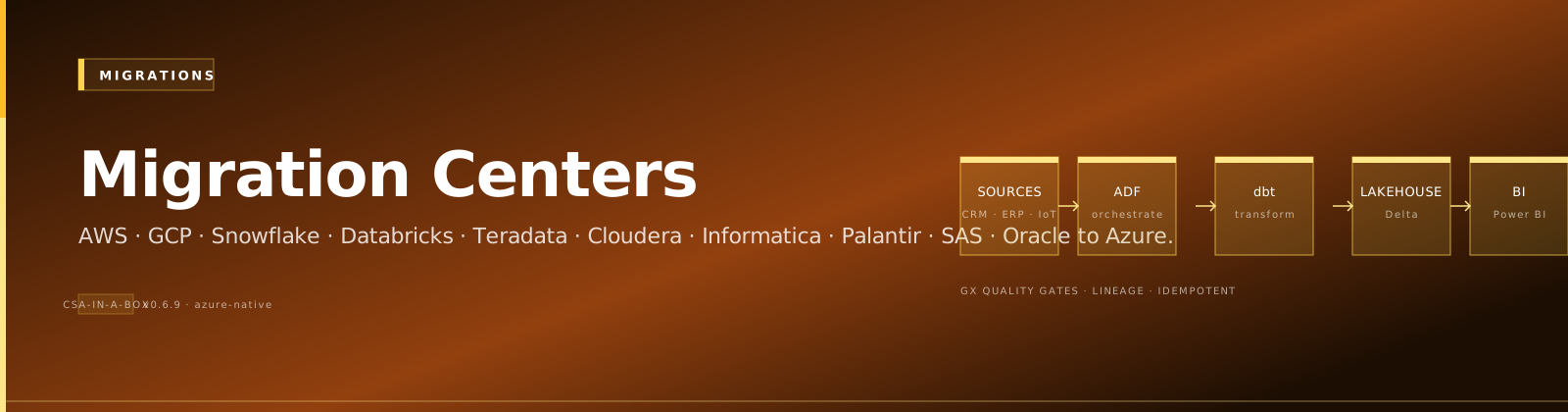
Why Azure over Informatica
Comparative positioning note
This document is written from the perspective of Microsoft Azure, Cloud Scale Analytics, and CSA Loom. Any description of third-party or competing products, services, pricing, or capabilities is derived from publicly available documentation and sources believed accurate at the time of writing, and is provided for general comparison only. We do not claim expertise in, or authority over, any non-Microsoft product or service; the respective vendor's official documentation is the authoritative source for their offerings, which may change over time. Nothing here is intended to disparage any vendor — where a competing product has genuine advantages, we aim to note them honestly. Verify all third-party details against the vendor's current official documentation before making decisions.
A strategic brief for CDOs, CIOs, and enterprise data leaders evaluating their ETL and data integration platform strategy.
Executive summary
Informatica has been a dominant force in enterprise data integration for over two decades. PowerCenter is battle-tested, Informatica Intelligent Cloud Services (IICS) is a modern SaaS offering, Informatica Data Quality (IDQ) is comprehensive, and Enterprise Data Catalog (EDC) is a capable metadata management platform. These are serious tools with real strengths.
However, the economics, architecture, and talent dynamics of the data engineering landscape have shifted fundamentally. The modern pattern -- code-first transformations (dbt), declarative orchestration (Azure Data Factory), consumption-based cloud pricing, and unified governance (Microsoft Purview) -- delivers better outcomes at lower cost for the majority of enterprise data workloads. This document presents the strategic case for migration and honestly acknowledges where Informatica retains advantages.
1. License economics: consumption vs CPU-based pricing
The Informatica cost structure
Informatica PowerCenter licensing is based on CPU cores. A typical enterprise license runs $500K to $3M+ per year depending on the number of PowerCenter servers, cores, and add-on products:
| Component | Typical annual cost | Notes |
|---|---|---|
| PowerCenter base license | \(200K-\)800K | Per-core licensing; scales with server count |
| PowerCenter maintenance (20-22%) | \(40K-\)180K | Annual support and updates |
| IDQ license | \(100K-\)400K | Per-core; add-on to PowerCenter or standalone |
| MDM license | \(150K-\)500K | Per-core; highest per-core rate in the portfolio |
| Enterprise Data Catalog | \(80K-\)250K | Per-core or per-user depending on edition |
| IICS subscription | \(100K-\)1M+ | IPU-based (Informatica Processing Units) |
| Infrastructure (servers, storage) | \(50K-\)200K | On-prem hardware for PowerCenter |
| DBA/admin team (2-3 FTEs) | \(300K-\)600K | PowerCenter repository, server management |
| Total (typical mid-enterprise) | \(1M-\)3M+ | Before development team costs |
The Azure cost structure
Azure Data Factory and dbt operate on consumption-based pricing:
| Component | Typical annual cost | Notes |
|---|---|---|
| ADF pipeline runs | \(20K-\)80K | Pay per activity run + data movement DIU-hours |
| ADF Integration Runtime | \(10K-\)40K | Self-Hosted IR for on-prem sources; Azure IR is pay-per-use |
| dbt Cloud (Team plan) | \(6K-\)36K | $100/seat/month for 5-30 developers |
| dbt Core (open source) | $0 | Self-hosted; no license cost |
| Azure SQL / Synapse compute | \(30K-\)150K | Target warehouse compute |
| Purview (governance) | \(10K-\)50K | Consumption-based scanning and classification |
| Great Expectations | $0 | Open source; self-hosted |
| Azure Monitor + Log Analytics | \(5K-\)20K | Operational monitoring |
| Total (typical mid-enterprise) | \(80K-\)400K | 70-90% reduction from Informatica |
What this means
The cost differential is not marginal. For a typical enterprise running PowerCenter + IDQ + EDC, the Azure-native stack delivers $500K to \(2.5M in annual savings**. Over a 5-year period, this compounds to **\)2.5M to $12.5M -- enough to fund the entire migration, retrain the team, and invest in modern data capabilities.
For detailed projections, see Total Cost of Ownership Analysis.
2. Code-first vs GUI-first: a paradigm shift
The PowerCenter paradigm
PowerCenter is GUI-first. Transformations are built in the PowerCenter Designer, a visual tool that stores logic as XML metadata in the PowerCenter Repository. This approach has genuine strengths:
- Visual debugging makes data flow intuitive for non-developers
- Drag-and-drop enables rapid prototyping by business analysts
- Built-in transformations (Lookup, Joiner, Router, Aggregator) provide declarative logic
But it also has structural weaknesses:
- XML metadata is not version-controllable in any meaningful way. PowerCenter "deployments" are repository exports, not Git commits
- Testing is manual. There is no unit test framework for PowerCenter mappings
- Code review is impossible. Two developers cannot diff a mapping change in a pull request
- Refactoring is painful. Changing a shared mapplet requires manual impact analysis across every mapping that uses it
- CI/CD is bolted on. Informatica's deployment tools exist but are not native to modern DevOps pipelines
The dbt + ADF paradigm
The modern stack inverts the model:
- Transformations are SQL (dbt models). Every transformation is a
.sqlfile in a Git repository - Version control is native. Every change is a Git commit with a diff, a branch, and a pull request
- Testing is built in. dbt includes schema tests (unique, not_null, accepted_values, relationships) and custom data tests
- Documentation is generated.
dbt docs generateproduces a browsable data dictionary from model metadata - CI/CD is native. dbt runs in GitHub Actions, Azure DevOps, or any CI system. ADF pipelines are ARM/Bicep templates
- Orchestration is declarative. ADF pipelines define dependencies, retries, and triggers as JSON -- not hidden in a GUI
The cultural shift
This is not just a tool swap. It is a paradigm shift from GUI-driven ETL development to software engineering for data. The implications are significant:
| Capability | PowerCenter | dbt + ADF |
|---|---|---|
| Version control | Repository export (binary) | Git (full diff, branch, PR) |
| Code review | Not possible | Standard pull request workflow |
| Unit testing | Manual QA | dbt test (automated, CI-integrated) |
| Documentation | Manual (separate wiki) | Auto-generated from model YAML |
| CI/CD | Bolted-on (Informatica Deployment tools) | Native (GitHub Actions, Azure DevOps) |
| Refactoring | Manual impact analysis | IDE refactoring + dbt ref() graph |
| Collaboration | One developer per mapping (lock-based) | Branch-based parallel development |
| Debugging | Visual debugger in Designer | SQL + dbt logs + ADF Monitor |
| Reuse | Mapplets (limited composability) | dbt macros (full Jinja templating) |
Honest assessment
PowerCenter's visual interface is genuinely easier for non-developer data analysts to learn. If your team is primarily business analysts who build simple extract-load-transform flows, the GUI has value. However, for production data engineering at scale, the code-first approach is categorically superior for testability, maintainability, and collaboration.
3. Cloud-native ADF vs on-prem PowerCenter
PowerCenter's architecture
PowerCenter was designed for on-premises deployment. The architecture requires:
- PowerCenter Server(s) -- the runtime engine
- PowerCenter Repository -- metadata store (typically Oracle or SQL Server)
- PowerCenter Client tools -- Designer, Workflow Manager, Monitor (Windows desktop apps)
- Integration Service -- the execution engine for sessions and workflows
- Network connectivity -- direct database connections to all source and target systems
This architecture works but creates operational overhead:
- Server patching, upgrades, and capacity planning
- Repository database maintenance and backup
- Client tool distribution and version management
- Network configuration for every new source/target
- Disaster recovery infrastructure
ADF's architecture
Azure Data Factory is serverless. There are no servers to manage:
- Pipelines are defined as JSON and deployed via ARM/Bicep
- Integration Runtimes are managed (Azure IR) or self-hosted (for on-prem sources only)
- Monitoring is built into Azure Monitor
- Scaling is automatic -- ADF provisions compute on demand
- Connectivity uses Managed VNet, Private Endpoints, and over 100 built-in connectors
What this means
The operational burden of running PowerCenter -- server management, patching, capacity planning, DR -- disappears entirely with ADF. Your data engineering team focuses on building pipelines, not managing infrastructure. For organizations still running PowerCenter on-prem, the migration to ADF eliminates an entire category of operational work.
4. Unified governance: Purview vs separate catalogs
Informatica's governance landscape
Informatica offers governance through multiple products:
- Enterprise Data Catalog (EDC) -- metadata management, lineage, business glossary
- Axon -- data governance and stewardship workflows
- IDQ -- data quality profiling and scorecards
- MDM -- master data management
Each product has its own license, its own UI, its own administration, and its own integration points. Unifying them requires additional configuration and often additional Informatica professional services.
Microsoft Purview
Purview provides a unified governance platform:
- Data Catalog -- automated discovery and classification across Azure, on-prem, and multi-cloud
- Data Map -- lineage from source to report, across ADF, dbt, Synapse, Fabric, and Power BI
- Business Glossary -- centralized term definitions with ownership and stewardship
- Data Quality (preview) -- profiling and quality rules integrated into the catalog
- Sensitivity Labels -- classification that propagates through the Microsoft 365 ecosystem
- Data Stewardship -- approval workflows for glossary terms and data access
What this means
Purview replaces three to four Informatica products (EDC, Axon, and partially IDQ and MDM) with a single, integrated service. The total cost of Purview is typically 10-20% of the combined Informatica governance stack, and the integration with Azure services is native rather than bolted on.
5. Modern data engineering practices
What Informatica lacks
Informatica was built before the modern data engineering stack matured. While IICS has added cloud capabilities, the core development workflow still lacks:
- dbt-style transformation patterns -- staging, intermediate, marts layers with clear lineage
- Data contracts -- schema enforcement at the interface between producers and consumers
- DataOps automation -- automated testing, deployment, and monitoring as a unified pipeline
- Lakehouse architecture -- Delta Lake, Apache Iceberg, or similar open table formats
- Semantic layer -- a shared business logic layer consumed by BI, AI, and operational systems
What Azure provides
The Azure + dbt stack provides all of these natively:
| Practice | Tool | Description |
|---|---|---|
| Layered transformations | dbt | staging / intermediate / marts pattern |
| Data contracts | dbt + Purview | Schema tests + Purview data products |
| CI/CD for data | GitHub Actions + dbt Cloud | Automated build, test, deploy |
| Lakehouse | Delta Lake / Fabric OneLake | Open table formats on open storage |
| Semantic layer | dbt semantic layer / Power BI | Shared metrics and business logic |
| Data observability | dbt source freshness + Great Expectations | Automated quality monitoring |
| Infrastructure as Code | Bicep / Terraform | Reproducible environments |
6. AI capabilities: no equivalent in the Informatica ecosystem
Informatica's AI story
Informatica has added AI-powered features to IICS (CLAIRE AI) for metadata recommendations, mapping suggestions, and anomaly detection. These are useful productivity features within the Informatica platform. However, Informatica does not offer:
- Large language model hosting or inference
- Custom model training or fine-tuning
- RAG (Retrieval-Augmented Generation) patterns
- AI agents or copilots for operational workflows
- Computer vision, speech, or multi-modal AI
Azure AI capabilities
Azure provides a comprehensive AI platform that operates on the same data assets:
| Capability | Azure service | Integration with data platform |
|---|---|---|
| LLM inference | Azure OpenAI Service | Reads from the same lakehouse / Purview catalog |
| Custom models | Azure ML | Trains on data produced by dbt pipelines |
| RAG patterns | Azure AI Search + OpenAI | Indexes data governed by Purview |
| AI agents | Copilot Studio / Azure AI Foundry | Operates on semantically modeled data |
| Copilot integration | Microsoft 365 Copilot | Surfaces data insights in Teams, Excel, PowerPoint |
| Document intelligence | Azure AI Document Intelligence | Extracts structured data for ADF ingestion |
What this means
With Informatica, your data platform and your AI platform are separate ecosystems requiring separate integration. With Azure, the data platform (ADF + dbt + Purview) and the AI platform (Azure OpenAI + AI Foundry + Copilot) share identity, governance, storage, and networking. This integration is not just convenient -- it is architecturally fundamental for building AI-powered data products.
7. Talent availability and hiring
Informatica talent market
The Informatica talent pool is shrinking. PowerCenter development is a legacy skill. New data engineers learn Python, SQL, Spark, and dbt -- not PowerCenter Designer. The implications:
| Metric | Informatica | Azure + dbt |
|---|---|---|
| Active job postings (US, 2025) | ~2,000 (declining YoY) | ~50,000+ (growing YoY) |
| New certifications per year | Not publicly tracked | 500,000+ Azure certifications/year |
| Stack Overflow activity | Minimal | Extensive (dbt, ADF, Azure) |
| Open-source community | None (proprietary) | dbt: 10,000+ packages; ADF: open ARM templates |
| Training resources | Informatica University (paid) | Microsoft Learn (free), dbt Learn (free) |
| Average salary premium | 10-15% premium for scarce skill | Market rate; abundant talent pool |
Hiring implication
Organizations that stay on Informatica face increasing difficulty hiring and retaining developers. Contractors with PowerCenter skills command premium rates due to scarcity, not value. The Azure + dbt talent pool is approximately 25x larger and growing, with extensive free training resources and a vibrant open-source community.
8. Where Informatica retains advantages
This comparison would be incomplete without acknowledging areas where Informatica products provide genuine value:
PowerCenter strengths
- Battle-tested reliability. PowerCenter has been running mission-critical ETL in Fortune 500 companies for 20+ years. It is stable, predictable, and well-understood by experienced teams
- Visual debugging. The PowerCenter session log and visual debugger are excellent for troubleshooting complex data flows
- Complex transformation library. Transformations like the Java Transformation, HTTP Transformation, and XML Generator have no direct single-activity ADF equivalent
- Mainframe connectivity. PowerCenter's mainframe connectors (VSAM, IMS, DB2 z/OS) are mature and battle-tested
IICS strengths
- Modern SaaS delivery. IICS is a genuine cloud-native platform with auto-scaling and managed infrastructure
- Intelligent Structure Models. IICS's ability to parse semi-structured data (JSON, XML, logs) visually is strong
- CLAIRE AI recommendations. Metadata-driven mapping suggestions reduce development time for common patterns
IDQ strengths
- Comprehensive data quality. IDQ's profiling, standardization, address validation, and matching capabilities are deep and mature
- Pre-built content. Address validation databases, name standardization dictionaries, and industry-specific rules are included
- Scorecard visualization. IDQ's quality scorecard dashboards are purpose-built and polished
Enterprise Data Catalog strengths
- Cross-platform lineage. EDC can trace lineage across PowerCenter, IICS, Teradata, Oracle, and other platforms in a single view
- Automated profiling. EDC's column-level profiling provides statistical analysis without manual configuration
9. Decision framework
| If your priority is... | Recommended direction | Rationale |
|---|---|---|
| Reducing annual platform cost by 70%+ | Migrate to Azure + dbt | Consumption pricing vs CPU-based licensing |
| Adopting modern data engineering (Git, CI/CD, testing) | Migrate to Azure + dbt | Code-first paradigm enables software engineering practices |
| Hiring and retaining data engineers | Migrate to Azure + dbt | 25x larger talent pool; skills are transferable |
| AI/ML integration with data platform | Migrate to Azure | No equivalent AI capability in Informatica ecosystem |
| Unified governance at lower cost | Migrate to Azure (Purview) | Replaces 3-4 Informatica products |
| Minimal disruption to stable workloads | Delay migration; plan incrementally | PowerCenter is stable if the team and budget allow it |
| Complex MDM with deep match/merge | Evaluate carefully | MDM migration is the hardest; consider Profisee or phased approach |
| Mainframe data integration | Hybrid approach | Keep PowerCenter for mainframe; migrate everything else |
| Team is 100% GUI-oriented analysts | Invest in training first | dbt requires SQL skills; plan 3-6 month ramp-up |
10. The bottom line
Informatica built a dominant ETL platform for the on-premises, GUI-driven, license-per-core era. That era is ending. The modern data engineering stack -- code-first transformations, consumption-based cloud services, unified governance, and AI integration -- delivers better outcomes at dramatically lower cost.
The migration is not trivial. A typical mid-size estate requires 12-24 months of dedicated effort. PowerCenter developers need retraining. Complex MDM workloads need re-engineering. But the economic and strategic case is compelling: $500K to $2.5M in annual savings, a 25x larger talent pool, native AI integration, and a platform that evolves with the industry rather than against it.
The question is not whether to migrate, but when and how fast.
Related resources
- Total Cost of Ownership Analysis -- Detailed financial projections
- Complete Feature Mapping -- Every Informatica feature mapped to Azure
- PowerCenter Migration Guide -- Detailed PowerCenter-specific migration
- IICS Migration Guide -- IICS-specific migration
- Migration Playbook -- End-to-end migration guide
- Benchmarks & Performance -- Throughput and velocity comparisons
Last updated: 2026-04-30 Maintainers: CSA-in-a-Box core team