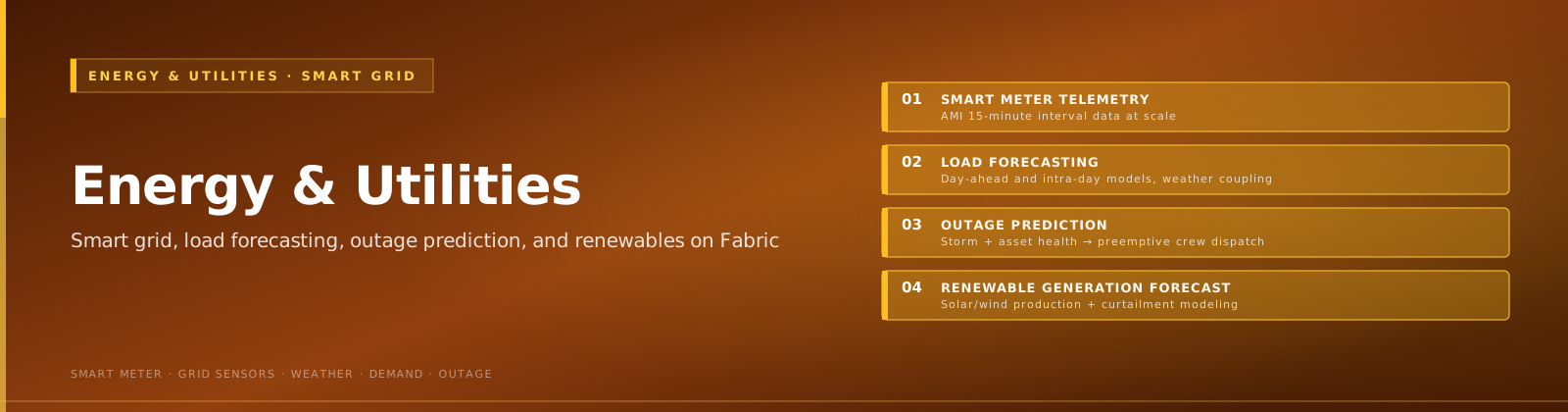
Energy & Utilities: Smart Grid Analytics¶ Feature
Last Updated: 2026-04-27 | Version: 1.0 Status: Phase 14 - Commercial Verticals | Vertical: Energy & Utilities Compliance: NERC CIP v7 | Regulation: FERC Order 2222, IEEE 1547



Executive Summary
A regional electric utility serves 1.2 million smart meters across a mixed-generation territory (natural gas, solar, wind) with a 15 GW peak demand. The Advanced Metering Infrastructure (AMI) generates 15-minute interval readings producing approximately 35 billion readings per year. Microsoft Fabric provides the unified analytics platform to transform this telemetry into actionable grid intelligence -- from real-time outage detection to day-ahead load forecasting and renewable integration optimization.
Business Outcomes
| Metric | Before Fabric | After Fabric | Impact |
|---|---|---|---|
| SAIDI (avg outage minutes) | 142 min | 98 min | -31% |
| Outage detection time | 8-12 min | < 90 sec | -87% |
| Load forecast accuracy (day-ahead) | 91% | 96.5% | +5.5pp |
| Revenue protection (theft detection) | $4.2M/yr loss | $1.1M/yr loss | -74% |
| Demand response participation | 18% | 34% | +89% |
| Renewable curtailment | 6.8% | 3.2% | -53% |
Estimated Monthly Cost: ~$20,000 (F64 SKU) Annual ROI: $12-18M from outage reduction, demand response savings, and revenue protection
Architecture Overview
graph TB
    subgraph "Data Sources"
        AMI["AMI Head-End<br/>15-min intervals<br/>1.2M meters"]
        SCADA["SCADA/EMS<br/>Real-time grid state<br/>2-4 sec intervals"]
        WX["Weather Services<br/>NWS, satellite, radar"]
        GIS["GIS/Asset Registry<br/>Feeders, transformers, poles"]
        DER["DER Telemetry<br/>Solar/Wind/Battery"]
        OMS["OMS/Outage Mgmt<br/>Trouble tickets"]
    end

    subgraph "Ingestion Layer"
        ES["Eventstream<br/>AMI + SCADA streaming"]
        BATCH["Batch Ingestion<br/>Weather, GIS, billing"]
    end

    subgraph "Real-Time Intelligence"
        EH["Eventhouse<br/>Grid anomaly detection<br/>Voltage sag/swell alerts"]
        KQL["KQL Dashboards<br/>Live grid status"]
    end

    subgraph "Medallion Lakehouse"
        B["Bronze<br/>bronze_meter_readings<br/>bronze_outage_events<br/>bronze_weather_obs"]
        S["Silver<br/>silver_meter_validated<br/>silver_outage_enriched<br/>silver_weather_gridded"]
        G["Gold<br/>gold_grid_reliability<br/>gold_load_forecast<br/>gold_revenue_protection"]
    end

    subgraph "Consumption"
        PBI["Power BI<br/>Direct Lake<br/>Grid Operations Dashboard"]
        DR["Demand Response<br/>Event Dispatch"]
        REG["Regulatory Reporting<br/>NERC/FERC filings"]
    end

    AMI --> ES
    SCADA --> ES
    WX --> BATCH
    GIS --> BATCH
    DER --> ES
    OMS --> BATCH

    ES --> EH
    ES --> B
    BATCH --> B
    EH --> KQL

    B --> S --> G

    G --> PBI
    G --> DR
    G --> REG
Data Model
Bronze Layer
bronze_meter_readings
Raw AMI interval data as received from the head-end system.
| Column | Type | Description |
|---|---|---|
meter_id | STRING | AMI meter identifier (e.g., MTR-00345921) |
reading_timestamp | TIMESTAMP | Interval end time (UTC, 15-min aligned) |
kwh_delivered | DOUBLE | Energy delivered to customer (kWh) |
kwh_received | DOUBLE | Energy received from customer -- net metering (kWh) |
voltage_a | DOUBLE | Phase A voltage (volts) |
voltage_b | DOUBLE | Phase B voltage (volts, null for 120V service) |
voltage_c | DOUBLE | Phase C voltage (volts, null for single-phase) |
power_factor | DOUBLE | Power factor (0.0-1.0) |
demand_kw | DOUBLE | Demand in kW for the interval |
tamper_flag | BOOLEAN | Meter tamper detection flag |
read_quality | STRING | Quality code: ACTUAL, ESTIMATED, MISSING |
_ingested_at | TIMESTAMP | Fabric ingestion timestamp |
_source | STRING | Source system identifier |
_batch_id | STRING | Ingestion batch ID |
Volume: ~115M records/day (1.2M meters x 96 intervals) Partition: year/month/day
bronze_outage_events
| Column | Type | Description |
|---|---|---|
event_id | STRING | Unique outage event ID |
feeder_id | STRING | Distribution feeder identifier |
substation_id | STRING | Substation identifier |
district | STRING | Operating district |
start_datetime | TIMESTAMP | Outage start time |
restore_datetime | TIMESTAMP | Power restoration time |
duration_minutes | DOUBLE | Outage duration |
cause_code | STRING | IEEE 1366 cause code |
cause_description | STRING | Human-readable cause |
customers_affected | INT | Number of customers interrupted |
equipment_failed | STRING | Failed equipment type |
weather_related | BOOLEAN | Weather-related flag |
major_event | BOOLEAN | Major Event Day (MED) flag per IEEE 1366 |
bronze_weather_observations
| Column | Type | Description |
|---|---|---|
station_id | STRING | NWS weather station |
observation_time | TIMESTAMP | Observation timestamp |
temperature_f | DOUBLE | Temperature (Fahrenheit) |
wind_speed_mph | DOUBLE | Wind speed |
wind_gust_mph | DOUBLE | Wind gust |
precipitation_in | DOUBLE | Precipitation (inches) |
humidity_pct | DOUBLE | Relative humidity |
pressure_mb | DOUBLE | Barometric pressure |
weather_condition | STRING | Condition category |
Silver Layer
silver_meter_validated
Cleansed and validated meter readings with quality enforcement.
| Column | Type | Description |
|---|---|---|
meter_id | STRING | Meter identifier |
reading_timestamp | TIMESTAMP | Interval timestamp |
kwh_delivered | DOUBLE | Validated kWh delivered |
kwh_received | DOUBLE | Validated kWh received |
voltage_avg | DOUBLE | Average voltage across phases |
voltage_valid | BOOLEAN | Within ANSI C84.1 Range A (114-126V @ 120V) |
power_factor | DOUBLE | Power factor |
demand_kw | DOUBLE | Demand kW |
read_quality | STRING | Quality code after validation |
tamper_score | DOUBLE | Theft/tamper probability (0-1) |
gap_interpolated | BOOLEAN | Whether this reading was interpolated |
daily_kwh | DOUBLE | Rolling daily consumption |
monthly_kwh | DOUBLE | Rolling monthly consumption |
rate_class | STRING | Customer rate class |
premise_type | STRING | Residential / Commercial / Industrial |
Validation Rules: - Voltage range: 108-132V for 120V service (ANSI C84.1 Range B extreme) - kWh must be non-negative - Intervals must be 15-min aligned - Gap detection: flag intervals > 15 min apart - Tamper detection: sudden zero readings, reverse flow anomalies, bypass patterns
silver_outage_enriched
| Column | Type | Description |
|---|---|---|
event_id | STRING | Outage event ID |
feeder_id | STRING | Feeder ID |
district | STRING | District |
duration_minutes | DOUBLE | Duration |
customers_affected | INT | Customers impacted |
cause_category | STRING | Normalized cause (Weather/Equipment/Vegetation/Animal/Other) |
cmi | DOUBLE | Customer Minutes Interrupted |
weather_temp_f | DOUBLE | Temperature at time of outage |
weather_wind_mph | DOUBLE | Wind speed at time of outage |
weather_precip_in | DOUBLE | Precipitation at time of outage |
vegetation_correlated | BOOLEAN | Correlated with vegetation contact |
Gold Layer
gold_grid_reliability
IEEE 1366 reliability indices aggregated by feeder, district, and time period.
| Column | Type | Description |
|---|---|---|
period | STRING | Aggregation period (daily/monthly/quarterly/annual) |
period_start | DATE | Period start date |
district | STRING | Operating district |
feeder_id | STRING | Feeder (null for district-level) |
saidi | DOUBLE | System Average Interruption Duration Index (min) |
saifi | DOUBLE | System Average Interruption Frequency Index |
caidi | DOUBLE | Customer Average Interruption Duration Index (min) |
asai | DOUBLE | Average Service Availability Index |
maifi | DOUBLE | Momentary Average Interruption Frequency Index |
customers_served | INT | Total customers in scope |
total_cmi | DOUBLE | Total Customer Minutes Interrupted |
outage_count | INT | Number of sustained interruptions |
med_threshold | DOUBLE | Major Event Day threshold (2.5 Beta) |
excluding_med | BOOLEAN | Whether MED events are excluded |
Key Formulas: - SAIDI = SUM(Customer Minutes Interrupted) / Total Customers Served - SAIFI = SUM(Customers Interrupted) / Total Customers Served - CAIDI = SAIDI / SAIFI - ASAI = 1 - (SAIDI / Total Minutes in Period)
gold_load_forecast
| Column | Type | Description |
|---|---|---|
forecast_datetime | TIMESTAMP | Forecasted interval |
forecast_horizon | STRING | hour_ahead, day_ahead, week_ahead |
district | STRING | Operating district |
predicted_mw | DOUBLE | Predicted demand (MW) |
lower_bound_mw | DOUBLE | 95% confidence lower bound |
upper_bound_mw | DOUBLE | 95% confidence upper bound |
temperature_f | DOUBLE | Forecast temperature |
solar_generation_mw | DOUBLE | Expected solar generation |
wind_generation_mw | DOUBLE | Expected wind generation |
net_load_mw | DOUBLE | Net load (demand - renewables) |
peak_flag | BOOLEAN | Expected peak period |
dr_eligible_mw | DOUBLE | Demand response capacity available |
gold_revenue_protection
| Column | Type | Description |
|---|---|---|
meter_id | STRING | Meter identifier |
analysis_date | DATE | Analysis date |
theft_score | DOUBLE | Theft probability (0-1) |
anomaly_type | STRING | Type of anomaly detected |
estimated_loss_kwh | DOUBLE | Estimated energy theft (kWh) |
estimated_loss_usd | DOUBLE | Estimated revenue loss ($) |
priority | STRING | Investigation priority (HIGH/MEDIUM/LOW) |
last_field_visit | DATE | Last physical meter inspection |
Use Cases
1. Smart Meter Analytics & AMI Data Management
Challenge: Processing 35 billion readings/year with quality validation, gap interpolation, and tamper detection at scale.
Fabric Solution: - Eventstream ingests 15-min AMI reads from the head-end via Event Hub - Bronze stores raw reads with full fidelity - Silver applies ANSI C84.1 voltage validation, gap interpolation, tamper scoring - Gold aggregates to daily/monthly billing determinants
KQL for Real-Time Voltage Monitoring:
MeterReadings
| where reading_timestamp > ago(1h)
| where voltage_a < 108 or voltage_a > 132
| summarize ViolationCount = count(),
            AvgVoltage = avg(voltage_a),
            AffectedMeters = dcount(meter_id)
    by bin(reading_timestamp, 5m), feeder_id
| where ViolationCount > 10
| order by ViolationCount desc
2. Grid Reliability (SAIDI/SAIFI/CAIDI)
Challenge: Calculating IEEE 1366 reliability indices across 200+ feeders with Major Event Day exclusion.
Fabric Solution: - Outage events flow from OMS into bronze, enriched with weather in silver - Gold computes reliability indices at feeder, district, and system levels - Power BI Direct Lake dashboard shows real-time reliability trends
DAX for Reliability Dashboard:
SAIDI Current Year =
VAR _TotalCMI = SUM(gold_grid_reliability[total_cmi])
VAR _TotalCustomers = SUM(gold_grid_reliability[customers_served])
RETURN
    DIVIDE(_TotalCMI, _TotalCustomers, 0)
3. Demand Response Optimization
Challenge: Identifying and dispatching demand response resources during peak events to avoid capacity purchases.
Fabric Solution: - Day-ahead load forecast identifies potential peak exceedance - Customer segmentation scores DR eligibility by rate class and historical response - Automated dispatch recommendations with MW reduction targets
4. Renewable Integration & Curtailment Reduction
Challenge: Balancing intermittent solar (4.2 GW installed) and wind (2.1 GW) generation with grid stability requirements.
Fabric Solution: - Combine DER telemetry with weather forecasts for generation prediction - Identify curtailment patterns and recommend battery storage dispatch - Track renewable portfolio standard (RPS) compliance
5. Vegetation Management
Challenge: Correlating outage data with weather, satellite imagery, and vegetation growth cycles to prioritize tree trimming.
Fabric Solution: - Outage cause analysis identifies vegetation-related interruptions - Weather correlation (wind + precipitation) highlights vulnerable feeders - Predictive model prioritizes trimming routes by outage risk
6. Revenue Protection (Theft Detection)
Challenge: Identifying energy theft patterns across 1.2M meters, including meter bypass, magnetic interference, and billing anomalies.
Fabric Solution: - Silver layer calculates tamper scores using consumption pattern analysis - Gold layer ranks meters by theft probability for field investigation - Estimated annual recovery: $3.1M
NERC CIP Compliance
Critical Infrastructure Protection Requirements
Microsoft Fabric deployment for BES (Bulk Electric System) data must comply with NERC CIP standards:
| Standard | Requirement | Fabric Implementation |
|---|---|---|
| CIP-002 | BES Cyber System Categorization | Classify Fabric workspace assets by impact level |
| CIP-003 | Security Management Controls | Workspace RBAC, sensitivity labels, audit policies |
| CIP-004 | Personnel & Training | Azure AD PIM for elevated access, training logs |
| CIP-005 | Electronic Security Perimeter | Private endpoints, VNet integration, IP allowlists |
| CIP-007 | System Security Management | Patch management via Fabric SaaS, endpoint protection |
| CIP-009 | Recovery Plans | BCDR with geo-redundant OneLake, Fabric mirroring |
| CIP-011 | Information Protection | Purview sensitivity labels, CMK encryption |
| CIP-013 | Supply Chain Risk Mgmt | Azure compliance certifications, vendor assessments |
Electronic Security Perimeter (ESP) Configuration
// BES Cyber System isolation via private endpoints
resource fabricEndpoint 'Microsoft.Network/privateEndpoints@2023-09-01' = {
  name: 'pe-fabric-bes'
  location: location
  properties: {
    privateLinkServiceConnections: [
      {
        name: 'fabric-bes-connection'
        properties: {
          privateLinkServiceId: fabricCapacity.id
          groupIds: ['fabric']
        }
      }
    ]
    subnet: {
      id: besSubnetId  // Dedicated BES subnet
    }
  }
}
Audit Log Requirements (CIP-007-7 R5)
All access to BES cyber system data must be logged and retained for minimum 3 years:
// NERC CIP audit trail query
FabricAuditLogs
| where TimeGenerated > ago(90d)
| where WorkspaceName contains "BES" or WorkspaceName contains "GRID"
| where Operation in ("ReadData", "WriteData", "DeleteData", "ModifyPermission")
| project TimeGenerated, UserPrincipalName, Operation,
          ItemName, WorkspaceName, ClientIP
| order by TimeGenerated desc
Data Classification
| Data Category | CIP Classification | Handling |
|---|---|---|
| AMI meter reads | Low BES Impact | Standard encryption, workspace isolation |
| SCADA telemetry | Medium/High BES Impact | ESP, restricted access, enhanced audit |
| Grid topology | BES Cyber System Info | BCSI protection, need-to-know access |
| Customer PII | Non-BES, PII regulated | Purview labels, masking in silver layer |
Implementation Timeline
gantt
    title Energy Grid Analytics - Implementation Phases
    dateFormat YYYY-MM-DD
    section Foundation
        Workspace & security setup       :a1, 2026-01-06, 10d
        AMI data ingestion pipeline       :a2, after a1, 14d
        Bronze/Silver medallion           :a3, after a2, 10d
    section Analytics
        Reliability indices (SAIDI/SAIFI) :b1, after a3, 10d
        Load forecasting models           :b2, after b1, 14d
        Revenue protection scoring        :b3, after b1, 10d
    section Advanced
        Renewable integration             :c1, after b2, 14d
        Vegetation management             :c2, after b3, 10d
        Demand response automation        :c3, after c1, 10d
    section Compliance
        NERC CIP audit & controls         :d1, after a1, 60d
        Regulatory reporting              :d2, after b1, 20d
Cost Model
Monthly Fabric Costs (F64 SKU)
| Component | CU Consumption | Monthly Cost |
|---|---|---|
| AMI batch ingestion (115M rows/day) | 12 CU-hours/day | $4,800 |
| Eventstream (real-time AMI + SCADA) | 8 CU-hours/day | $3,200 |
| Eventhouse (grid anomaly detection) | 4 CU-hours/day | $1,600 |
| Silver validation pipelines | 6 CU-hours/day | $2,400 |
| Gold aggregation & ML | 8 CU-hours/day | $3,200 |
| Power BI Direct Lake | 10 CU-hours/day | $4,000 |
| OneLake storage (Delta, ~2TB/month) | — | $800 |
| Total | ~$20,000 |
ROI Analysis
| Benefit Category | Annual Value |
|---|---|
| Outage reduction (31% SAIDI improvement) | $6.2M |
| Demand response savings (avoided capacity) | $3.8M |
| Revenue protection (theft detection) | $3.1M |
| Renewable curtailment reduction | $1.4M |
| Vegetation management optimization | $0.9M |
| Total Annual Benefit | $15.4M |
| Annual Fabric Cost | $240K |
| Net ROI | $15.2M (63:1) |
Power BI Dashboard
Grid Operations Command Center
Page 1: System Overview - System-wide SAIDI/SAIFI gauges with YTD vs target - Real-time generation mix (gas/solar/wind/battery) - Active outages map with customer count - Current demand vs forecast vs capacity
Page 2: Reliability Analytics - SAIDI/SAIFI trend by month (3-year history) - Worst-performing feeders ranked by CMI - Outage cause Pareto chart - Major Event Day timeline
Page 3: Demand & Forecasting - Day-ahead load forecast with confidence bands - Peak demand heatmap (hour x day-of-week) - Demand response event history and MW reduction achieved - Temperature-load scatter with regression
Page 4: Revenue Protection - Theft detection scores distribution - High-priority investigation queue - Estimated loss by district - Field visit outcomes tracking
Page 5: Renewable Performance - Solar/wind generation vs forecast - Curtailment events timeline - Battery storage dispatch optimization - RPS compliance tracker
References
- IEEE 1366 - Electric Power Distribution Reliability Indices
- ANSI C84.1 - Electric Power Systems and Equipment Voltage Ratings
- NERC CIP Standards
- FERC Order 2222 - DER Participation
- Microsoft Fabric Real-Time Intelligence
- Eventstream for IoT Ingestion
Next: Tutorial 51 - Energy & Utilities | Related: Real-Time Intelligence | Medallion Architecture