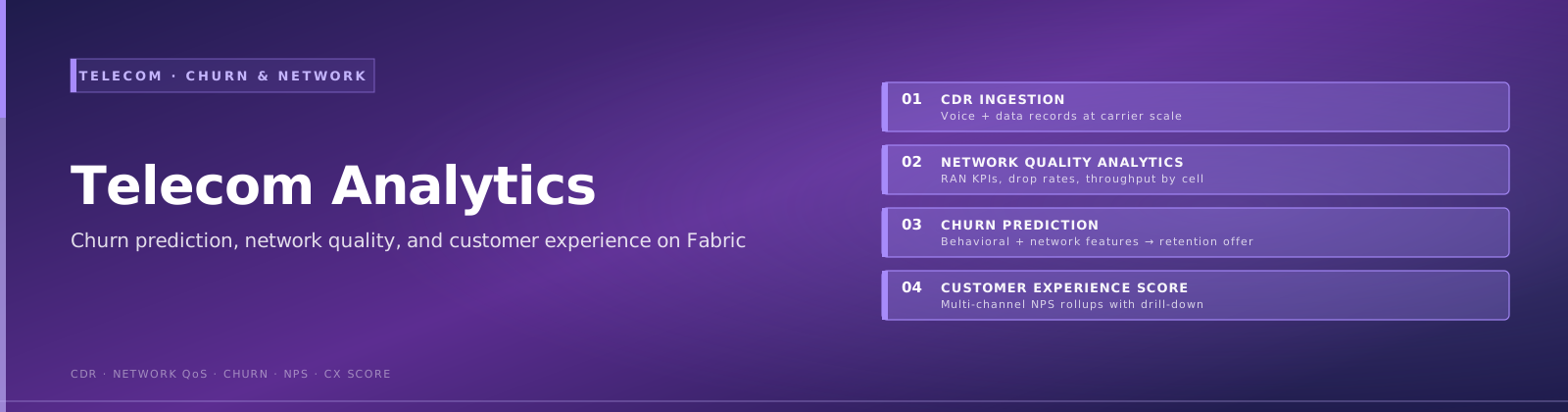
📡 Telecommunications — Network Performance & Churn Prediction¶ Feature
CDR analytics, 5G capacity planning, and subscriber intelligence on Microsoft Fabric



Last Updated: 2026-05-05 | Version: 1.0.0
"Telecom operators sit on petabytes of network and subscriber data — the ones that analyze it in real time will win on experience, not just coverage."
🎯 Scenario Overview
| Scenario | Fabric Pattern | Latency Target | Key Features |
|---|---|---|---|
| Network performance monitoring | Eventstream → Eventhouse KQL + Real-Time Dashboard | < 5 sec | RTI, Alerting |
| Churn prediction | Gold feature store + AutoML classification | Daily scoring | AutoML, Semantic Link |
| CDR analytics (billing, fraud) | Lakehouse medallion + Warehouse aggregation | Hourly | Medallion Architecture, Warehouse Setup |
| 5G capacity planning | Lakehouse Gold + AutoML time-series forecasting | Daily | AutoML, Maps in Fabric |
| Customer 360 for telco | Lakehouse Gold + Direct Lake semantic model | Near-real-time | Direct Lake, Data Sharing |
| Cell tower digital twin | Digital Twin Builder with RAN telemetry | < 10 sec | Digital Twin Builder, RTI |
📋 Regulatory Landscape
| Framework | Applicability | Fabric Controls |
|---|---|---|
| GDPR / ePrivacy Directive | Subscriber PII and location data in EU markets | GDPR Right to Deletion, Data Governance sensitivity labels |
| CCPA / CPRA | California subscriber data | CCPA Privacy Rights, data subject access request workflows |
| CALEA (Communications Assistance for Law Enforcement Act) | Lawful intercept data segregation | RBAC strict role separation, OneLake Security |
| FCC Open Internet / Net Neutrality | Traffic management transparency | SQL Audit Logs for traffic analytics access, Monitoring |
| PCI-DSS | Subscriber billing and payment card data | OneLake Security CLS for card masking, CMK, Network Security |
| SOC 2 Type II | Third-party assurance for managed services | SOC 2 Readiness, Audit Trail |
🏗️ Data Flow Architecture
flowchart LR
    subgraph Sources["📡 Data Sources"]
        RAN["RAN / eNodeB<br/>Performance Counters"]
        CDR["CDR / xDR<br/>Mediation Platform"]
        OSS["OSS / NMS<br/>(Network Mgmt)"]
        BSS["BSS / CRM<br/>(Billing, Orders)"]
        PROBE["Network Probes<br/>(DPI / QoE)"]
    end

    subgraph Bronze["🥉 Bronze Layer"]
        B1["PM Counters<br/>(Eventstream)"]
        B2["CDR Records<br/>(batch → Delta)"]
        B3["Alarm & Fault<br/>(Eventstream)"]
        B4["Subscriber Events<br/>(CDC → Delta)"]
        B5["QoE Metrics<br/>(Eventstream)"]
    end

    subgraph Silver["🥈 Silver Layer"]
        S1["Cell KPIs<br/>(aggregated, validated)"]
        S2["CDR Rated<br/>(deduplicated, enriched)"]
        S3["Fault Correlation<br/>(root-cause mapped)"]
        S4["Subscriber Master<br/>(PII pseudonymized)"]
    end

    subgraph Gold["🥇 Gold Layer"]
        G1["Network Performance<br/>Star Schema"]
        G2["Churn Prediction<br/>Feature Store"]
        G3["Revenue Assurance<br/>KPIs"]
        G4["5G Capacity<br/>Planning"]
    end

    subgraph BI["📊 Consumption"]
        DTB["Digital Twin<br/>Builder (Tower)"]
        EVH["Eventhouse<br/>(real-time KQL)"]
        DL["Direct Lake<br/>Semantic Model"]
        PBI["Power BI<br/>Dashboards"]
        DA["Data Activator<br/>NOC Alerts"]
    end

    RAN --> B1
    CDR --> B2
    OSS --> B3
    BSS --> B4
    PROBE --> B5

    B1 --> S1
    B2 --> S2
    B3 --> S3
    B4 --> S4
    B5 --> S1

    S1 --> G1
    S1 --> G4
    S2 --> G3
    S2 --> G2
    S4 --> G2
    S3 --> G1

    G1 --> DL --> PBI
    G2 --> DL
    G3 --> DL
    G4 --> DL
    B1 --> EVH --> DTB
    G1 --> DA
💡 Why Fabric for Telecommunications
Petabyte-scale CDR analytics without a Hadoop cluster. Call detail records are among the largest datasets in any industry. Fabric's Lakehouse with Delta Lake handles billions of CDR rows with V-Order optimization, while Warehouse provides SQL-based aggregation for billing and revenue assurance — all on OneLake.
Real-time NOC visibility. RAN performance counters and network alarms flow through Eventstreams into Eventhouse, where KQL dashboards and Data Activator alerts give the Network Operations Center sub-5-second visibility into degradation, handover failures, and capacity exhaustion.
Churn prediction with built-in ML. AutoML trains classification models on subscriber behavior, CDR patterns, and network experience features, scoring daily and feeding retention campaigns through the same Direct Lake dashboards that marketing uses.
5G capacity planning with geospatial context. Gold-layer traffic forecasts combined with Maps in Fabric let RF engineers visualize demand hotspots and plan small-cell deployments — no external GIS tooling required.
Cell tower digital twins. Digital Twin Builder models tower sites with live RAN telemetry binding, enabling operators to monitor antenna tilt, power levels, and throughput per sector in a unified Eventhouse experience.
Subscriber privacy by design. Pseudonymized subscriber identifiers in the Silver layer, RBAC-controlled access, and GDPR deletion workflows ensure compliance with ePrivacy and CCPA requirements without sacrificing analytical depth.
🚀 Getting Started
- Ingest network telemetry — Configure Eventstreams to pull RAN counters and alarm feeds into Eventhouse for real-time NOC dashboards.
- Build the medallion Lakehouse — Follow Medallion Deep Dive for CDR, subscriber, and network data.
- Apply privacy controls — Enable OneLake Security CLS for PII, configure GDPR deletion workflows, and set up RBAC for CALEA data segregation.
- Build churn prediction — Create Gold-layer feature tables and train classification models via AutoML.
- Model cell towers — Use Digital Twin Builder to create tower entities with live RAN telemetry binding.
- Create NOC and executive dashboards — Connect Direct Lake semantic models to Power BI for network performance, revenue assurance, and capacity planning reports.
📚 References
| Resource | Link |
|---|---|
| Real-Time Intelligence | RTI Guide |
| Digital Twin Builder | DTB Guide |
| Direct Lake connectivity | Direct Lake Guide |
| AutoML Model Endpoints | AutoML Guide |
| Maps in Fabric | Maps Guide |
| Data Governance | Governance Deep Dive |
| Network Security | Network Security |
| SOC 2 Readiness | SOC 2 Guide |