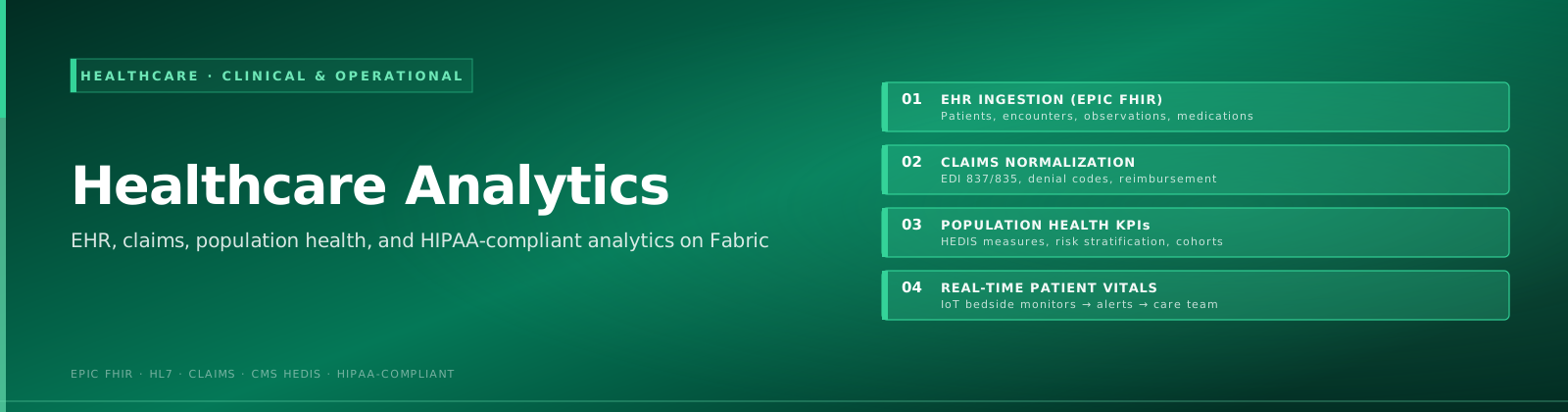
🏥 Healthcare — Patient Analytics & Clinical Intelligence¶ Feature
Unified clinical, operational, and research analytics on Microsoft Fabric



Last Updated: 2026-05-05 | Version: 1.0.0
"The healthcare industry generates roughly 30% of the world's data volume, yet most clinical insights still arrive too late to change patient outcomes."
Third-party references — publicly sourced, good-faith comparison
This page references non-Microsoft products and services. That information is drawn from each vendor's publicly available documentation and is offered for honest, good-faith comparison only. This is a personal project written from a Microsoft Fabric and Azure perspective; it does not claim expertise in, or authority over, any third-party product, and nothing here is an official statement by, or endorsed by, those vendors. Capabilities, pricing, and features change often — always verify against the vendor's current official documentation. Where a third-party offering is the stronger choice, we say so plainly.
🎯 Scenario Overview
| Scenario | Fabric Pattern | Latency Target | Key Features |
|---|---|---|---|
| Patient 360 analytics | Lakehouse medallion + Direct Lake semantic model | < 15 min (near-real-time refresh) | Direct Lake, Semantic Link |
| Clinical trial data integration | Lakehouse Bronze/Silver with FHIR R4 schema mapping | Daily batch | Medallion Architecture, Data Governance |
| Real-time patient vitals monitoring | Eventstream → Eventhouse → Data Activator alerts | < 5 sec | RTI, Alerting |
| Readmission risk prediction | Lakehouse Gold + AutoML model endpoint | Hourly scoring | AutoML, MLOps |
| Medical device telemetry | Eventstream → Eventhouse with Digital Twin Builder | < 2 sec | Digital Twin Builder, RTI |
| Population health dashboards | Warehouse star schema + Direct Lake | Daily | Warehouse Setup, Direct Lake |
📋 Regulatory Landscape
| Framework | Applicability | Fabric Controls |
|---|---|---|
| HIPAA (Health Insurance Portability and Accountability Act) | All entities handling PHI — providers, payers, clearinghouses, and business associates | OneLake Security row/column-level security, CMK encryption at rest, SQL Audit Logs for access tracking |
| HITECH (Health Information Technology for Economic and Clinical Health) | Extends HIPAA breach notification and enforcement | Monitoring & Observability for breach detection, Data Activator for anomalous access alerts |
| 21 CFR Part 11 (FDA Electronic Records) | Clinical trial data, pharmaceutical manufacturing records | Audit Trail Immutability, Delta Lake time-travel for version history |
| GDPR / State Privacy Laws | Patient data for EU residents or applicable US states | GDPR Right to Deletion, CCPA Privacy Rights |
| HL7 FHIR R4 | Interoperability standard for clinical data exchange | Lakehouse schema mapping in Silver layer with FHIR resource normalization |
🏗️ Data Flow Architecture
flowchart LR
    subgraph Sources["🏥 Data Sources"]
        EHR["EHR / EMR<br/>(Epic, Cerner)"]
        FHIR["FHIR R4 APIs"]
        IOT["Medical Devices<br/>(IoT Hub)"]
        CLAIMS["Claims &<br/>Payer Feeds"]
        LAB["Lab / LIMS<br/>Results"]
    end

    subgraph Bronze["🥉 Bronze Layer"]
        B1["Raw EHR Extracts<br/>(append-only)"]
        B2["FHIR Bundles<br/>(JSON → Delta)"]
        B3["Device Telemetry<br/>(Eventstream)"]
        B4["Claims Files<br/>(flat file → Delta)"]
    end

    subgraph Silver["🥈 Silver Layer"]
        S1["Patient Master<br/>(deduplicated, PHI masked)"]
        S2["Encounters &<br/>Diagnoses (ICD-10)"]
        S3["Vitals Time-Series<br/>(validated ranges)"]
        S4["Claims Adjudicated<br/>(schema-enforced)"]
    end

    subgraph Gold["🥇 Gold Layer"]
        G1["Patient 360<br/>Star Schema"]
        G2["Readmission<br/>Risk Scores"]
        G3["Clinical Trial<br/>Cohort Analytics"]
        G4["Population Health<br/>KPIs"]
    end

    subgraph BI["📊 Consumption"]
        DL["Direct Lake<br/>Semantic Model"]
        PBI["Power BI<br/>Dashboards"]
        RTD["Real-Time<br/>Dashboard"]
        DA["Data Activator<br/>Alerts"]
    end

    EHR --> B1
    FHIR --> B2
    IOT --> B3
    CLAIMS --> B4
    LAB --> B1

    B1 --> S1
    B1 --> S2
    B2 --> S1
    B3 --> S3
    B4 --> S4

    S1 --> G1
    S2 --> G1
    S2 --> G2
    S3 --> G2
    S4 --> G4
    S1 --> G3

    G1 --> DL --> PBI
    G2 --> DL
    G4 --> DL
    S3 --> RTD
    S3 --> DA
💡 Why Fabric for Healthcare
Unified platform for diverse clinical data. Healthcare organizations typically operate dozens of siloed systems — EHR, lab, pharmacy, claims, devices. Fabric's OneLake eliminates data copies by providing a single storage layer that Lakehouse, Warehouse, and Eventhouse all read from, reducing data sprawl and governance risk.
Built-in compliance primitives. Row-level security, column-level security, sensitivity labels, customer-managed keys, and SQL audit logs map directly to HIPAA technical safeguards — without bolting on third-party tools.
Real-time clinical alerting without custom code. Medical device telemetry flows through Eventstreams into Eventhouse, where Data Activator can trigger alerts on abnormal vitals — no Kafka clusters or custom stream processing required.
Direct Lake for clinical dashboards. Clinicians and administrators need sub-second dashboard performance. Direct Lake reads Parquet files directly from OneLake into Power BI, eliminating import refresh windows and keeping PHI in a single governed location.
Predictive analytics at scale. AutoML model endpoints can score readmission risk, sepsis probability, or length-of-stay predictions on Gold-layer data without moving data to a separate ML platform.
🚀 Getting Started
- Stand up the medallion architecture — Follow Tutorial 01: Bronze Ingestion and Medallion Deep Dive to create
lh_bronze,lh_silver,lh_goldLakehouses. - Map FHIR resources to Silver schemas — Normalize FHIR R4 Bundles (Patient, Encounter, Observation, Condition) into Silver Delta tables with schema enforcement.
- Apply security controls — Configure OneLake Security RLS/CLS, enable Customer-Managed Keys, and turn on SQL Audit Logs.
- Stream device telemetry — Set up Eventstreams from IoT Hub to Eventhouse for real-time vitals monitoring.
- Build Direct Lake reports — Create a semantic model over Gold tables and connect Direct Lake to Power BI for Patient 360 dashboards.
- Deploy predictive models — Use AutoML to train and deploy a readmission risk model on the Gold layer.
📚 References
| Resource | Link |
|---|---|
| Direct Lake connectivity | Direct Lake Guide |
| Real-Time Intelligence | RTI Guide |
| Digital Twin Builder | DTB Guide |
| Data Governance | Governance Deep Dive |
| Network Security | Network Security |
| RBAC Patterns | Identity & RBAC |
| Testing Strategies | Testing Guide |
| BCDR | Disaster Recovery |