🔒 SOC 2 Compliance Mapping for Microsoft Fabric¶ Compliance
Trust Service Criteria Mapped to Fabric Controls



Last Updated: 2026-05-05 | Version: 1.0.0
🎯 Overview
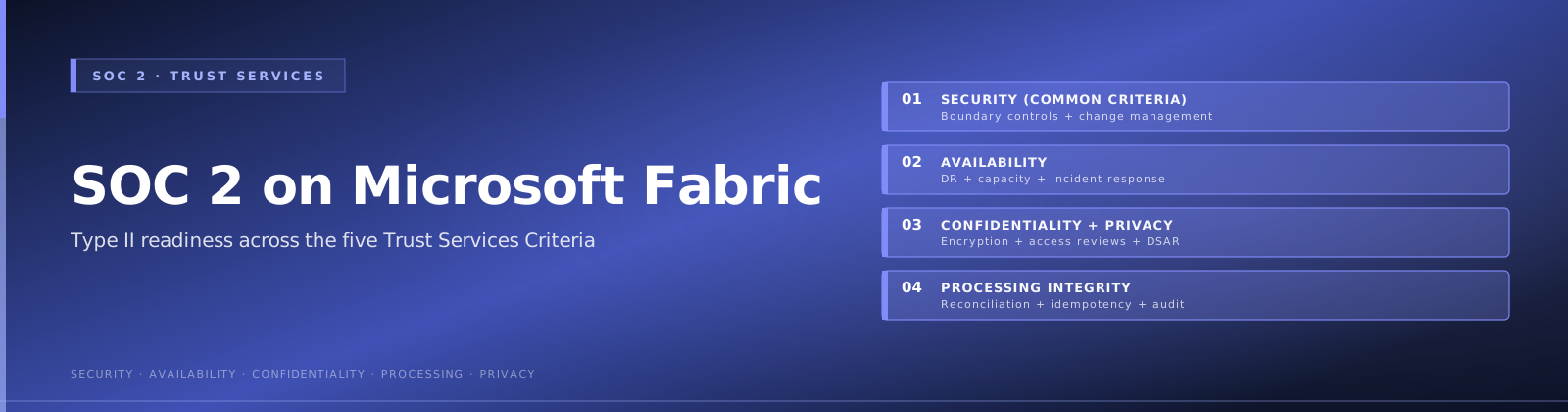
SOC 2 (System and Organization Controls 2) is a compliance framework developed by the AICPA (American Institute of Certified Public Accountants) that evaluates an organization's controls relevant to security, availability, processing integrity, confidentiality, and privacy — known as the Trust Service Criteria (TSC).
Applicability to Fabric
SOC 2 applies to Microsoft Fabric deployments when:
- Your organization provides SaaS or cloud services and must demonstrate control effectiveness to customers
- Customer contracts or RFPs require SOC 2 Type II attestation
- You process or store customer data in Fabric and must demonstrate security posture
- Your organization's internal risk management program requires SOC 2 compliance
Microsoft's SOC 2 Coverage
Microsoft Azure (including Fabric) maintains SOC 2 Type II reports covering all five Trust Service Criteria. Customers can:
- Leverage Microsoft's SOC 2 report for platform-level controls (available via Service Trust Portal)
- Implement customer-level controls for their specific Fabric configuration
- Include Fabric in their own SOC 2 audit by referencing the complementary user entity controls (CUECs)
Trust Service Categories
| Category | Description | Fabric Relevance |
|---|---|---|
| Security (CC) | Protection against unauthorized access | RBAC, MFA, encryption, network controls |
| Availability (A) | System uptime and performance | SLA, BCDR, capacity management |
| Processing Integrity (PI) | Data processing is complete, valid, accurate, timely | ETL validation, Delta ACID, data quality checks |
| Confidentiality (C) | Confidential information is protected | Sensitivity labels, DLP, CMK, data classification |
| Privacy (P) | Personal information lifecycle management | Purview, consent management, data subject rights |
📊 Control Mapping Table
Trust Service Criteria mapped to Microsoft Fabric implementations:
| Control ID | Control Name | TSC Category | Fabric Implementation | Evidence |
|---|---|---|---|---|
| CC1.1 | COSO Principle 1 — Integrity and Ethics | Security | Organization-level code of conduct; Fabric acceptable use policy; tenant admin controls restricting unauthorized actions | Policy documents, tenant settings export |
| CC2.1 | Internal Communication of Objectives | Security | Documented Fabric security architecture; workspace naming conventions with classification; onboarding procedures for Fabric users | Architecture documentation, naming standards |
| CC3.1 | Risk Assessment | Security | Risk assessment covering Fabric data processing; threat modeling for data flows; Defender for Cloud risk scoring | Risk assessment report, Defender findings |
| CC5.1 | Control Activities — Logical Access | Security | Entra ID authentication; MFA enforcement via Conditional Access; workspace RBAC (Admin/Member/Contributor/Viewer); OneLake data access roles | CA policies, role assignments, data access roles |
| CC5.2 | Control Activities — Access Provisioning | Security | Entra ID group-based provisioning; access request workflows; quarterly access reviews; automated deprovisioning | Access review reports, provisioning logs |
| CC5.3 | Control Activities — Access Removal | Security | Automated deprovisioning via Entra ID lifecycle; workspace role removal on team change; guest access expiration policies | Deprovisioning logs, guest expiration config |
| CC6.1 | Logical and Physical Access — Infrastructure | Security | Microsoft datacenter physical security; Fabric managed VNet; private endpoints; Outbound Access Protection; IP firewall rules | SOC 2 report (Microsoft), network config |
| CC6.6 | Encryption at Rest | Security | AES-256 encryption for OneLake (MMK); SQL Database TDE with CMK option; Storage Account SSE with CMK | Encryption configuration, CMK status |
| CC6.7 | Encryption in Transit | Security | TLS 1.2+ enforced for all Fabric communications; HTTPS-only access; encrypted gateway connections | TLS audit, network configuration |
| CC7.1 | Monitoring — Anomaly Detection | Security | Microsoft Sentinel SIEM integration; Fabric admin audit logs; Defender for Cloud alerts; anomalous access detection via Entra ID Protection | Sentinel rules, Defender alerts, risk detections |
| CC7.2 | Monitoring — Incident Management | Security | Incident response procedures; Microsoft Sentinel playbooks; Fabric admin notifications; integration with ITSM | IR plan, Sentinel playbooks, incident logs |
| A1.1 | Availability — Capacity Management | Availability | Fabric capacity monitoring; auto-pause/resume; capacity alerts and budgets; Azure Monitor metrics | Capacity metrics, alert config, budget settings |
| A1.2 | Availability — Recovery | Availability | OneLake geo-redundant storage; SQL Database backup/restore; workspace BCDR procedures; documented RTO/RPO | BCDR plan, backup config, DR test results |
| PI1.1 | Processing Integrity — Data Accuracy | Processing Integrity | Delta Lake ACID transactions; Great Expectations data quality suites; schema enforcement at Bronze layer; reconciliation checks | GE suite results, schema definitions, pipeline logs |
| C1.1 | Confidentiality — Data Classification | Confidentiality | Microsoft Purview sensitivity labels; DLP policies; workspace-level classification; data governance policies | Label assignments, DLP policy reports, governance config |
🤝 Shared Responsibility Model
| TSC Category | Microsoft Responsibility | Customer Responsibility |
|---|---|---|
| Security — Physical | Datacenter physical security, environmental controls, hardware security (attested in Microsoft SOC 2 report) | N/A |
| Security — Platform | Fabric runtime security, OneLake storage encryption, platform patching, network backbone | N/A |
| Security — Logical Access | Entra ID infrastructure, MFA platform, RBAC engine, platform audit event generation | User provisioning, role assignments, MFA policy enforcement, access reviews, RLS configuration |
| Security — Network | TLS enforcement, Azure backbone encryption, DDoS protection | Managed VNet configuration, private endpoints, OAP, firewall rules |
| Security — Encryption | Platform-managed encryption (MMK), TLS in transit | CMK configuration, sensitivity labels, DLP policies |
| Availability | Azure SLA (99.9%+ for Fabric), infrastructure redundancy, platform scaling | Capacity planning, BCDR procedures, DR testing, monitoring dashboards |
| Processing Integrity | Platform data integrity (storage checksums, transaction logs) | ETL validation logic, data quality checks, reconciliation, schema enforcement |
| Confidentiality | Platform encryption, tenant isolation | Data classification, sensitivity labels, DLP policies, access controls for confidential data |
| Privacy | Privacy controls in Azure platform; Microsoft Privacy Statement | Data subject request handling, consent management, privacy impact assessments, data retention policies |
⚠️ Gap Analysis and Limitations
| Gap | TSC Criteria | Impact | Compensating Control |
|---|---|---|---|
| No built-in data classification discovery | C1.1, CC3.1 | Confidential data may be unclassified | Deploy Purview auto-labeling policies; scan OneLake with data classification rules |
| Fabric lacks native DLP enforcement for all item types | C1.1 | DLP policies may not cover all Fabric artifacts | Apply DLP at the Power BI layer; use sensitivity labels for classification; restrict export capabilities |
| No automatic access review in Fabric | CC5.2, CC5.3 | Stale access may persist | Use Entra ID Access Reviews for quarterly recertification; script workspace role audits via Admin API |
| Processing integrity monitoring requires custom implementation | PI1.1 | No built-in data quality dashboard | Implement Great Expectations suites; build monitoring notebook for data quality metrics |
| Privacy request fulfillment requires manual orchestration | P1.1 | No automated DSR fulfillment for OneLake data | Build DSR workflow using Power Automate; document data locations for each PII category |
| Capacity throttling may impact availability | A1.1 | Heavy workloads can be throttled on shared capacity | Use dedicated capacity (F64+); configure capacity alerts; implement workload scheduling |
| No formal penetration testing API for Fabric | CC3.1 | Cannot fully test application-layer security | Conduct authorized pen testing through Microsoft's process; focus on configuration review |
| SOC 2 Type II evidence collection is manual | All | Ongoing evidence collection burden | Automate evidence collection via Admin API scripts; build compliance dashboard |
✅ Implementation Checklist
Security (Common Criteria)
- CC5.1: Configure Conditional Access policies enforcing MFA for all Fabric users
- CC5.1: Implement workspace RBAC with least privilege roles
- CC5.1: Configure OneLake data access roles for granular data access control
- CC5.2: Set up Entra ID group-based provisioning for Fabric workspace access
- CC5.2: Configure quarterly Entra ID Access Reviews for Fabric workspace roles
- CC5.3: Verify automated deprovisioning removes Fabric access on employee offboarding
- CC6.1: Deploy managed VNet and private endpoints for Fabric workspace
- CC6.1: Enable Outbound Access Protection
- CC6.6: Enable CMK for Fabric SQL Database; document MMK for OneLake
- CC7.1: Integrate Fabric audit logs with Microsoft Sentinel
- CC7.1: Configure anomaly detection alerts for unusual data access patterns
- CC7.2: Document incident response procedure specific to Fabric workloads
Availability
- A1.1: Configure capacity alerts and budget thresholds
- A1.1: Implement auto-pause and workload scheduling for capacity management
- A1.2: Document RTO/RPO for all Fabric workloads
- A1.2: Configure SQL Database backup retention and test restore procedures
- A1.2: Conduct annual DR test and document results
Processing Integrity
- PI1.1: Implement schema enforcement at Bronze layer ingestion
- PI1.1: Deploy Great Expectations data quality suites for Silver/Gold layers
- PI1.1: Configure pipeline monitoring and alerting for processing failures
- PI1.1: Implement data reconciliation checks between source and Fabric
Confidentiality
- C1.1: Deploy sensitivity labels across all Fabric workspaces
- C1.1: Configure DLP policies for sensitive data types
- C1.1: Restrict data export formats for workspaces containing confidential data
- C1.1: Enable Purview auto-labeling for known confidential data patterns
Privacy
- Document PII data flows through Fabric
- Implement data subject request workflow for OneLake data
- Configure data retention policies aligned with privacy requirements
- Conduct privacy impact assessment for Fabric analytics workloads
📚 References
Internal Best-Practices
| Guide | Relevant TSC Criteria |
|---|---|
| Customer-Managed Keys | CC6.6 — Encryption at rest |
| SQL Audit Logs Compliance | CC7.1 — Monitoring |
| Identity & RBAC Patterns | CC5.1, CC5.2, CC5.3 — Access controls |
| Network Security | CC6.1 — Infrastructure security |
| Outbound Access Protection | CC6.1 — Boundary protection |
| Monitoring & Observability | CC7.1, CC7.2 — Monitoring and incident management |
| Disaster Recovery & BCDR | A1.1, A1.2 — Availability |
| Capacity Planning | A1.1 — Capacity management |
| Testing Strategies | PI1.1 — Processing integrity |
| Data Governance Deep Dive | C1.1 — Confidentiality |
External References
- AICPA Trust Service Criteria
- Microsoft SOC Reports — Service Trust Portal
- Microsoft Compliance Offerings
- SOC 2 Complementary User Entity Controls
This mapping reflects SOC 2 Trust Service Criteria (2017) and Microsoft Fabric capabilities as of May 2026. Organizations should reference Microsoft's SOC 2 Type II report from the Service Trust Portal and implement complementary user entity controls (CUECs) for their specific Fabric deployment.