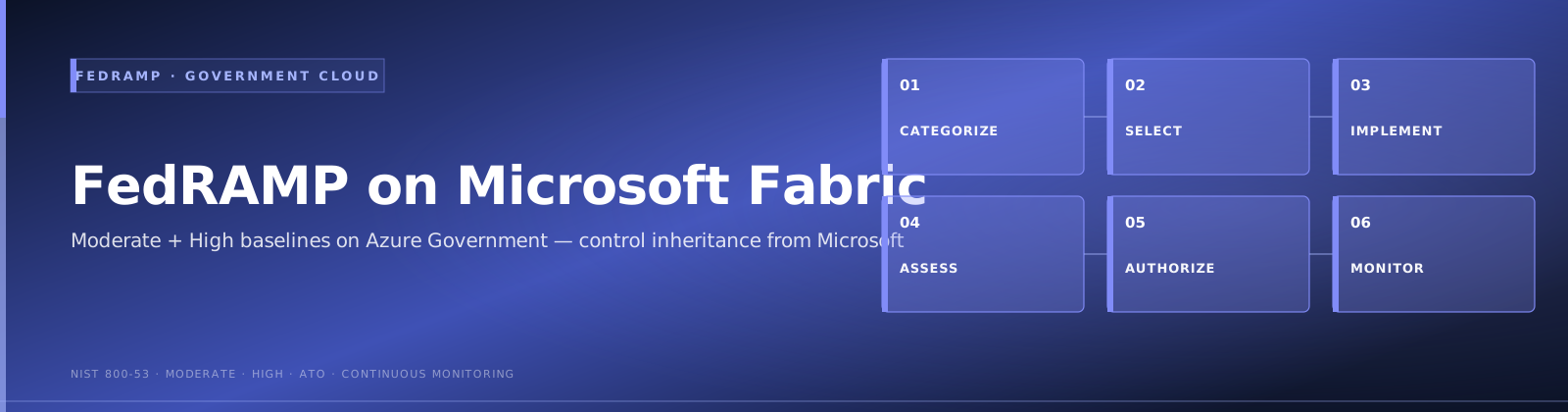
☁️ FedRAMP Compliance Mapping for Microsoft Fabric¶ Compliance
Federal Risk and Authorization Management Program — Fabric Authorization Path



Last Updated: 2026-05-05 | Version: 1.0.0
🎯 Overview
The Federal Risk and Authorization Management Program (FedRAMP) provides a standardized approach to security assessment, authorization, and continuous monitoring for cloud products and services used by US federal agencies. FedRAMP is built on NIST 800-53 controls with additional requirements for cloud service providers (CSPs).
Applicability to Fabric
FedRAMP applies to Microsoft Fabric when:
- A federal agency consumes Fabric services (directly or via system integrator)
- Fabric processes, stores, or transmits federal data
- Fabric is part of a system boundary seeking an Authority to Operate (ATO)
- The deployment handles Controlled Unclassified Information (CUI)
FedRAMP Impact Levels
| Impact Level | Data Sensitivity | Cloud Requirement | Fabric Availability |
|---|---|---|---|
| Low | Public, non-sensitive | FedRAMP Low P-ATO | Via Azure Commercial (inherited) |
| Moderate | CUI, PII, financial | FedRAMP Moderate P-ATO | Via Azure Commercial (inherited) |
| High | Law enforcement, healthcare, critical infrastructure | FedRAMP High P-ATO | Azure Government only |
| DoD IL4/IL5 | DoD CUI, national security | DoD CC SRG | Azure Government / GCC High |
📊 Fabric FedRAMP Authorization Status
Current State (May 2026)
| Component | FedRAMP Status | Region | Notes |
|---|---|---|---|
| Azure Commercial | FedRAMP Moderate P-ATO | US regions | Foundation for Fabric |
| Microsoft Fabric (Commercial) | Inherits Azure Moderate P-ATO | US regions | Fabric runs on FedRAMP-authorized Azure infrastructure |
| Azure Government | FedRAMP High P-ATO | US Gov regions | Fabric availability limited |
| Microsoft Fabric (GCC) | In progress | US Gov regions | Check Microsoft roadmap for GA date |
| Power BI (GCC) | FedRAMP Moderate authorized | GCC regions | Subset of Fabric capabilities |
| Power BI (GCC High) | FedRAMP High authorized | GCC High regions | BI-only, not full Fabric |
Key Point: Microsoft Fabric in Azure Commercial inherits the FedRAMP Moderate Provisional ATO through Azure's authorization. However, Fabric-specific capabilities (OneLake, Eventhouse, Data Engineering) may require additional agency-level assessment.
Authorization Path
flowchart LR
    subgraph CSP["Cloud Service Provider (Microsoft)"]
        A[Azure FedRAMP P-ATO] --> B[Fabric Inherits P-ATO]
        B --> C[3PAO Assessment of Fabric-Specific Controls]
    end

    subgraph Agency["Federal Agency"]
        D[Agency Security Assessment] --> E[Agency ATO for Fabric Workload]
        E --> F[Continuous Monitoring]
    end

    C --> D
🗺️ Control Mapping Table
The following maps key FedRAMP Moderate baseline controls to Fabric implementations. FedRAMP uses NIST 800-53 controls with additional cloud-specific requirements. See the NIST 800-53 mapping for the full control family breakdown.
| Control ID | Control Name | FedRAMP Requirement | Fabric Implementation | Evidence |
|---|---|---|---|---|
| AC-2 | Account Management | Automated account lifecycle; disable inactive accounts within 90 days | Entra ID lifecycle management; Conditional Access policies for inactivity; Fabric workspace role audits | Entra ID access reviews, role audit exports |
| AC-17 | Remote Access | Encrypt all remote access; MFA required | All Fabric access via HTTPS/TLS 1.2+; Conditional Access MFA enforcement | CA policies, TLS audit |
| AU-2 | Audit Events | Log all account/object/management events per FedRAMP audit requirements | Fabric admin audit logs capture user activities, admin operations, data access events | Audit log configuration, sample events |
| AU-6 | Audit Review | Review audit logs at least weekly; automated alerting for anomalies | Microsoft Sentinel integration; Power BI monitoring workspace; custom KQL alert rules | Sentinel workbook, alert rule definitions |
| CA-7 | Continuous Monitoring | ConMon plan with monthly vulnerability scans, annual assessment | Azure Security Center continuous assessment; Fabric admin monitoring; monthly Defender scans | ConMon plan, scan reports, assessment schedule |
| CM-6 | Configuration Settings | Implement DISA STIGs or equivalent hardening benchmarks | Fabric tenant settings hardened per agency baseline; Bicep templates enforce configuration | Tenant settings export, IaC templates |
| IA-2(1) | MFA — Privileged | Phishing-resistant MFA for all privileged access | Conditional Access requiring FIDO2/passkey for Fabric Admin roles | CA policy for privileged roles |
| IA-2(12) | PIV Credentials | Accept and verify PIV/CAC credentials | Entra ID certificate-based authentication (CBA) for PIV/CAC; Conditional Access grant controls | CBA configuration, CA policy |
| IR-6 | Incident Reporting | Report incidents to US-CERT within required timeframes | Microsoft incident response process; customer SOC integration via Sentinel | Incident response plan, Sentinel playbooks |
| RA-5 | Vulnerability Scanning | Monthly authenticated scans; remediate High within 30 days | Defender for Cloud vulnerability assessment; Fabric infrastructure scanned by Microsoft | Defender scan reports, remediation tracking |
| SC-7 | Boundary Protection | Define and enforce authorized connections at managed interfaces | Managed VNet; private endpoints; Outbound Access Protection; tenant IP allowlist | Network configuration, OAP settings |
| SC-8 | Transmission Confidentiality | FIPS 140-2 validated encryption for data in transit | TLS 1.2+ for all Fabric communications (Azure infrastructure uses FIPS-validated modules) | TLS configuration, FIPS attestation |
| SC-28 | Protection at Rest | FIPS 140-2 validated encryption for data at rest | AES-256 encryption for OneLake and SQL Database; CMK option via Key Vault | Encryption config, CMK status, FIPS attestation |
| SI-4 | Information System Monitoring | Real-time alerting on security-relevant events | Microsoft Sentinel SIEM; Fabric admin audit stream; Defender for Cloud alerts | Sentinel analytics rules, Defender alerts |
🤝 Shared Responsibility Model
FedRAMP defines explicit CSP and customer responsibilities. In the Fabric context:
| FedRAMP Domain | Microsoft (CSP) | Customer (Agency) |
|---|---|---|
| Physical & Environmental (PE) | Full datacenter security, FedRAMP PE controls | N/A |
| Infrastructure Security | Azure infrastructure hardening, patching, monitoring | N/A |
| Platform Services | Fabric runtime security, OneLake storage, Spark engine | N/A |
| Identity & Access (AC, IA) | Entra ID infrastructure, MFA platform, PIV/CBA support | MFA policy enforcement, role assignments, access reviews, PIV integration |
| Audit & Monitoring (AU, SI) | Audit event generation, platform monitoring | Log collection, SIEM integration, audit review, ConMon reporting |
| Configuration (CM) | Platform baseline, OS hardening, runtime updates | Tenant settings, workspace configuration, IaC pipelines |
| Incident Response (IR) | Platform incident detection and Microsoft reporting obligations | Agency-specific IR plan, US-CERT reporting, SOC integration |
| Risk Assessment (RA) | Infrastructure vulnerability scanning | Application-layer scanning, POA&M management, annual assessment |
| System Security Plan | CSP SSP for Azure/Fabric platform controls | Agency SSP for customer-configured controls and shared responsibilities |
⚠️ Gap Analysis and Limitations
| Gap | FedRAMP Requirement | Impact | Compensating Control |
|---|---|---|---|
| Fabric not separately FedRAMP authorized | Independent P-ATO for each service | Agency must assess Fabric-specific controls beyond inherited Azure P-ATO | Conduct agency-level security assessment; leverage Azure P-ATO inheritance |
| No FIPS 140-2 attestation specific to Fabric | FIPS-validated cryptographic modules | High baseline may require explicit FIPS validation | Azure infrastructure uses FIPS-validated modules; request Microsoft attestation letter |
| Limited GCC/GCC High Fabric availability | FedRAMP High requires Gov Cloud | Full Fabric not yet available in all Gov regions | Use Power BI GCC High for BI; plan Fabric GCC migration when available |
| OneLake CMK not available | SC-28 requires customer key option for High | Cannot use customer-managed keys for Lakehouse data | Document MMK in SSP; use CMK for SQL Database; accept risk or use alternative storage |
| PIV/CAC authentication | IA-2(12) requires PIV acceptance | Requires Entra CBA configuration | Configure Entra certificate-based authentication for PIV/CAC |
| ConMon automation | CA-7 requires automated continuous monitoring | Manual monitoring gaps | Integrate Sentinel for automated monitoring; build ConMon dashboard |
| FedRAMP inventory requirements | CM-8 requires automated discovery | Fabric item inventory requires API scripting | Use Fabric Admin API and OneLake Catalog for automated inventory |
✅ Implementation Checklist
Pre-Authorization
- Determine FedRAMP impact level (Low/Moderate/High) based on data classification
- Verify Azure region has FedRAMP P-ATO at required impact level
- Confirm Fabric availability in target region (Commercial vs. GCC)
- Identify inherited controls from Azure P-ATO vs. customer-configured controls
- Engage 3PAO for Fabric-specific security assessment if required
Identity & Access
- Configure Entra ID Conditional Access with MFA for all Fabric users
- Configure certificate-based authentication (CBA) for PIV/CAC if required
- Implement privileged access policies (phishing-resistant MFA for admins)
- Configure workspace RBAC with least privilege roles
- Enable automated access reviews for quarterly recertification
Audit & Monitoring
- Enable Fabric admin audit logging with required event coverage
- Configure SQL audit logs for all Fabric SQL databases
- Set up Microsoft Sentinel with Fabric data connector
- Create ConMon dashboards for weekly audit log review
- Configure automated alerting for security-relevant events
- Set audit log retention to meet agency requirements (min 1 year for Moderate)
Network & Encryption
- Deploy managed VNet for Fabric workspace
- Configure private endpoints for data sources
- Enable Outbound Access Protection
- Verify TLS 1.2+ enforcement for all connections
- Configure CMK for Fabric SQL Database via Azure Key Vault
- Document encryption status for all data stores in SSP
Configuration & Change Management
- Implement Bicep templates for all infrastructure (version-controlled)
- Deploy fabric-cicd pipeline with PR review gates
- Document tenant settings baseline and hardening rationale
- Establish Spark runtime migration schedule for patching
Continuous Monitoring
- Develop ConMon plan with monthly scan schedule
- Configure Defender for Cloud vulnerability assessments
- Schedule annual security assessment with 3PAO
- Establish POA&M tracking for open findings
- Set up automated monthly reporting to agency AO
📚 References
Internal Best-Practices
| Guide | Relevant FedRAMP Controls |
|---|---|
| Customer-Managed Keys | SC-12, SC-13, SC-28 |
| SQL Audit Logs Compliance | AU-2, AU-3, AU-6, AU-11 |
| Identity & RBAC Patterns | AC-2, AC-3, IA-2, IA-8 |
| Network Security | SC-7, SC-8, AC-17 |
| Outbound Access Protection | SC-7, AC-4 |
| Monitoring & Observability | AU-6, CA-7, SI-4 |
| fabric-cicd Deployment | CM-2, CM-3, CM-5 |
| Disaster Recovery & BCDR | CP-6, CP-7, CP-9, CP-10 |
External References
- FedRAMP Marketplace
- FedRAMP Security Assessment Framework
- Microsoft FedRAMP Documentation
- Azure Government Compliance
- NIST 800-53 Rev. 5
This mapping reflects FedRAMP Moderate baseline requirements and Microsoft Fabric capabilities as of May 2026. Federal agencies must conduct their own security assessment and obtain an agency-specific ATO before processing federal data in Fabric.